Last Updated on September 25, 2026 by Umar Farooq
The right pressure washer nozzle for car paint is the white 40-degree tip, held 18 inches back, with effective pressure at the panel around 1,200–1,900 PSI. Black 65-degree applies the soap. Green 25-degree is for wheels and arches only. Red and turbo never come out of the bag.
That is the whole answer, and you can stop reading if the car is already wet. The rest of this is the reasoning, because the tip you pick matters far less than the two things nobody puts on the box: how far away you stand, and whether you let the detergent do any work first.
Most washing damage on a car is not a stripe of missing paint. It is a lifted badge, a trim strip with water behind it, or a chip on the leading edge of the bonnet that has quietly become a rust bloom. All four of those come from the same mistake — going narrow instead of going patient.
The Three Tips That Belong Anywhere Near a Vehicle
There are six tips in a standard set. Three of them have a job on a car and three do not. The full colour system is covered in the pressure washer nozzle chart; this is the vehicle-only subset.
| Tip | Angle | Where it goes on a car | Working distance |
| Black | ~65° | Applying soap or snow foam | 3–6 ft |
| White | 40° | All paint, glass, plastic bumpers, roof | 18 in |
| Green | 25° | Wheels, tyres, arch liners, underbody | 12 in, below the sill only |
| Yellow | 15° | Nothing | — |
| Red | 0° | Nothing | — |
| Turbo | 0° rotating | Nothing | — |
The working order is black, then wait, then white, then green if the wheels need it. Every car I have read a “which tip” question about could have been washed with those three and a bit of patience.
If Your Machine Came With One Adjustable Tip
Plenty of entry-level electrics ship with a single twist-adjustable lance instead of six quick-connect tips. You still have all of this — you just have a dial instead of a colour. Twist it to the widest fan for paint. Twist it to the low-pressure setting (usually the outer collar pulled forward) to draw detergent. Do not twist it toward pencil for anything on a vehicle, including the wheels. Briggs & Stratton’s own nozzle and spray-gun guidance treats the adjustable lance and the tip set as the same control, which is exactly right.
Picking a Pressure Washer Nozzle for Car Paint vs Wheels
Paint and wheels are two different materials with two different tolerances, and treating them as one surface is how people end up compromising on both.
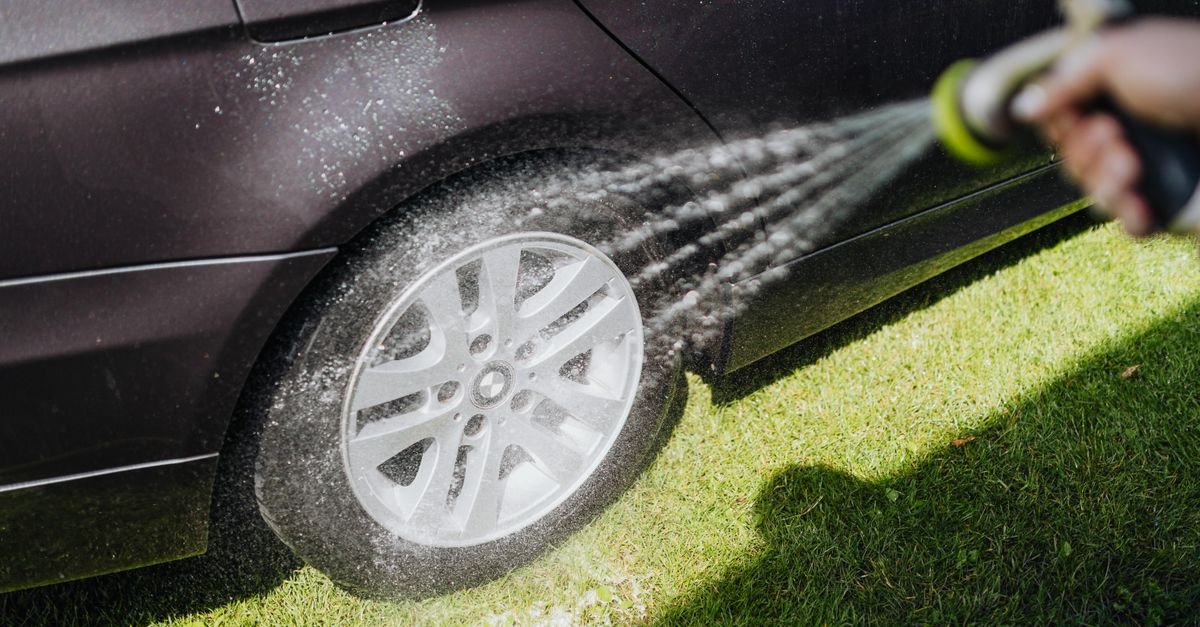
Paint gets white, 40 degrees. The clear coat over your colour is thinner than most people picture. DeFelsko, which makes the gauges detailers use to measure it, puts clear coat at 1.5–2.0 mils, or 35–50 microns, inside a total factory film of 4–7 mils. That layer is doing all the UV protection. A 40-degree fan spreads the machine’s output across a wide sheet so no single point of it is carrying much force, which is the entire design brief.
Wheels get green, 25 degrees. Brake dust is iron particles that have been welded on by heat, and it does not care about a gentle fan. A 25-degree tip at about 12 inches will shift the loose layer. It will not shift the bonded layer, and neither will 15 degrees — that needs an iron-removing wheel cleaner and five minutes of dwell.
Here is the rule that keeps the two from mixing: the green tip stays below the sill line. Wheels, tyres, arch liners, sills, exhaust tips. The moment the wand comes up to a door or a wing, it goes back to white. Green is not a “slightly stronger paint tip.” It is a different tool that happens to live in the same bag.
One more thing about green on wheels — painted and powder-coated alloys have a finish too, and a lacquered rim will cloud if you sit on one spot. Keep it moving there as well.
Safe Pressure on a Vehicle Is 1,200 to 1,900 PSI
The published safe range for cars and vehicles is 1,200–1,900 PSI with a 25- to 40-degree tip. That number confuses people, because the machine in their garage says 2,700 on the side and they assume they are already over the limit.
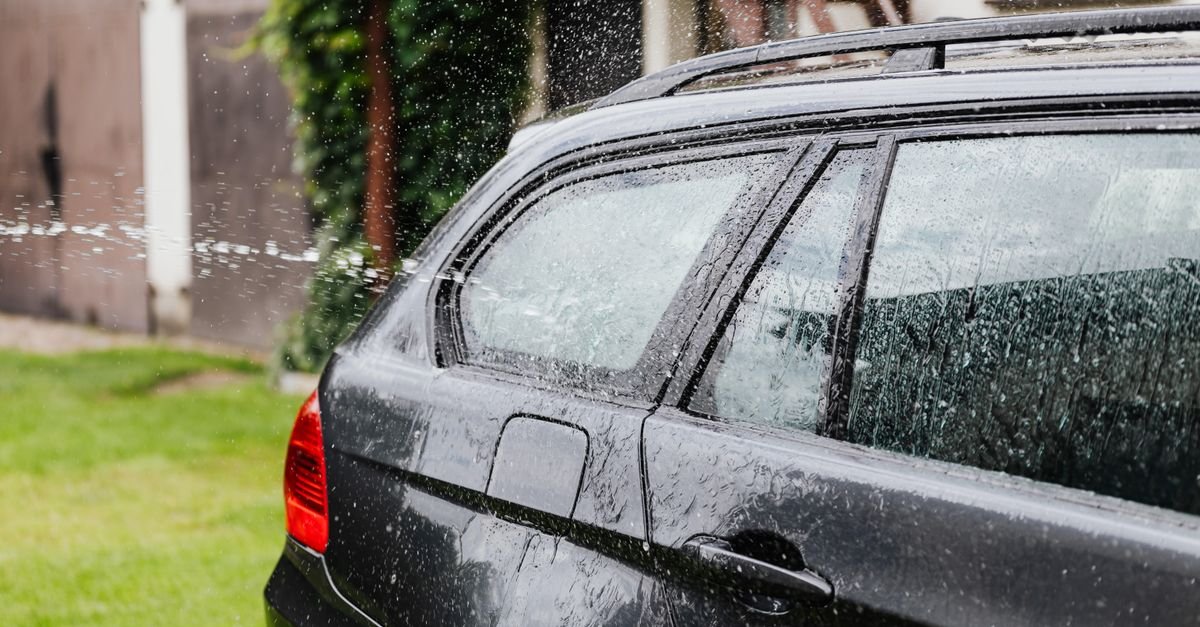
They are not, and this is the part worth understanding. The figure on the box is the pressure the pump generates at the nozzle orifice, measured with the correct tip fitted at zero distance. What arrives at your door panel is much lower, because two things eat it:
1. The fan angle. A 40-degree tip takes the same flow and spreads it across a sheet several inches wide. Force per square inch drops accordingly.
2. Distance. Impact force falls off sharply as the fan opens and the stream loses coherence. Halving the distance roughly quadruples the force landing on the surface — which also means doubling the distance cuts it dramatically.
So a 2,000 PSI electric with a white tip at 18 inches is comfortably inside the safe window. The same machine with a green tip at 4 inches is not, and the number on the box never changed. If you want the full version of that arithmetic across every surface, it is in what PSI pressure washer do I need.
If you are shopping rather than washing: an electric in the 1,600–2,000 PSI range at 1.2–1.5 GPM washes cars perfectly well and is far harder to hurt yourself or the car with. You do not need a 3,200 PSI gas machine for a driveway you clean twice a year and a car you clean twice a month.
Eighteen Inches, Moving, and Never Square On
Distance is a pressure control you already own, and it is more precise than swapping tips. Three habits do most of the work:
Start at three feet and walk in. Fit the white tip, stand well back, and move closer until the dirt starts lifting. Stop there. That is your working distance for this car, this day, this dirt. It is usually somewhere around 18 inches and it is occasionally 30.
Keep the wand moving. A fan held still is a fan concentrating on one spot for as long as you leave it there. Move along the panel at roughly walking speed, overlapping passes by about a third.
Angle the spray, do not aim it square. Hold the wand at roughly 45 degrees to the panel so the water sweeps across the surface rather than driving into it. This matters enormously at panel gaps, badges and trim edges, where a square-on jet has somewhere to go and a swept one does not.
And rinse top-down. Soap goes on bottom-up so it does not run over dry paint and streak; rinsing goes top-down so gravity takes the dirt with it. The same rule works on siding and it works here.
Foam Cannon or the Black Soap Nozzle?
This is the one genuine buying question in car washing, and the honest answer annoys both camps.
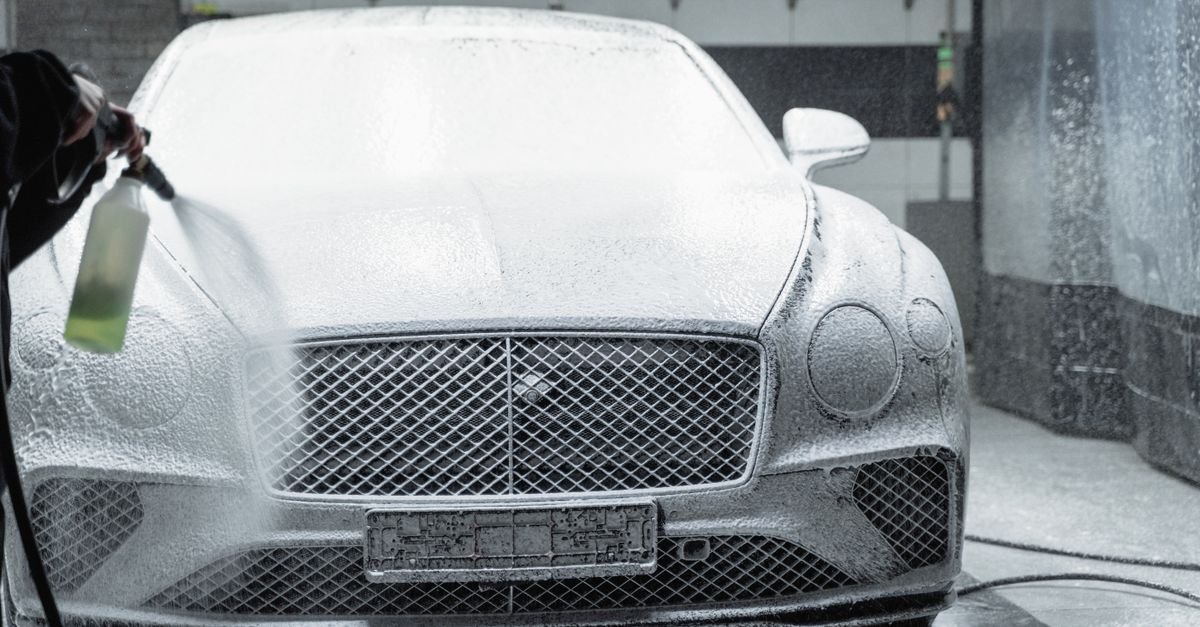
The black soap nozzle uses the machine’s downstream injector. Its orifice is the widest in the set, which collapses system pressure to a few hundred PSI, and that pressure drop is the only reason the injector can draw detergent at all. Fit any other tip and the machine will not pull soap — a fact that generates more “my soap dispenser is broken” posts than any actual fault. It costs nothing, it is already in your bag, and it lays down a wet, thin layer of detergent.
A foam cannon is a separate attachment with its own soap bottle and a mesh that whips air into the solution. It clings. That is the whole advantage, and it is a real one: clinging foam stays wet for the five to ten minutes of dwell time that actually breaks the bond between road film and clear coat, where a thin layer has half-dried by minute three.
| Black soap nozzle | Foam cannon | |
| Cost | Already included | Extra purchase |
| Dwell time achieved | 2–4 min before drying | 5–10 min |
| Soap used per wash | Less | More |
| Needs a minimum GPM | No | Yes — thin foam below ~1.4 GPM |
| Best for | Light weekly rinse | Bonded road film, winter salt, bug splatter |
My position: if you wash the car every week or two, the black nozzle is genuinely enough and the cannon is buying you foam photos. If the car gets washed monthly and lives outside near a road, the cannon earns its money on dwell time alone — not on thickness. The full comparison, including why a foam gun is a different thing again, is in foam cannon vs foam gun.
And here is the opinion this whole article rests on. If dirt will not come off at 40 degrees and 18 inches, the answer is never a narrower tip. It is more dwell time. Bonded road film, tar and bug protein are chemical problems, and pressure is what you reach for after chemistry has failed — not instead of it. Every person who has etched a stripe into their clear coat got there by reaching for the green tip at minute two instead of waiting until minute seven.
Red and Turbo Tips Lift Clear Coat and Trim
The red 0-degree tip is not a cleaning nozzle. It is a paint stripper that came free with your machine, and on a car it will do the job it was designed for.
The mechanism is simple: it concentrates the machine’s entire output into a jet roughly the width of a pencil. Nothing is spread. A 2,000 PSI machine that delivers a perfectly safe fan through a white tip delivers something closer to a cutting tool through a red one. On a panel with an existing stone chip, it gets under the edge of the clear coat and peels rather than cleans.
A turbo nozzle is a 0-degree jet spinning in a cone. It covers roughly the area of a 25-degree tip while hitting with the force of a 0-degree one, which is a clever trick on concrete and a genuinely bad one on a vehicle. Treat it as a red tip in disguise, because that is what it is. It will also happily lift a chrome trim strip, a door mirror cap, or the edge of a windscreen seal — parts that are held on with adhesive and clips, not welds.
There is also the version of this that has nothing to do with the car. The wheel arch is where people’s fingers end up, and a jet that breaks the skin drives water and road grime into the tissue through a wound that looks like a pinhole. If that happens, you go to the emergency room the same hour. Not tomorrow, and not after you finish the wheels.
Five Places on a Car to Keep the Jet Away From
The tip choice is only half of it. Even a white 40-degree fan can cause problems if you point it at the wrong six square inches.
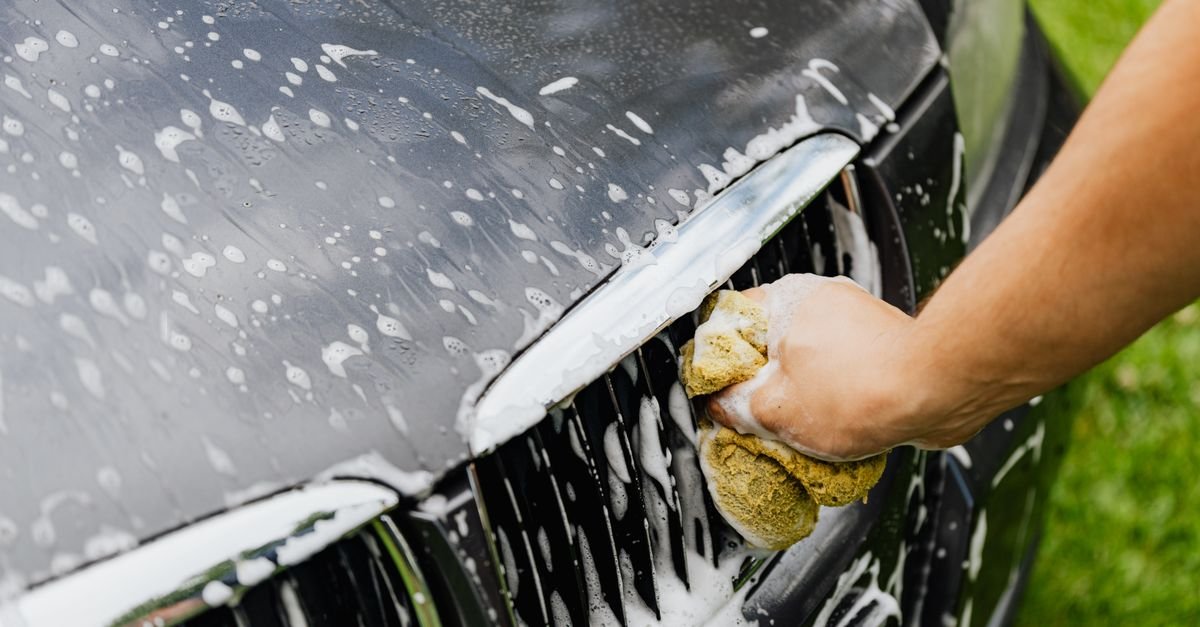
1. Door, window and boot seals. Rubber weatherstrip sheds rain. It does not resist a jet aimed into the gap. Water in the door card is how speakers die and how a car develops a smell nobody can locate.
2. Badges, emblems and chrome trim. Adhesive-mounted, every one of them. Sweep past at an angle, never hold square on the edge.
3. The grille and radiator core. Aim at it from the front and you can fold over the aluminium fins, which quietly costs you cooling. Wash the grille with a sponge. It takes ninety seconds.
4. Stone chips and existing scratches. Any break in the clear coat is an edge, and edges are what high-pressure water finds. Keep distance generous over damage you already know about.
5. The engine bay. Modern bays are full of connectors that are weather-resistant, not pressure-resistant. A garden hose and a degreaser will do everything you wanted, without the electrical gremlin three weeks later.
The underbody is the exception and the one place a green tip genuinely earns its place — road salt lives up there and nothing sensitive does, as long as you stay off the exhaust heat shields, which dent if you look at them firmly.
FAQ
What nozzle do I use to pressure wash a car?
White 40 degrees for all paint, glass and plastic, held about 18 inches away. Black 65 degrees to apply soap. Green 25 degrees only for wheels, tyres and the underbody. Never red, yellow or turbo.
Can I use a 25-degree nozzle on car paint?
You can, at 18 inches or more, but there is no reason to. Green is the most aggressive tip that should ever come near a vehicle, and its job is wheels and arches. If white at your working distance is not cleaning the paint, add dwell time rather than narrowing the fan.
Is 2,000 PSI too much for a car?
No. The safe range for vehicles is 1,200–1,900 PSI at the surface, and a 2,000 PSI machine with a 40-degree tip at 18 inches lands well inside that. The rated figure is measured at the orifice, not at your door panel.
Will a pressure washer remove car paint?
With a red or turbo tip held close, yes — and it will start at a stone chip or a trim edge rather than in the middle of a panel. With a white 40-degree tip at a sensible distance, no.
Do I need a foam cannon, or is the black soap nozzle enough?
The black nozzle is enough for a car washed every week or two. A foam cannon is worth it when the car is washed monthly or less, because clinging foam holds a 5–10 minute dwell time that a thin layer of soap cannot.
Why won’t my pressure washer pull soap for the car?
Almost always the wrong tip. A downstream injector only draws detergent when system pressure drops, and only the black 65-degree nozzle drops it far enough. Check that before you touch the injector or the chemical hose.
How far away should I hold the wand from the car?
Start at three feet and move in until dirt lifts, which is usually around 18 inches. Hold the wand at about 45 degrees to the panel rather than square on, and keep it moving.
Can I use a turbo nozzle on alloy wheels?
No. A turbo is a 0-degree jet in a spinning cone, and the lacquer on a painted or powder-coated rim will cloud or lift. Use green at 12 inches and a dedicated wheel cleaner for what is left.
White Tip, Long Distance, Let the Soap Do the Work
Three tips, one distance, and a five-minute wait while the foam does the part you were about to do with pressure. That is the whole method, and the only piece of it people skip is the waiting.
If you have already put a mark on a panel and you are standing there deciding whether to carry on with the other side — carry on, but swap to white and step back a foot. The car will look better for it, and so will the half you already did.