Last Updated on September 26, 2026 by Umar Farooq
Cleaning farm equipment turns out to be mostly a dry job, and the four components a pressure washer damages on agricultural machinery are named in a single sentence of John Deere’s own combine manual: bearings, hydraulic seals, electrical connectors and fuel injection pumps.
There is a neat problem buried in that. The reason anybody drags a hose across a yard to a combine in October is the cooler pack — five or six heat exchangers stacked in one airstream with a summer of chaff pressed into them. It is the most satisfying thing on the machine to clean and the most expensive thing to get wrong, and it is the one component where two Deere manuals tell you, in two different strengths, to put the wand down.
Three of the pages ranking for this query opened for me. They run between roughly 650 and 1,200 words, not one publishes a pressure figure for the machinery, and one recommends “a high-pressure setting on the rest of the equipment.” Kärcher’s agriculture page does publish numbers — up to 5,000 PSI — but those are specifications for washers, not limits for machines. So every figure below comes from the people who built the thing you are standing next to.
Two boundaries first. The building itself — why the engine stays outside with only the hose coming in, why the muck leaves before any water arrives, and what that grey corrugated sheet over your head might be made of — belongs to cleaning a barn. Why a grease seal is a one-way component that a jet uses backwards is worked through on cleaning a lawn mower, along with the clearest manufacturer instruction I have found anywhere to re-grease a machine after washing it. Both apply to a combine. Neither gets re-derived here.
The Cooler Pack Is Why You Are Washing and the First Thing You Will Wreck
Open the rotary screen door on a late-model combine and you are not looking at a radiator. You are looking at a stack. Deere’s list for the S-series names the rotary screen, condensers and a fuel cooler on the door itself, then the radiator, engine oil cooler and charge air cooler behind it, with a vacuum duct and a transfer duct underneath collecting what the screen throws off (John Deere S660, S670, S680 and S690 combine operator’s manual, OMHXE51478). Six heat exchangers in series, one airflow, and a self-cleaning screen in front whose whole job is to stop the chaff that would otherwise fill them. It stops most of it. The fine stuff gets through, which is why this section exists.
Deere’s instruction for cleaning that pack contains no water at all. “Clean rotary fan screen with a brush and compressed air when dirt and chaff builds up on or behind screen.” Then, for the coolers: “Clean with compressed air, blowing from inside out.” Then the caution: “When using high pressure air or water, be careful of fin damage to coolers. Use a fin comb to straighten bent fins. Bent fins decrease cooler performance.”
Read the direction twice, because it is the opposite of the instinct. The front is the dirty face, so the front is where you point things. Deere wants the air going the other way, out through the face the dirt arrived at, because chaff that entered from the front will only leave from the front — push it the way the fan pushes it and you are loading a filter rather than clearing one. Note too what the caution quietly admits: there is a named tool for straightening the fins you bent, and it appears in the operator’s manual rather than the workshop manual, which tells you how routine that damage is.
Deere’s other document on this drops the caution and writes a prohibition. Its compact utility tractor manual says: “Do not use pressure washers to clean radiator cooling fins. The force produced by pressure washers will damage the radiator and cooling fins.” It gives the number nobody expects — “Reduce compressed air pressure to 210 kPa (30 psi) when cleaning radiator and cooling fins” — and an angle: “Spray compressed air straight into radiator. Do not spray radiator on an angle or cooling fins will be bent.” On the removable screen in front, the same page says flatly that “cleaning with water is not recommended” (John Deere OMM175434, Cleaning Radiator Screen and Fins).
One manufacturer, two documents, two strengths, and you will meet both. My reading is that the combine manual assumes an operator with a fin comb in the toolbox and a dealer on speed dial, and the tractor manual assumes the rest of us. Take the prohibition.
The figure is what to carry around. Thirty PSI of air, applied perpendicular, is the published method for a radiator core. The smallest domestic electric pressure washer on the shelf makes about 1,300. A factor of forty is not a rounding error, and it is why three ranking pages publishing no pressure at all is not a small omission.
The mechanism is geometry rather than strength. A cooler fin is aluminium a few thousandths of an inch thick, folded into a corrugation that holds a channel open between two tubes. Lay one fin over and you have not scratched anything — you have closed the channel at its entrance, so the rows behind it are now downstream of a wall. A jet that flattens the front rank while driving chaff into the second has converted a cleaning job into a repair. The industry’s own answer to a packed cooler says the same thing from the other end: reversing cooling fans, which flip the blade pitch and blow the pack out from the inside on a timer, are a factory option and a substantial retrofit market. More air in the other direction. Never water.
Mud and Water Cut a Deere Grease Interval by Four-Fifths
Here is the number that changed how I think about washing anything with grease fittings on it, and it sits in the routine lubrication pages rather than anywhere near a warning triangle.
Deere’s every-10-hours list for the S-series reads: “When operating in mud and water, grease rear axle spindle bearings and motor pivots every 10 hours. Normal conditions grease every 50 hours.” The same wording repeats for the final drive outer bearings and for the heavy-duty axle spindle bearings and pivot pins.
That is a manufacturer pricing an environment. Wet and dirty consumes the grease in a bearing five times faster than dry and dirty, and Deere was confident enough to publish a service interval on it. Now consider what a wash-down is: mud and water, applied deliberately, at pressure, aimed at the outside of exactly those bearings. You are not risking the condition that interval describes. You are manufacturing it, on purpose, in about forty minutes.
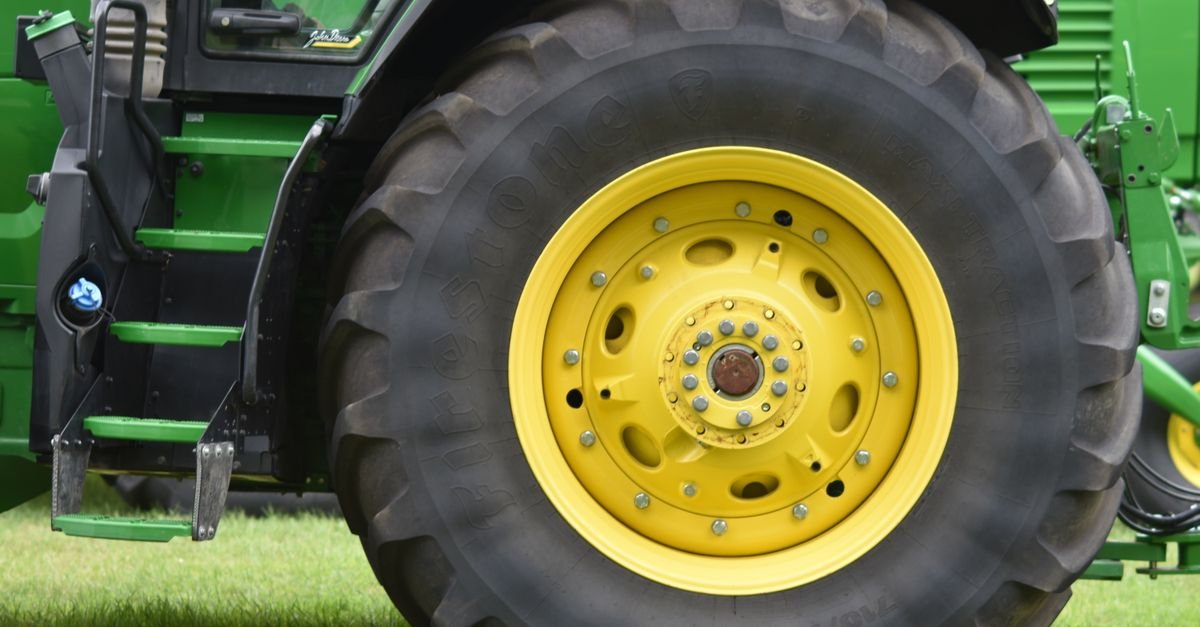
The seal mechanism belongs to the mower page. What is different on agricultural machinery is scale and dose, and the dose is where people come unstuck, because a combine’s fittings are not all “one pump until it purges.” Deere specifies 20 to 25 shots for the separator variable speed sheaves, with “DO NOT OVER GREASE” in capitals. The feeder house reverser drive gearcase is fussier still: the 12 o’clock fitting takes five to eight pumps every 10 hours in severe conditions and “excess grease will purge from under spring”, while the 2 o’clock fitting takes two to three, because “over greasing this fitting can allow grease to purge on belt and cause belt failure.”
There is a grease point on a combine where being generous costs you a belt. Which makes “just grease everything afterwards” less of a free recovery than it sounds, and a grease gun in the hands of somebody working fast and feeling guilty its own small hazard.
The worse half is the fittings that are not there. Case IH, on preparing harvest equipment for storage, says to clear as much buildup as you can with compressed air, then puts the machine in the conditional: “If you choose to use a power washer, be careful and mindful of delicate components and avoid spraying water into electrical parts, bearings or shaft seals.” Shaft seals have no fitting behind them. Whatever gets past one stays there until something is pressed out.
Deere’s own storage procedure puts the two steps in a revealing order. “Clean machine inside and out” comes first. Then the caution this page opened with: “Directing pressurized water at electronic/electrical components or connectors, bearings and hydraulic seals, fuel injection pumps or other sensitive parts and components may cause product malfunctions. Reduce pressure, and spray at a 45 to 90 degree angle.” Then repainting, then: “Lubricate machine and grease adjusting bolt threads.” Wash, then lubricate — though Deere never says the lubrication is *because* of the washing, and I am not going to pretend otherwise. The manufacturer that states that causal link outright builds commercial mowers, and its sentence is quoted in full on the mower page.
The angle is the underused instruction. Forty-five to ninety degrees means perpendicular or nothing shallower, which is the exact opposite of how anybody cleans a hub: you get low and come in flat along the shaft, because flat along the shaft is where the dirt is. It is also the one line that ends at a seal lip.
Control Units and Cylinder Rods Have No Warning Stage
Two components on modern machinery fail invisibly and permanently, and they fail for opposite reasons.
The first is the control unit. Deere’s standing note across its manuals reads: “Do not open control unit and do not clean with a high-pressure spray. Moisture, dirt, and other contaminants may cause permanent damage.” It then draws a line that is unusually useful: “the wiring harness terminals and connectors for electronic control units are repairable”, while “control units are not repairable.” The harness is a repair and the box is a replacement, which is worth knowing before you decide which end of the machine to be casual at.
Sensors get named separately, and the wording is a genuine bind. Deere’s guidance for its sprayer couplers says the air seal and proximity sensors “may not function properly when covered with dirt or debris and can lead to equipment malfunction” — and, in the next line, “Do not pressure wash sprayer coupler components. Pressure washing can lead to equipment malfunction.” A dirty sensor fails, a jetted sensor fails, and the sanctioned method between those two failures is a clean damp cloth. Unsatisfying, but published.
Why a wet connector bites a fortnight later rather than that afternoon — the oxide layer, the millivolt signal, the intermittent fault nobody connects back to the wash — is argued on the engine bay page, and it holds on a tractor without amendment.
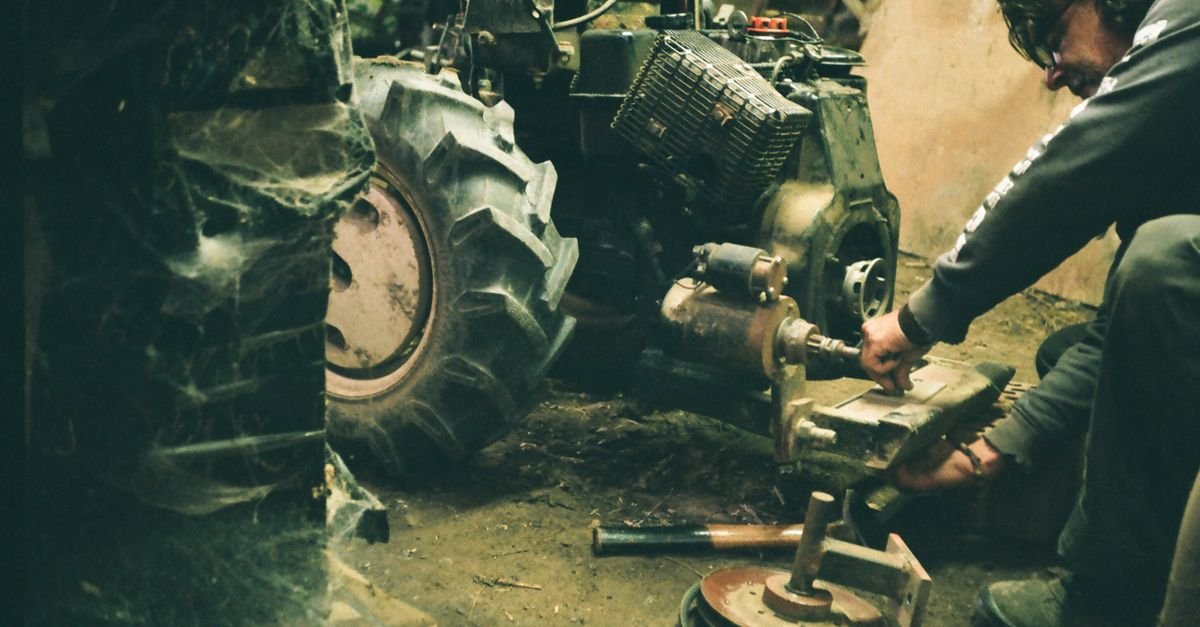
The second component is the hydraulic cylinder rod, and this one is not about a seal facing the wrong way. It is about a conveyor.
The outermost ring on a cylinder gland is not the pressure seal. SKF, which manufactures them, describes wiper seals — “also known as scrapers, excluders or dust seals” — as “fitted on the external side of the cylinder head” to prevent contaminants “from entering the cylinder assembly and hydraulic system”, and names agriculture among the applications it builds them for. The load-bearing sentence is about motion: “Without a wiper seal, the retracting piston rod could transport contaminants into the cylinder.” SKF adds that the wiper’s static seal in its own groove exists “to avoid moisture or particles from entering around the outside of the wiper seal” (SKF wiper seals).
So the wiper is a scraper working against a solid arriving on a moving rod. Think about what a header lift ram, a fold cylinder or a loader ram does all day: it sits half-extended, a length of exposed chrome standing in whatever the field is making, and every retraction drags that surface home through a rubber lip sized for a dusting of dry soil under gravity. The problem with washing a rod is not that you might force water past the wiper. It is that you have just coated the conveyor, and next time the cylinder comes home the rod carries what is on it to the gland whether you aimed there or not.
Which is why the useful instruction is about the rod rather than the trigger. Wipe a rod dry before it retracts, and bring the cylinders in before you finish for the day rather than leaving wet chrome standing out overnight. Then accept the gap: I went looking for an agricultural manufacturer publishing a pressure limit or a standoff for a cylinder rod specifically, and there is not one. Deere gives “reduce pressure”, an angle range, and hydraulic seals on a list. Water in hydraulic oil does not announce itself while you are still holding the wand.
Seed and Soil Ride to the Next Field on the Machine
This is the argument that makes the job worth doing at all, and it has nothing to do with how the machine looks parked.
Alberta’s agriculture ministry publishes an equipment sanitation programme for clubroot, and its framing is the most honest thing I read this week: “three consecutive steps that increase efficacy at the expense of additional time and labour“, with the level chosen by contamination risk and how risk-averse the producer is. The steps are removing soil and plant debris “by scraping or knocking off clumps”, then “cleaning residual soil and debris from surfaces by pressure washing, steaming or compressed air”, then a disinfectant mist at 1 to 2% active ingredient bleach (Alberta Agriculture and Irrigation, Best management practices — equipment sanitation).
The pressure washer is step two of three, it is one of three options inside step two, and it is there to deal with residue after the bulk has been knocked off by hand. That is this machine’s honest position on a farm, and it is the position every page selling one declines to mention. Steam and compressed air are listed as equals. The step that moves the most material is done with a scraper and a boot.
Alberta also lists what defeats all of this, and it is a list of the biggest things on the place: air seeders, combines, multi-wheeled tractors, large grain trucks, grain handling equipment including augers and dryers, and forage harvesters. Alongside it sits a caution arriving from an unexpected direction — “Electronics may not be compatible with water, detergents and disinfectants, and compressed air may have to be used instead for cleaning”, followed by an instruction to check with the manufacturer. A provincial plant-health programme and a combine manual, written for entirely different reasons, agreeing about the same components.
What is being moved deserves specifics, because “keep it clean” is not an argument and a permanent condition is. The North Central Agriculture and Natural Resource Academy’s between-field factsheet records that “some weed species produce upwards of 500,000 seeds per plant, and species like Palmer amaranth or water hemp hold their seed very tightly”, and on soil-borne pests it is blunter: once soybean cyst nematode “becomes established in a field, it cannot be removed and becomes a lifelong management issue for the landowner” (Between-Field Tillage and Planting Equipment Clean-up and Sanitation). That is the asymmetry the job rests on: an hour with a scraper against a condition that outlives the mortgage. The same factsheet times the hour — about sixty minutes to strip the biomaterial and soil off a twelve-row planter.
Then the finding I did not expect. Deere publishes a procedure for exactly this job, and there is no water in it.
The section is “Cleaning Out Machine (Annual and Specialty Crops)”, and the manual says it is “recommended when cleaning out machine for certified seed crops or when transporting machine inter-state” — the seed-purity reason and the regulatory one in a single clause. The method: take the header off. “Drive machine over end rows or bumps to jar and shake dirt loose.” Open or remove all doors and drain holes. Engage the separator until chaff stops coming out of the back, then drop to low idle and engage it several times, because “running the separator at low idle removes dirt from inside the rotor.” Park with the right-hand side about 150 mm (6 in.) higher, or on an incline, “so dirt can run out.” Work from the top down, with compressed air on a wand at least 2 m (6 ft.) long, goggles and a dust mask.
Shaking, self-agitation, gravity and air. The one cleaning job on a combine with a regulatory reason behind it never reaches for a trigger, for the same reason the only tool that properly gets inside a rotor is the rotor. The wash is for the remainder, which is a great deal less than you would be removing on a machine nobody had shaken first.
The disinfectant end of step three — why organic matter consumes a product before it reaches anything, and why that order is never negotiable — is argued in full on the barn page, and the mechanism is identical on a set of discs.
Cleaning Farm Equipment a Hundred Feet From the Wellhead
This part runs backwards from the rest of this site, and I am flagging it as an inversion rather than slipping it in, because a reader who has been through the driveway articles will otherwise assume it is a typo.
Everywhere else here, the advice on runoff is to keep the water on hard standing and control where it goes. For farm machinery the published guidance is the reverse. The between-field factsheet’s site selection reads: “Unpaved areas consisting of grass or gravel allow for water infiltration. Medium and fine textured soils below the surface can serve as a filter and reduce surface runoff.” Then the number: “Avoid potential contamination. Never wash your equipment within 100 feet of a wellhead or drainage tile inlet.“
It makes sense once you look at what is receiving the water. On a driveway the worry is a cleaning solution reaching a storm drain, so a hard surface and a blockable drain are assets. In a farmyard the receiving features are a wellhead with a direct line to drinking water and a tile inlet with a direct line to a ditch, and there is no soil in between either of them. Grass or gravel is not sloppiness here; the soil column is the filter, and a concrete pad with a drain in it is a pipe. Keep the hundred feet, mostly because a farmyard has a tile inlet somewhere in it and very few people could walk out and point at theirs.
The technique in the same document is all published and none of it is dramatic.
- Pre-soak. “Pre-soaking is recommended to loosen material and increase efficiency, saving time and water during cleaning.” Dried soil on a disc gang behaves like dried mortar, and no pressure you own removes it faster than water and ten minutes.
- Stand back further than feels useful. “Choose the correct nozzle or tip for your power washer and hold the unit two to three feet from the surface being cleaned.” This is the only published standoff for farm machinery I could find, and two to three feet throws away most of what the nozzle produces, which is the point rather than a side effect. The nozzle chart has the tip you want if the bag went in a bin some years ago.
- Top down, in wide horizontal passes. “Working from the top of the unit and making your way towards the bottom” — the same direction as any wall, gravity carrying — with “smooth, left to right horizontal motions while covering a three- to four-foot area in one pass.”
- If you disinfect, mix it in a sprayer and rinse it off. “Use a 1% bleach solution applied via a backpack or deck (pump) sprayer. Soak surface for 15-20 seconds with solution, then thoroughly rinse to prevent corrosion.” A pump sprayer rather than the washer’s injector, because a downstream injector’s draw ratio is nobody’s published figure and a percentage on a label is a percentage. And the rinse is not tidiness — the product protecting the next field corrodes the machine if it stays on.
Alberta answers the off-farm question in one line, and the timing is the whole of it: “Clean and disinfect equipment, vehicle tires, boots, etc., before leaving the field and/or farm.” Not on arrival at the next one. A contractor or a dealer turning into your yard has already either done this or not, and you cannot fix it at your end without importing the thing you were keeping out.
One last option the sources keep raising and the search results never do. Alberta lists steaming alongside pressure washing as an equal member of step two, and for baked-on crop residue heat does more than pressure — the case for hot water is stronger on a combine than almost anywhere else, because what you are removing is largely plant oils and sugars set hard by a fortnight in the sun.
FAQ
Can you pressure wash farm equipment?
Yes, with published carve-outs. Deere’s storage procedure says directing pressurised water at electronic components and connectors, bearings and hydraulic seals, fuel injection pumps “or other sensitive parts and components may cause product malfunctions”, and asks you to reduce pressure and spray at a 45 to 90 degree angle. Its compact tractor manual goes further and forbids pressure washers on radiator cooling fins outright. Case IH puts the machine in the conditional — clear what you can with compressed air, and “if you choose to use a power washer”, stay off electrical parts, bearings and shaft seals. So: yes to painted sheet metal, frames, wheels, tyres and crop-contact surfaces, no to the cooler pack, the gland areas and anything with a connector on it.
What PSI should you use to clean farm equipment?
No agricultural manufacturer publishes a PSI figure for machinery, and I checked several. What gets published instead is a distance and an angle: two to three feet from the surface, from the North Central Agriculture and Natural Resource Academy’s between-field factsheet, and 45 to 90 degrees from Deere. The only pressure figure anywhere near this job is for compressed air on a radiator core, and it is 210 kPa — 30 PSI. Treat distance and angle as your controls, because they are what the sources quantify.
Can you pressure wash a tractor or combine radiator?
No, and this is the clearest prohibition in the subject: “Do not use pressure washers to clean radiator cooling fins. The force produced by pressure washers will damage the radiator and cooling fins.” The published method is compressed air at 30 PSI, sprayed straight in rather than at an angle. On a combine’s stacked cooler pack Deere adds the direction — blowing from inside out, against normal airflow, so chaff leaves by the face it arrived at. If fins are already laid over, a fin comb straightens them, and Deere names that tool in the operator’s manual.
Do you have to grease a machine after washing it?
Deere’s storage sequence puts washing before lubrication without stating a causal link, so read it as an order rather than an instruction. What Deere does publish is more useful: bearings needing grease every 50 hours in normal conditions need it every 10 hours “when operating in mud and water”, a fivefold reduction for exactly the conditions a wash creates. Two warnings come with re-greasing. Some fittings have a counted dose — 20 to 25 shots on the separator sheaves, with “DO NOT OVER GREASE” in capitals — and over-greasing one feeder house fitting purges grease onto a belt and causes belt failure. And any sealed point with no fitting cannot be flushed at all, which is the real reason to keep water off it.
Where should you wash farm equipment?
On grass or gravel, and at least 100 feet from any wellhead or drainage tile inlet. That is the published guidance, and it reverses the advice for a house or a driveway, where you want a hard surface and a drain you can control. The reason is the receiving feature: an unpaved area lets the water infiltrate and the soil beneath acts as a filter, whereas a tile inlet is a pipe straight to open water and a wellhead is a pipe straight to a tap. If your only hard standing drains to a yard inlet, wash somewhere else.
How do you clean a combine out between fields or for certified seed?
Deere publishes a procedure and there is no water in it. Remove the header, drive over end rows or bumps to jar dirt loose, open or remove all doors and drain holes, then run the separator until chaff stops coming out of the back — including several engagements at low idle, which clears dirt from inside the rotor. Park with one side about six inches higher, or on an incline, so dirt can run out. Then compressed air from the top down, on a wand at least six feet long, with goggles and a dust mask. The pressure washer is for what is left, not where you start.
Most of This Job Is Dry
The most useful thing on this page is a list, and it is Deere’s rather than mine: electronic components and connectors, bearings, hydraulic seals, fuel injection pumps. Every item on it fails without telling you, none can be inspected from where you are standing with the wand, and between them they account for most of what a jet can reach on a combine. The cooler pack is not on that list only because it has a sentence of its own, and that sentence is a prohibition with 30 PSI of compressed air written next to it.
What is left for the machine is real work, just less of it than the size of the yard suggests. Painted panels, frames, wheels, tyres, ladders, the underside of a header after canola. Knock the clumps off, pre-soak, stand two to three feet back, come in at 45 degrees or steeper, work top to bottom, and do it on grass a hundred feet from the tile inlet. Then put the grease gun on the fittings that take a counted number of pumps, and leave the one that ruins belts alone.
The combine will look worse than a close-up jet would have left it, and it will start next August.