Last Updated on September 26, 2026 by Umar Farooq
Removing leaf stains concrete depends on one thing you can check from standing height: is the mark brown, or is it nearly black? A brown mark is tannin, and an oxidiser will take it apart. A black, grey or blue-black mark is tannin that has found iron and become something else entirely — a metal complex whose colour lives in the bond between the iron and the tannin, where an oxidiser has nothing to grip. Same leaf, same slab, two different chemistries, and the bottle that clears one does almost nothing to the other.
Nearly every page on this subject gives you one answer, usually a bleach dilution, and sends you off to scrub. That works about half the time, which is exactly the hit rate that keeps the advice circulating. The other half of the time the mark gets a shade lighter around the edges, the concrete around it gets a shade paler, and the contrast ends up worse than it started.
This page assumes you have already worked out that the mark is organic rather than oil, rust or salt, and that you know whether your slab is sealed. Both of those decisions, plus the water-drop test that settles the second one, belong to cleaning stains from concrete, and the general order of operations on any slab stain lives there too. What follows is only what is specific to a leaf — which turns out to be a great deal more than the internet lets on.
The Leaf Was Empty by the Time You Lifted It
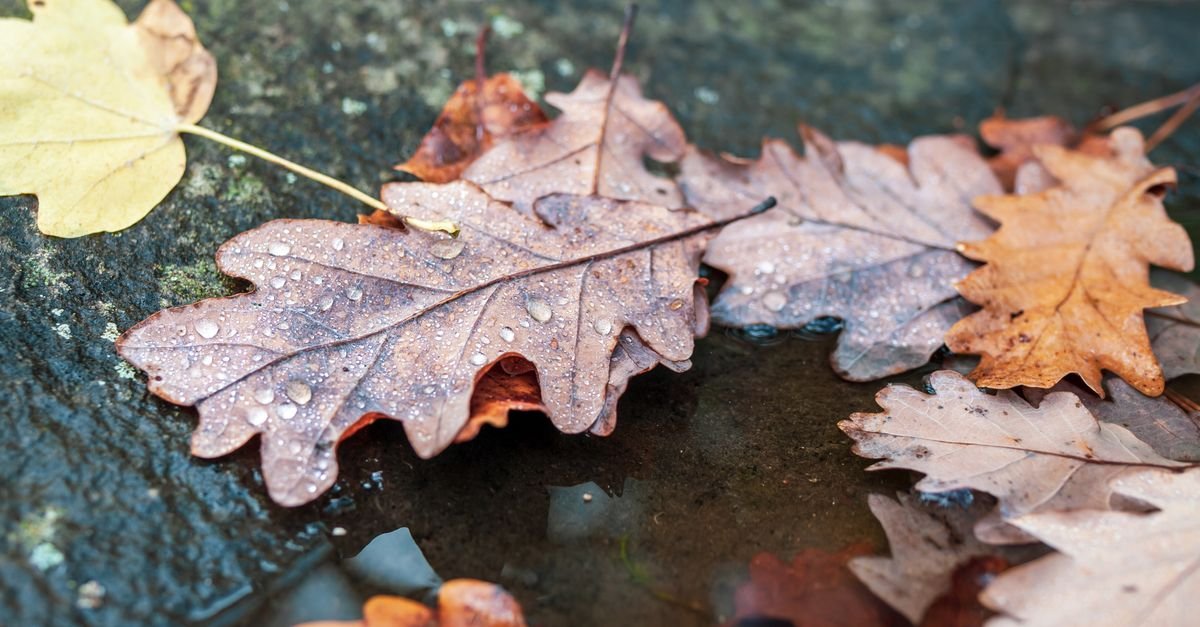
Tannins are polyphenols: big molecules built from phenolic rings, and importantly for you, water-soluble ones. They do not need to be scrubbed out of a leaf. They leave on their own the moment the leaf gets properly wet, which means the staining happens in the first few days of a wet autumn, not slowly over the winter you spent ignoring it.
I could not find anyone who has measured this on a driveway, so I went to the litter-decomposition literature, where it is measured properly. A 2008 laboratory study in *iForest* immersed leaf litter from eight species in distilled water for fifteen days and weighed it at intervals. The headline result: **”The mass loss varied from 2.39% (*L. lanceolata*) to 18.87 (*X. americana*), in 24 h”, and “For all species, half of the mass loss by leaching occurred within 3 days (72 h).” Phenol compounds specifically made up between 1.24% and 3.69% of the starting litter, and by day fifteen, “40 -89% of phenol were leached after 15 days of immersion in water.”** (Ibrahima, Biyanzi and Halima, *Changes in organic compounds during leaf litter leaching*, iForest 1: 27-33)
Carry the caveat with the number, because it matters: those were eight Sudano-Guinean savanna species, fully immersed in distilled water at 23 degrees C in a laboratory, not an oak leaf pinned to a cold slab by November rain. What transfers is not the percentage, it is the shape of the curve. The soluble fraction of a leaf is front-loaded and it goes fast. A wet leaf is a teabag with nowhere to drain.
Two useful consequences fall out of that. The first is that the leaf you eventually sweep up in March is a husk with nothing left to give — the mark under it was finished months ago, and moving the leaf is not a treatment. The second is that prevention is a calendar problem rather than a chemistry problem. Getting leaves off a slab while they are still dry costs nothing and prevents the whole page. Getting them off after the first proper rain is already too late for that patch.
It also explains why scrubbing underperforms so badly here. Dissolved tannin went into the pore structure with the water. A brush works on the top surface of a broom finish and the pigment is below it, which is why twenty minutes of effort moves the mark about as far as two minutes does.
The Oldest Black Dye in the World Is Made of Leaves and Rust
Here is the part nobody on the first page of search results mentions, and it is the whole reason this article exists.
Put tannin and iron together in water and you do not get a stronger stain. You get a different compound, and it is one humanity has been making deliberately for thousands of years. A 2012 paper in *Heritage Science* on producing model iron-tannate textiles for conservation research opens with the scale of it: “For millennia, iron-tannate dyes have been used to colour ceremonial and domestic objects shades of black, grey, or brown,” and “Iron-tannate complexes have been used as inks (iron gall inks) and dyes for thousands of years and are now present in objects of cultural significance worldwide.”
The chemistry is specific enough to be useful. “Iron-tannate dyes are formed through the combination of iron ions (usually iron(II)) and tannic acids (usually hydrolysable) in water,” and “On combination with ferrous ions hydrolysable tannins form blue-black coloured iron(III)-tannate dye complexes; the colour being due to a reversible charge transfer across the Fe(III)-O bond.” Condensed tannins behave slightly differently and “form green-black coloured dye complexes on combination with iron(III) ions.” (Hunt, Kite and Cigić, *Production and validation of model iron-tannate dyed textiles*, PMC3495704)
Read that second quote twice, because it answers a question people ask constantly: the iron goes in as iron(II) and the colour belongs to iron(III). The complex has to oxidise before it turns dark. That is why a mark can look like an unremarkable damp shadow on the Sunday you sweep the leaves off, and be a hard grey-black outline by Wednesday. It was not getting dirtier. It was getting air.
The conservation trade confirms the reaction from the opposite direction, because it uses it on purpose. The Canadian Conservation Institute’s note on treating corroded ironwork states that “When applied to iron, tannic acid reacts with the iron ions to form ferric tannate, a somewhat porous blue-black film,” and that it “produces a uniform finish that enhances the appearance of an object.” The same note warns, in a sentence worth pinning above the bench, that “Tannic acid can permanently stain materials such as wood, paper, wool, silk, leather, bone, horn and ivory.” (Canadian Conservation Institute, *Tannic Acid Coating for Rusted Iron Artifacts*, CCI Note 9/5)
So a museum conservator, faced with rusted iron, applies tannic acid deliberately to convert the rust into a stable dark film they intend to keep. A pile of wet oak leaves sitting on the rust ring left by your patio table foot is running the identical reaction, in situ, on concrete, without being asked.
That reframes the dark mark completely. It is not a worse version of the brown one. It is a dye, applied by accident, and dyes are formulated to stay. The same paper is blunt about how well conservators do against it: “The current lack of suitable stabilisation treatments means that many historic iron-tannate dyed objects are rapidly crumbling to dust.” People with laboratories and funding are not winning this, so you should not expect a bottle from the hardware aisle to clear it in one pass.
Which means the useful question on a black mark is not which cleaner, but where the iron came from. The usual suspects on a driveway are a steel furniture foot, a dropped screw or nail that has been quietly rusting in a joint, granular fertiliser thrown wide of the lawn, iron-bearing sand in the mix itself, and an existing rust streak that the leaves simply landed on. Finding and removing the supply is the same job as it is for any iron mark on a slab, and it is set out properly in cleaning rust stains off concrete.
Bleach Gets the Brown and Stops at the Black
On a plain brown leaf mark, chlorine bleach is a perfectly good answer and this site has said so for a while. Hypochlorite destroys colour by taking apart the double bonds in coloured organic molecules, the pH-family rules and the mixing hazards are covered in concrete cleaning chemicals, and a brown tannin mark is squarely in its category. I am not here to talk you out of it.
The failure is on the dark mark, and the reason is narrower and more interesting than the internet’s version.
An oxidiser removes colour by wrecking a chromophore. In an iron-tannate complex the colour is not sitting in an organic chromophore at all — it is the charge transfer across the Fe(III)-O bond, as that paper puts it. There is no double bond you can break that takes the colour with it. To lose the colour you have to take the complex apart, which means pulling the iron out of it, and hypochlorite cannot chelate anything. It has no mechanism for that. What it does instead is lighten the cement paste around the mark, so the mark reads darker once the slab dries and you conclude the product was too weak.
Then there is the bottle everybody actually recommends for tannin, and this is where I will plant a flag.
On a black or grey leaf mark, both oxidisers are the wrong choice, and oxygen bleach is the wronger of the two. Sodium percarbonate works through hydrogen peroxide, and transition metals — iron chief among them — catalytically decompose hydrogen peroxide into radicals that do not do the job you wanted. The iron sitting in your stain is the exact catalyst that destroys the oxidiser you brought to remove it, and the peroxide trade routinely strips transition metals out of a substrate before a peroxide stage for precisely this reason. That mechanism, with the sources, is laid out in oxygen bleach for cleaning. Every page ranking for this query recommends oxygen bleach for tannin. On the half of these stains that has gone dark, it is the least suitable thing on the shelf.
One claim I went looking for and could not stand behind: that chlorine bleach *sets* a tannin stain or darkens it. It is widely repeated, it sounds plausible, and I found no primary source for it. What is supportable is the narrower version above — bleach cannot chelate, so it cannot touch the iron half, and it changes the background rather than the mark. That is enough reason to put the jug down on a black stain without inventing a mechanism to go with it.
The answer for the dark mark is a chelating acid, and that is the same chemistry, the same dilutions and the same cautions as any iron stain on concrete, so it lives on the rust page rather than being re-argued here. What must be said here is the sequencing: an oxidiser and an acid never share an afternoon on the same slab. Rinse, let it dry, come back tomorrow.
Removing Leaf Stains From Concrete: The Colour Chooses the Chemistry
The general slab-stain routine — sweep, pre-wet, apply past the edge, dwell without drying, agitate, rinse, judge dry — is given step by step in cleaning stains from concrete and none of it changes. Four things are specific to a leaf, and getting these right is most of the outcome.
1. Sort the mark by colour before you buy anything. Brown, tan or yellow-brown with a soft halo is free tannin and belongs to an oxidiser. Grey, blue-black, green-black or charcoal, especially if it is concentrated in a small area rather than spread across a drift, is the iron complex and belongs to an acid. If you have both on one slab, and on a driveway under a tree you probably do, they are two separate jobs on two separate days, not one job with a stronger mix. (If the mark is precisely the outline of a maple leaf, the diagnostic stage of this project is over.)
2. Work the drift, not the prints. Leaves do not land evenly. They collect where the wind drops them and the water stops moving: along a fence line, behind a step riser, in the dead corner by the garage, at the low edge of the fall. Treat only the individual leaf shapes you can see and you finish with a patchwork; treat the whole drift and it reads as a clean slab. The geography of the drift is also the prevention plan, because it will be the same spot next October.
3. Give the oxidiser warmth and time, and keep it wet. A tannin mark that has been in the pores since last autumn is not a five-minute job, and a treatment that dries on the slab re-deposits what it lifted. Two or three moderate passes with a re-mist between them beat one strong pass, and the second pass is nearly always the one that does the visible work.
4. On a slope, rinse upward. Your rinse water is carrying dissolved tannin, which is a dye precursor looking for somewhere with iron in it. Sending it down over clean concrete you have not treated yet is how a cleaning job produces a new faint stain below the old one. That is backwards from the way almost everything else on this site is rinsed, and the reason it inverts is argued properly in removing graffiti.
The thing not to do at any point is turn the pressure up. Pressure does not reach dissolved pigment in a pore, and a rotary nozzle on cement paste trades a brown mark for a lighter, rougher, permanently more absorbent patch that will stain again faster than the concrete around it did.
Broom Finish, Sealer and Paving: Where the Tannin Stops
Three surfaces, and the only question that matters is what the tannin met on the way in.
| Surface | Where the tannin ends up | What shifts it | The real limit |
| Broom-finished concrete | Down in open pores, deepest in the grooves | Oxidiser and long dwell for brown; chelating acid for black; two or three cycles | No boundary to the depth, so nobody can tell you when to stop |
| Sealed or coated concrete | In or under the film, depending on the sealer’s age | Detergent and a soft brush first; the mark may be under the coating, where no cleaner reaches | Acid is off the table while the sealer is on, so a black mark can mean stripping before treating |
| Pavers, flags and stone | In the dense top face, with runoff pooling in the joints | Oxidiser and dwell, low pressure, shallow angle | Joint sand, which leaves long before the stain does |
The sealed row is the one that catches people, because it inverts the usual advice. On bare concrete an acid is available to you for the dark mark. On sealed concrete it is not, because the acid attacks the coating before it reaches the complex, and a dulled patch of sealer is more visible from the street than the stain was. That makes a black leaf mark on a sealed drive one of the few concrete stains where the honest answer may be to leave it until the sealer is due for renewal anyway.
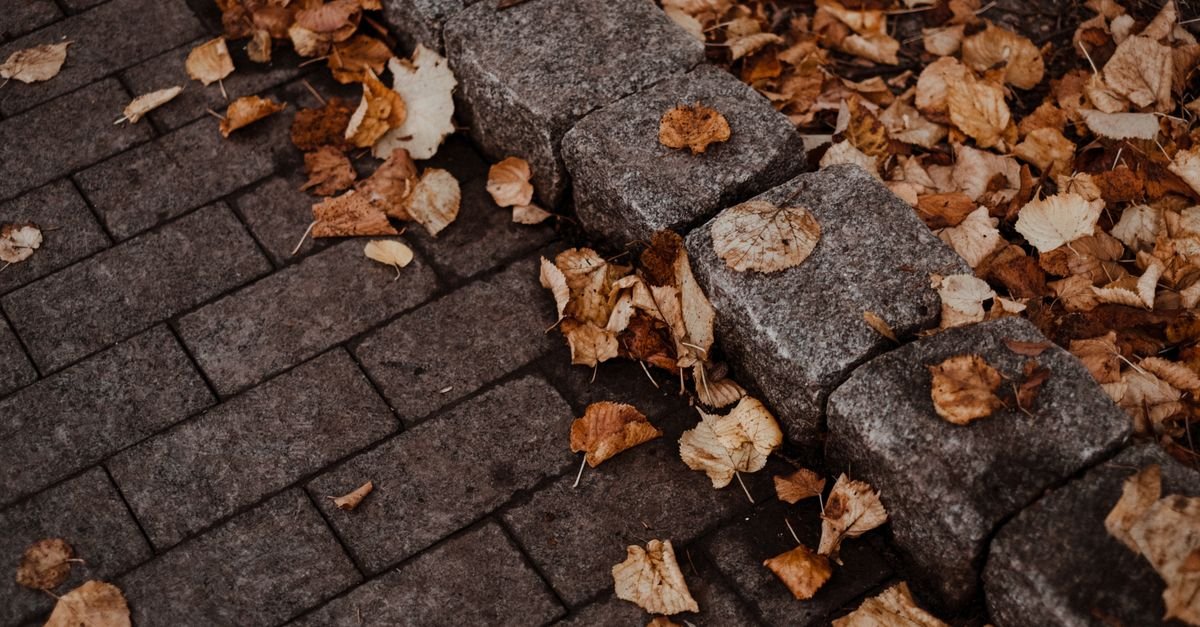
Paving has its own problem and it is not the stone. Tannin-laden water runs to the joints and sits there, so the staining is often worst along the joint lines while the middle of each unit looks fine — and the joint is also the thing that aggressive rinsing removes. The full treatment for block paving, including the leaf and berry case, is in how to clean brick patio pavers.
The Sun Does Fade It, and That Is All Anyone Knows
Every page on this subject, including the one that ranks first, tells you that sunlight will eventually fade a leaf stain. I went looking for how long. Nobody has published a number. Not a manufacturer, not a concrete institute, not a standards body, not a study. The claim travels with no figure attached and no source under it, which is worth saying out loud, because a reader deciding whether to spend a Saturday on this deserves to know that the patient option is folklore rather than data.
What is documented points the same way, at least. The *Heritage Science* paper describes “the breakdown of the blue-black iron-tannate dye complex with thermal ageing” — the complex is not permanent, it comes apart with time and energy. On a museum textile that is a disaster, because the dye takes the fibre with it. On a concrete slab there is no fibre to lose, which is the single piece of luck in this whole subject.
So the honest guidance is a judgement rather than a timetable. Leaving it alone is a legitimate plan when the mark is brown, spread thin across a drift, on unsealed concrete that gets direct sun for part of the day, and you are reading this in spring with the staining season behind you. Weather and light are genuinely working on it, and a leaf stain is the only common concrete mark where that is true — oil does not weather out, iron oxide does not, and efflorescence just comes back.
Leaving it alone is the wrong plan when the mark is dark and localised. That one has an iron supply, the supply is probably still there, and every wet season adds to it. Go and find the rusting thing before you deal with the colour.
FAQ
What removes leaf stains from concrete?
It depends on the colour. A brown or tan mark is free tannin and responds to an oxidiser — chlorine bleach or sodium percarbonate — applied generously, kept wet for a long dwell, brushed, and repeated two or three times. A grey or blue-black mark is an iron-tannate complex, and no oxidiser will clear it; that one needs a chelating acid of the kind used on rust, on a separate day, after the slab has dried.
Does bleach remove leaf stains from concrete?
On a brown tannin mark, yes, and it is a reasonable first choice. On a dark mark, no, and the reason is specific: the colour in an iron-tannate complex comes from a charge transfer in the iron-oxygen bond rather than from an organic chromophore, and bleach has no way to remove iron from a complex. It will lighten the cement paste around the mark, which usually makes the contrast worse once the slab dries.
Why did my leaf stain turn black instead of brown?
Because it found iron. Tannin plus iron in water forms an iron-tannate dye — the same chemistry as iron gall ink — and the complex has to oxidise before the colour appears, which is why a mark can darken over the days after you sweep the leaves off. Look for a steel furniture foot, a rusting fastener in a joint, spilled granular fertiliser or an existing rust streak underneath the spot.
Will a pressure washer remove leaf stains on its own?
It removes the leaf litter, the surface film and the spent chemistry, and it does that far better than a hose. It does not remove the stain, because dissolved tannin is inside the pore structure and a jet only ever acts on the surface it strikes. Raising the pressure instead of the dwell time erodes cement paste and leaves a patch that stains faster next autumn.
How long do leaf stains take to fade on their own?
Nobody has published a figure, and I looked. Every page asserting that sunlight will handle it does so without a source. What can be said is that brown tannin does fade with weather and light, while a dark iron-complexed mark fades far more slowly and keeps being topped up if the iron source is still in place.
Do leaf stains damage the concrete?
The brown ones do not. They are pigment sitting in pores. The dark ones are more interesting: iron-tannate complexes are acidic and metal-bearing, and in conservation they are documented as accelerating damage to the material they colour. Concrete is not cotton or silk, and nobody has published a study on the slab case, so treat that as a reason not to leave a black mark indefinitely rather than as a reason to panic.
Should I seal the slab to stop leaf stains coming back?
A penetrating sealer lines the pores and makes the next autumn’s staining much shallower and much easier to remove, which is the strongest prevention available short of sweeping. A film-forming sealer is a different trade-off, because tannin that gets under or into the film becomes a coating problem rather than a cleaning one. Either way, seal a clean dry slab, never a stained one.
Dry Leaves Never Stained Anything
The mechanism in one line: tannin is water-soluble, so it needs liquid water to get out of the leaf and into the slab, and it needs iron to turn from a stain into a dye. A dry leaf on a dry slab in October is doing nothing at all. Add three days of rain and it is a teabag. Add a rusting screw in the joint underneath and it is ink.
That is why the cheapest useful action on this whole page costs nothing and involves no chemicals: get the drifts off the concrete before the first sustained rain, and go and look at what metal is sitting in the spot where the dark marks appear. Everything after that is cleanup, and cleanup on a slab is always slower and less certain than the ten minutes with a broom you did not spend.