Last Updated on September 25, 2026 by Umar Farooq
A pressure washer leaving streaks is almost always recording how you moved rather than reporting a fault in the machine, and the only question that decides what happens next is whether the stripe is a difference in cleanliness — which a second full pass evens out — or a difference in surface texture, which nothing washes out.
Those two look identical from standing height on a wet surface. They look completely different once you know which two minutes of testing to spend. So before anyone reaches for the wand again, or for the muriatic acid the internet keeps recommending, work out which one is on the wall.
There is also a third possibility worth naming early, because it is the one that makes people wash the same panel four times: the stripe was already there. Some marks are the surface’s own history being revealed, not damage you caused, and pressure was never going to shift them.
The Five Marks a Wash Leaves Behind
Almost everything people call a streak falls into one of five families. They have different causes, different tests and very different outcomes, and the fastest way to stop worrying is to find yours in this table.
| What you see | Where it shows up | What it actually is | Outcome |
| Pass marks — clean bands beside less-clean ones, straight or gently curved, following your route | Concrete, pavers, render | Uneven energy per square foot: missed overlap, drifting height, changing speed | Recoverable |
| Etch grooves — lighter, rougher, and you can feel the edge | Concrete, mortar, soft brick, render | Surface paste eroded away, aggregate standing proud | Permanent |
| Dry-detergent lines — faint bright tracks that were not there when you packed up | Siding, render, painted surfaces | Soap dried before the rinse reached it | Recoverable |
| Rinse tracks — dark, narrow, running with gravity | Walls, and anything below a wall | Dirty water dried where it ran | Recoverable |
| Oxidation and film bands — vertical, evenly spaced, indifferent to pressure | Gutters, painted metal, chalked siding | Bonded oily film, or chalk removed at different rates | Depends entirely which |
Three of the five are fixable in an afternoon. One is not fixable at all. One is a chemistry job that more pressure actively makes worse. The tests below sort them in about the time it takes to uncoil a hose.
Wet It, Rake It, Wipe It
Three tests, no products, and between them they identify every mark in that table. Do them in this order, because each one rules out a family before the next one starts.
Wet it. Hose the whole area down evenly — the whole plane, not the stripe — and look at it while it is uniformly wet. A film of water sitting in the surface pores flattens out small differences in soil, so a cleanliness stripe fades a long way toward invisible. A texture change does not fade, because you have not changed how much water it holds relative to its neighbours. Then walk away and come back while it dries, which is the half of this test people skip. A rougher, more open surface holds more water and gives it up more slowly, so an etched band is the part of the slab still damp when everything around it has gone pale. Concrete that dries in a map of your wand strokes is telling you something a wet slab cannot.
Rake it. Wait for low sun, or take a torch out after dark and hold it almost flat against the surface. Light arriving at a shallow angle turns every change in depth into a shadow and leaves every change in colour alone. If the stripe vanishes under raking light, it is dirt. If it appears more sharply than it does at noon, it has depth. Confirm with a fingertip dragged across the boundary: grit standing proud, or a lip you can feel, means material has gone.
Wipe it. This one is for painted surfaces only — siding, gutters, trim, painted render. Press a damp white cloth on the light part of a band and then on the dark part, and look at the cloth. Chalky white powder means the binder in the paint has broken down and your wash removed the loose pigment unevenly; what does chalked mean covers what that finish has left in it. A greasy grey or black smear means a bonded film, which is a chemistry problem. A clean cloth on both means the difference is soil sitting in the surface, and a proper second wash will take it.
When a Pressure Washer Leaving Streaks Is Only Missed Overlap
If the tests said dirt, you are in the best of the five categories, and the cause is nearly always geometry rather than pressure.

A fan tip does not deliver a neat rectangle of equal force. It is heavy through the middle and thins out toward both edges, so two passes laid edge to edge meet in a seam that got a fraction of a dose from each side and a full dose from neither. That seam is invisible on a wet surface and obvious a week later, which is why people are so certain they overlapped properly. Overlap by a third to a half of the pattern, hold the tip at one height, and move at one speed — distance is a pressure control in its own right, and an inch of drift is a visible change in how hard that strip got hit.
The fix for marks you already have is the part most people get wrong, so it is worth stating plainly. Re-wash the entire surface, never the stripe. Spot-cleaning a band on a plane that has already been washed gives you a bright rectangle inside a stripe, which is one more shade than you started with, and the second attempt is always more visible than the first. That rule holds on concrete, on render, on a chalked wall and on decking.
Here is the opinion, and it points the opposite way to instinct. The correct answer to a striped slab is a second pass at *lower* pressure across the whole thing, not a hotter pass over the stripes. Concrete flatwork cleans at 2,500 to 3,000 PSI with detergent doing half the work; the numbers by concrete type are in how much PSI to clean a concrete driveway. Everything above that band is removing surface paste you cannot replace, in pursuit of a soil difference that a full even pass would have erased anyway. And if you own or can hire one, a pressure wash surface cleaner takes height, speed and overlap out of your hands entirely, which is the whole point of it.
One distinction while we are here: if the jet itself is coming out of the tip split, forked or lopsided before it even reaches the surface, that is a damaged or partly blocked nozzle rather than a technique problem, and it is a hardware fault with a different fix. What this article is about is the marks left on the surface by an otherwise healthy machine.
Etching Is a Groove, Not a Shade
If the raking-light test found depth, the honest answer is the one nobody wants: that mark is not dirt and it will not wash out, because the water removed material rather than uncovering it.
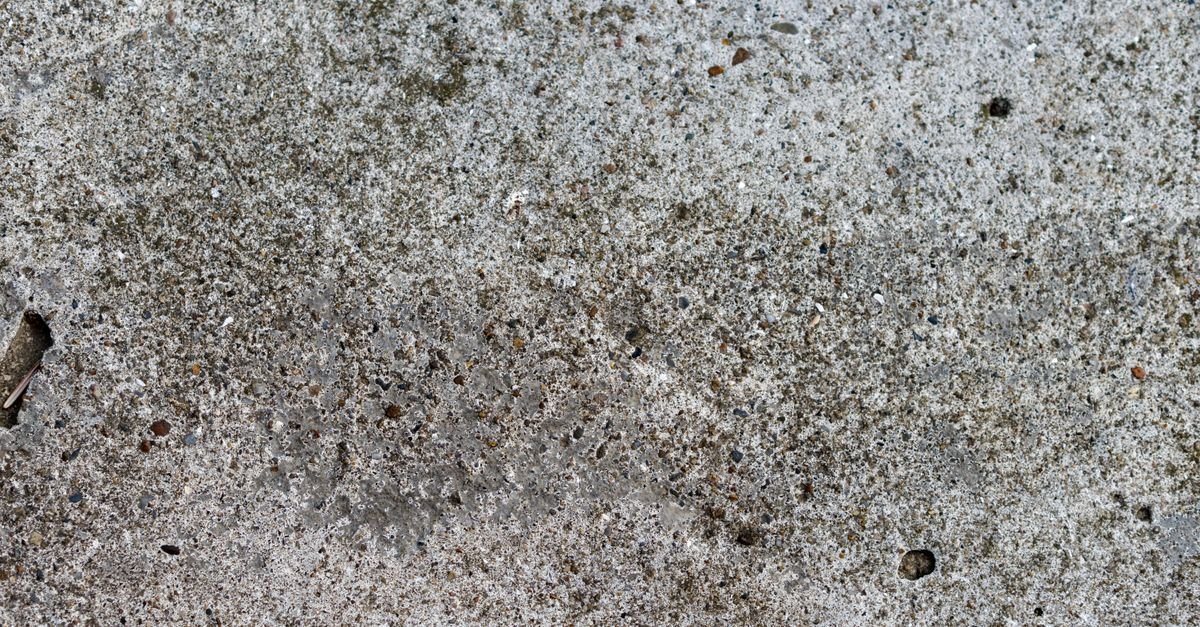
The mechanism is simple enough once you know what the top of a slab is made of. The finished surface is a thin skin of cement paste covering sand and stone. That paste is the softest thing there, and a narrow jet held close will wash it off and leave the aggregate behind. This is not a theory about what might happen — it is a recognised finishing technique used deliberately. Concrete Network describes the oldest method of producing exposed aggregate as washing away the thin layer of surface mortar covering the aggregate, with a working rule of removing it to a depth no more than one-third of the aggregate diameter. A turbo nozzle parked in one spot is doing the same job without the brief.
What makes etching worse over time rather than better is porosity. An etched band has more open surface and more edges, so it takes on dirt faster than the intact concrete beside it. The stripe you can barely see this month is the stripe that stands out next spring, which is the opposite of how a cleanliness mark behaves.
Three honest options, in ascending order of cost:
- Leave it. Weathering genuinely does blend a light etch over a season or two, because the surrounding concrete slowly loses its own paste to rain and traffic. This is the right answer for faint marks in places nobody stands and looks.
- Resurface it. A cement-based overlay goes over the whole slab, not the stripe. Quikrete’s Re-Cap is typical of the category and states its purpose as providing a new, durable, wear-resistant surface over worn or scaled concrete. It is a weekend, a bagged product and a squeegee, and it resets the finish uniformly.
- Even out the whole surface. Contractors will grind or acid-etch an entire slab to a matched profile. It works, it is not cheap, and it removes more material than your wand did.
Wood works the same way with different vocabulary. Lift the fibres on cedar or pine and you have furred it, and furring is sanding work, not washing work — softwood is generally handled at 500 to 600 PSI, which is a fraction of what a gas machine idles at.
The Dark Bands Pressure Never Touches
Some streaks were never yours. Evenly spaced vertical bands down a gutter face, or on painted metal cladding, or on an old rendered wall under a sill, are usually one of two things, and the cloth test already told you which.
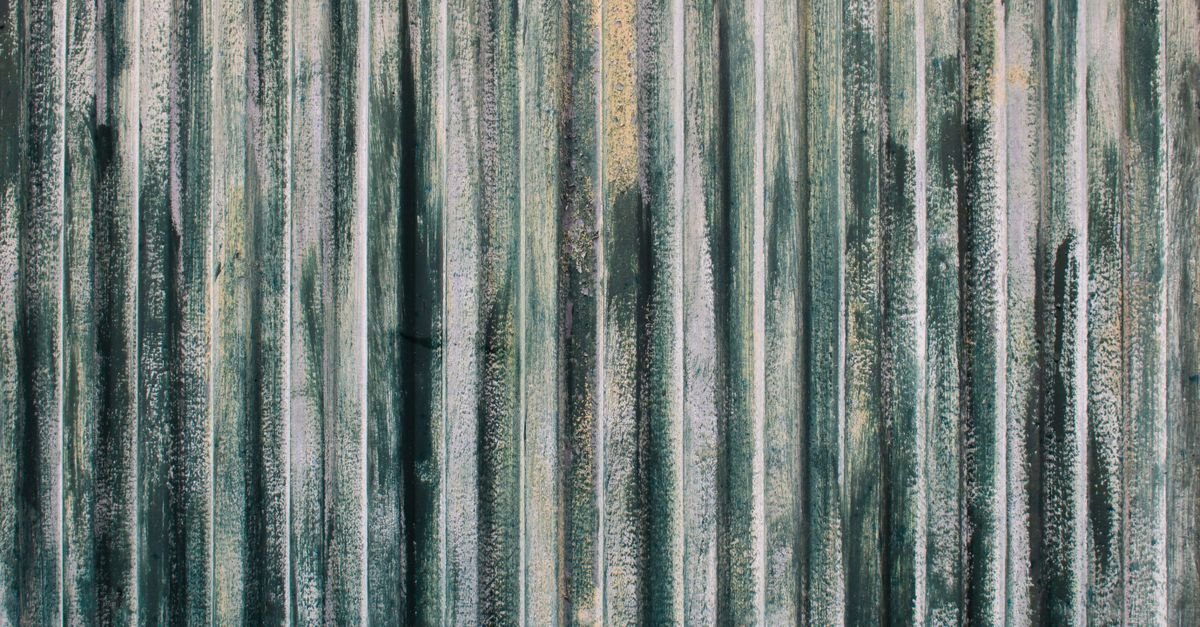
If the cloth came away greasy and grey, that is a bonded film — the oily fraction of whatever runs off the roof, left behind every time a rivulet dried in the same place. It is held on by chemistry, not by dirt, and a jet does not lift oil. It wants a surfactant or degreaser, five to ten minutes of dwell, a soft brush and a rinse. Raising the pressure on it achieves nothing except driving water where water should not go.
If the cloth came away chalky white, the band is a record of how much chalk each strip lost. Chalk comes off in proportion to energy and dwell, so a wand that lingered at the end of a pass removed more than a wand that swept through, and on a faded wall that difference is a different colour. There is no product that puts the colour back. There is only washing the whole elevation evenly, in one session, at one pressure — and accepting that the wall you end up with is a uniform faded, not the shade it was in 1998.
The reason this distinction matters so much is that the two respond in opposite directions. The film gets better with chemistry and worse with pressure. The chalk band gets better with uniformity and worse with any amount of extra attention paid to one spot.
Dried Soap and Dirty Water Leave Their Own Marks
The last two families are the ones that appear after you have coiled the hose, which is what makes them so annoying to diagnose. Neither is a pressure problem and neither needs a product to fix.
Detergent that dries on a surface leaves its own mark, and manufacturers say so directly — STIHL’s detergent guidance is to thoroughly rinse all surfaces and “do not allow detergent to dry on the surfaces you are cleaning”. On a warm wall in direct sun that gives you rather less time than the five to ten minutes of dwell the detergent actually wants, which is the real argument for working on an overcast morning. Work in sections you can rinse inside ten minutes, and mist anything that starts to go matte.
The same guidance covers direction, and the reasoning is worth having. Apply detergent starting at the bottom and working up, because soap running down a dry wall arrives as a narrow concentrated rivulet and soaks in as a line, while soap running down an already-wet wall spreads out and does nothing visible. Then rinse from the top down, so gravity works with you and dirty water always lands on surface you have not finished yet. Get the order backwards and you spend the afternoon redistributing a grey film over your own work.
Rinse tracks follow the same logic one storey lower. Everything under the wall is downstream — steps, decking, brick, the path — and a run of dirty water that dries on a dry surface leaves a track exactly where it went. Wet everything below before you start, and give the whole elevation and everything under it a final rinse after the wall has stopped dripping. The moment you feel finished is reliably about twenty minutes before you are.
One more culprit hides in this family and it is not your technique at all: hard water. A surface left to air-dry with dissolved minerals in the film dries to a spot or a faint white haze, and no amount of washing technique prevents it. That is the water, not the wash.
Recoverable, Improvable, or Permanent
This is the part of the article I would want if I were the one standing on a striped driveway right now, so it goes in plainly.
| The mark | The test that names it | Realistic best outcome |
| Pass marks from missed overlap | Fades when uniformly wet; no shadow under raking light | Gone after one even re-wash of the whole plane |
| Etch grooves in concrete | Stays damp longest; casts a shadow; you can feel it | Never washes out. Weathering blends it, a resurfacer replaces it |
| Furred wood | Fibres lift, surface feels fuzzy dry | Sanding, then refinish. No wash helps |
| Dried detergent lines | Appeared after the job, bright rather than dark | Gone after a rinse, or a light re-wash |
| Rinse tracks | Dark, narrow, runs with gravity | Gone after rinsing the whole elevation |
| Bonded film bands | Cloth comes away greasy grey | Gone with degreaser, dwell and a brush. Not with pressure |
| Chalk-removal bands | Cloth comes away chalky white | Evened out by washing the whole elevation. Colour does not return |
| Hard water spotting | Whole surface, not a route | Prevented by not air-drying; removed with an acidic cleaner |
Two of those eight are genuinely permanent, and both of them are damage to the surface rather than to the way it looks. That ratio is worth holding onto while you wait for the slab to dry, because the odds are firmly on your side.
FAQ
Why does my driveway look striped after pressure washing?
Almost always it is uneven energy: passes that did not overlap enough, a tip that drifted closer at the middle of each sweep, or a slowdown at the end of a stroke. It shows up as the slab dries because wet concrete hides small differences in soil. Re-wash the whole slab with detergent and an even pass before concluding anything.
Will pressure washer streaks go away on their own?
Cleanliness stripes do, sort of — the lightly cleaned bands pick up dirt at the same rate as everything else and the slab weathers back to one tone over a season. Etched stripes go the other way for a while, getting more visible as the rougher band collects dirt faster, before very slowly blending as the rest of the surface wears.
Can muriatic acid remove pressure washer marks from concrete?
Not in the way the advice implies. Acid does not fill a groove; it dissolves surface paste across whatever it touches, so it works by etching the rest of the slab down to match. That can genuinely even out tone, but it is aggressive, it leaves the whole surface more porous, and it will damage plants and skin without much persuasion. Try a full detergent re-wash first, and treat acid as a last resort on a test patch.
Does a surface cleaner stop streaks completely?
It removes the three variables you cannot hold steady by hand — height, speed and overlap within the disc — so it eliminates wand striping. What it cannot do is cover the seam between one pass and the next, so overlap the housing two to three inches onto the strip you just did, and detail the perimeter with a wand afterwards.
Why did streaks only appear on my siding after it dried in the sun?
Because a wet wall is uniformly dark and hides everything. Dried detergent, late drips from the laps and rinse tracks all need a dry, warm surface to become visible, which is typically the second sunny morning after the job. It is not a new problem appearing; it is the old one becoming legible.
How long should I wait before deciding streaks are permanent?
Give it a full day of drying before you judge anything, and a full second wash before you call anything permanent. The only mark that deserves an immediate verdict is one you can feel with a fingertip, because that is texture rather than tone and no amount of patience changes it.
Re-Wash the Whole Plane, Never the Stripe
If the water flattened it, the light ignored it and the cloth came back clean, you have a cleaning problem and one even pass will end it. If the light found depth or the cloth found chalk, you have a surface problem, and the useful move is deciding which of the three honest options you want rather than washing it again harder.
And if you are reading this standing over a slab with a very clear record of your own arm movement across it: it is fixable, it is the most common outcome on this list, and nobody is going to be looking at it in a fortnight. Wet the whole thing, overlap far more than feels reasonable, and let it dry before you decide anything.