Last Updated on September 25, 2026 by Umar Farooq
If your pressure washer starts then dies a few seconds later, the engine is almost certainly being fed by the choke and starved the moment the choke comes off — which makes this a fuel-delivery fault, not an ignition one. An engine with no spark does not fire at all. An engine that fires, catches, runs for three or five or fifteen seconds and then quietly gives up has spark, compression and enough fuel to start. It just cannot get enough fuel to keep going.
That narrows the search enormously, and it is worth holding onto, because the internet will happily sell you a spark plug for a problem the spark plug has already proved it does not have.
Why a Pressure Washer Starts Then Dies Instead of Never Starting at All
Three different symptoms get filed under “my pressure washer is broken,” and they have almost nothing in common mechanically. Sorting yours correctly saves you the entire afternoon.
| What the machine does | What it means | Where to look |
| Cranks and cranks, never fires | No spark, no fuel at all, or a safety cutout blocking the start | Pressure washer won’t start |
| Fires, runs a few seconds, dies | Fuel reaches the bowl but not the running engine | This article |
| Runs fine for minutes or an hour, then cuts out | Heat, electrical supply, or a load fault | Pressure washer keeps shutting off |
The middle row has the tightest fault tree, and that is good news. A machine that fires has proven four things in one pull: the coil works, the plug sparks, compression is adequate, and there is fuel somewhere in the system. Everything left is downstream of the tank and upstream of the cylinder.
One boundary before we go further: if you own an electric pressure washer that dies seconds after starting, none of this applies — there is no carburetor to blame, and the causes are Total Stop System, GFCI and thermal, all covered in the shutting-off guide above.
Read the Choke Before You Read Anything Else
Before you touch a tool, run the engine once more and watch what the choke does. It is the most diagnostic thing on the machine, and it costs one pull of the recoil.
A closed choke restricts incoming air, which makes the mixture richer. That is why a cold engine needs it, and it is also why a partially blocked fuel circuit hides behind it — the choke is compensating for a fuel shortage you cannot see.
| What happens | What it tells you |
| Starts on full choke, dies the instant you open the choke | Fuel circuit is restricted. The choke was doing the metering. |
| Runs indefinitely at half choke, dies at full open | Same fault, slightly less severe. Same fix. |
| Starts and dies in 2–3 seconds regardless of choke position | Bowl is not being refilled — valve, vent, filter or float |
| Runs fine until you squeeze the trigger, then dies | Load fault, not a starting fault — air filter, or the pump itself |
| Ran fine last month, sat since, now dies in seconds | Fuel age. Stop diagnosing and drain it. |
That last row is a position rather than a reading, and I will defend it. If the machine has sat with fuel in it since the last time you used it, do not diagnose anything — drain it first. Honda’s own fuel guidance states that petrol “may deteriorate and oxidize more rapidly (in as little as 15 days)” and that “fuel deterioration problems may occur in less than 30 days” (Honda Engines, fuel recommendations). Briggs & Stratton draws the same line at 30 days and names the consequence as “acid and gum deposits forming in the fuel system or carburetor” (Briggs & Stratton, fuel recommendations). The two manufacturers disagree about the number and agree about the direction. A tank that sat through a winter is not borderline. It is several times past both limits, and troubleshooting around it is troubleshooting around a known variable.
The Five-Minute Order That Costs Nothing
Work these in order. Every one of them is free, three of them are reversible in seconds, and between them they account for most of the machines that get carried to a repair shop.
1. Fuel valve fully open. Not “on” — fully open. A valve rotated halfway fills a bowl slowly and then fails to keep up. The handle points along the line when open and across it when shut, which is not obvious in a dim garage, and on many machines it sits where a knee can knock it.
2. Actual fuel in the tank. Look in it. Small-engine gauges are a plastic float on a stalk and they stick.
3. Fuel cap loose test. Start it, and as it begins to die, loosen the cap half a turn. Detail below.
4. Look at the fuel. Fresh petrol is clear and smells sharp. Old petrol is darker, smells sour or like varnish, and may show a distinct layer at the bottom.
5. Fuel line, end to end. A kink where the line crosses the frame, a cracked section at a clamp, or an inline filter gone brown.
6. Oil on level ground. Not on the slope of the drive. Details below — a different system, an almost identical symptom.
7. Air filter, held up to daylight. If you cannot see light through it, it is finished.
Nothing there needs a tool beyond a screwdriver. If the answer is in the list you are done in five minutes; if it is not, the rest of this article is the fuel path, part by part, in the order it fails.
Ethanol Pulls Water In, and the Water Sinks
Most pump petrol in the US contains up to 10% ethanol, and both Honda and Briggs & Stratton approve up to that limit and no further. The problem is not the ethanol itself. It is that ethanol is hygroscopic — it pulls water vapour out of the air above the fuel, through the very vent that keeps the tank breathing.

Honda describes the mechanism precisely: “Ethanol in the gasoline attracts water. Initially it mixes with the ethanol, but at higher concentrations it separates and settles to the lowest point, which leads to corrosion and starting and running problems.”
Read that last part again — *settles to the lowest point*. In a pressure washer, the lowest point in the fuel system is the carburetor bowl, which is exactly where the jets draw from. That is the whole story of the machine that starts then dies after a season in the shed: the choke pulls a rich enough mixture to fire on whatever petrol is left, then the engine settles down to draw from the bottom of the bowl, where a layer of water and alcohol is sitting.
Two practical consequences:
- Draining the tank is not enough. The bowl holds its own small reservoir below the tank, and that is the contaminated one. Take the bowl off and look at what comes out. Water beads sitting separately from fuel is a definitive answer.
- Octane is not the fix. Briggs & Stratton specifies a minimum 87 octane and states that E15 “is not recommended or approved for use in small engines.” Premium petrol is not cleaner, it is just harder to ignite. Buying 93 to solve a water problem is paying extra for a slightly worse cold start.
Prevention is the same either way: buy fuel in amounts you will use inside a month, and stabilise or empty the tank before the machine goes away for the season.
Loosen the Cap and Listen for the Hiss
This one is genuinely common, takes ten seconds to test, and the pages ranking for this problem tend to give it a single line.
As the engine burns fuel, the level in the tank drops, and something has to replace the volume. That is what the tiny vent in the fuel cap is for. Block the vent — with dust, with a swollen rubber gasket, with a wash of detergent overspray that dried in the hole — and the falling fuel level pulls a partial vacuum above it. The vacuum fights gravity. Fuel flow slows, then stops, and the engine dies with a full tank sitting eight inches above it.
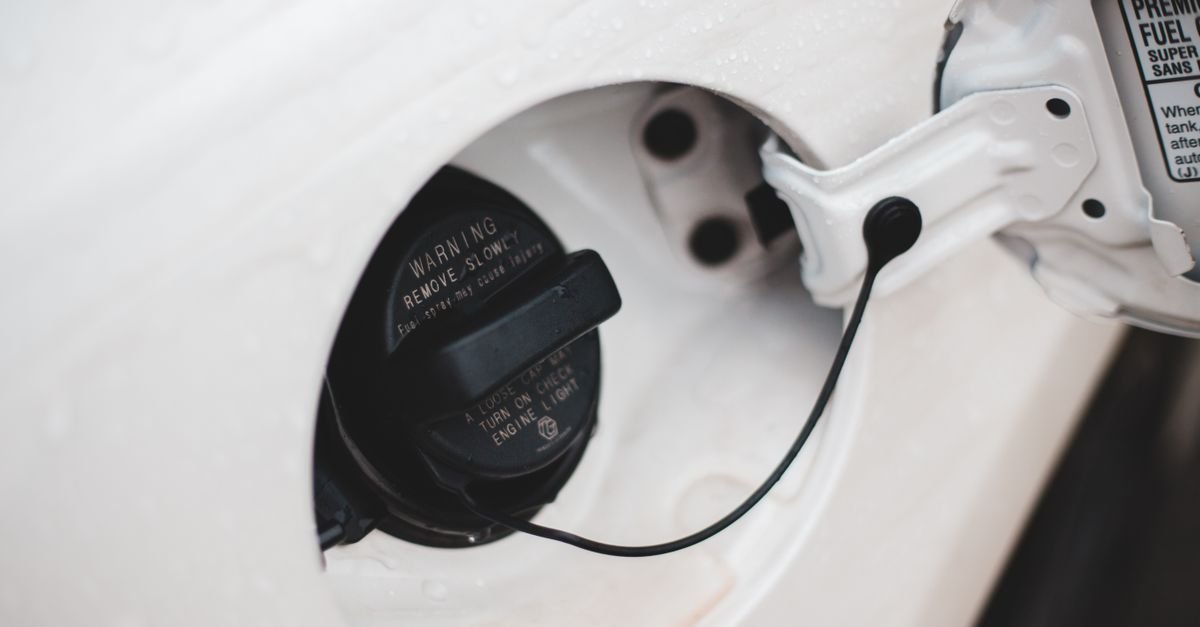
The test: run the machine until it begins to falter, then loosen the fuel cap half a turn. A small hiss of air rushing in, followed by the engine picking straight back up, is the answer. The confirmation: run it with the cap loose for ten minutes. If it now runs all day, the cap is the fault and nothing else is.
The fix: clear the vent hole with compressed air, and check the underside for a gasket that has swollen and closed the passage. Caps are cheap, and a cracked one is not worth saving. Do not just leave it loose and call it fixed — a loose cap on a machine that gets knocked over is a fuel spill beside a hot exhaust.
One nuance that trips people up: a vent blockage rarely kills the engine in three seconds. The vacuum takes time to build, so this fault usually appears somewhere between thirty seconds and several minutes, and the machine restarts happily after sitting because the vacuum has equalised. If yours dies in three seconds every time, this is not it.
The Pilot Jet Is the Part That Actually Starved
Here is the mechanism nearly every article on this symptom skips, and it is the one that explains why the choke test works.
A small-engine carburetor does not have one fuel passage. It has at least two. The main jet feeds the engine at speed and under load. The pilot jet — also called the low-speed or idle jet — feeds it at idle and through the transition just off idle. They are separate brass parts with separate holes, and the pilot jet’s hole is the smaller of the two by a wide margin. On a typical residential engine it is a drilling you can barely see against the light, which is a design decision someone made with great confidence and nobody has revisited since.
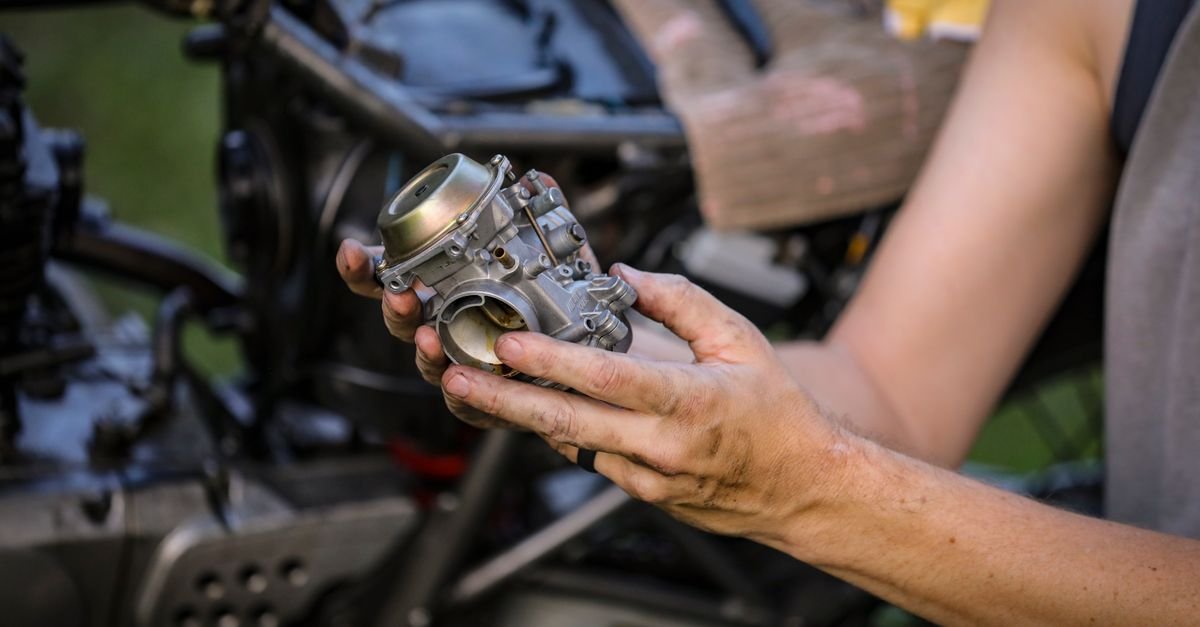
Varnish does not block both jets equally. It blocks the small one first. So the sequence goes like this: you close the choke, which restricts air and enriches the mixture enough to overcome the blocked pilot circuit. The engine fires and runs on that rich mixture. You open the choke. The engine now needs the pilot circuit to carry it, and the pilot circuit is closed. It dies within a second or two.
What to do about it:
1. Shut the fuel valve and disconnect the spark plug lead. Depressurise the machine by squeezing the trigger with the engine off.
2. Put a container underneath and remove the bowl. On many engines the bowl is held on by a single nut in the centre, and that nut is frequently the main jet itself, with cross-drilled holes through its side. Do not lose it and do not clean it with anything metal.
3. Empty the bowl and look at it. Varnish is a brown-gold film. Water sits as separate beads. Both are diagnoses.
4. Spray carburetor cleaner through the main jet and out through the cross-drillings, then blow it through with compressed air.
5. Find the pilot jet — usually a small brass screw in the body beside the main jet tower, sometimes under a brass plug. Remove it, hold it to the light, and confirm you can see through the hole. If you cannot, that is your fault, in both senses.
6. Clear it with carburetor cleaner and compressed air only. Never a wire, never a pin, never a drill bit. A jet is a calibrated orifice, and enlarging it by two thousandths of an inch means chasing a rich-running fault you created for the rest of the machine’s life.
If both jets are clean and it still dies on choke-off, the blockage is in the emulsion tube or the internal passages — a comprehensively clogged carburetor rather than one starved circuit, and a strip-and-soak or a replacement unit. Price that against the machine before committing a Saturday to it.
A Stuck Float Fails Two Different Ways
The float is a hollow plastic or brass body that rides on the fuel in the bowl and pushes a needle into a seat when the bowl fills. It is a toilet cistern, scaled down and bolted to an engine, and it fails in two opposite directions.
Stuck up, or needle stuck closed. The float tells the carburetor the bowl is full when it is not, and fuel stops entering. The engine starts on whatever was left in the bowl, burns it in a few seconds and dies. This is the classic two-to-three-second death, and it repeats identically on every restart, because each restart burns only what dripped in while the machine sat.
Stuck down, or needle not seating. Fuel keeps entering after the bowl is full, overflows into the throat and floods the engine. Tells: raw fuel smell, fuel weeping from the carburetor or the filter housing, a wet plug, black smoke on the brief run. A flooded engine is its own fault with its own clearing procedure, so if that is what you have, the fix is not in this article.
A waterlogged float — cracked and holding fuel inside — sinks and produces the flooding version permanently. Take it out and shake it. If you hear liquid, it is done.
The Low-Oil Sensor Kills It in Seconds
This one is not a fuel fault at all, but it imitates one so well that it belongs in the same triage.
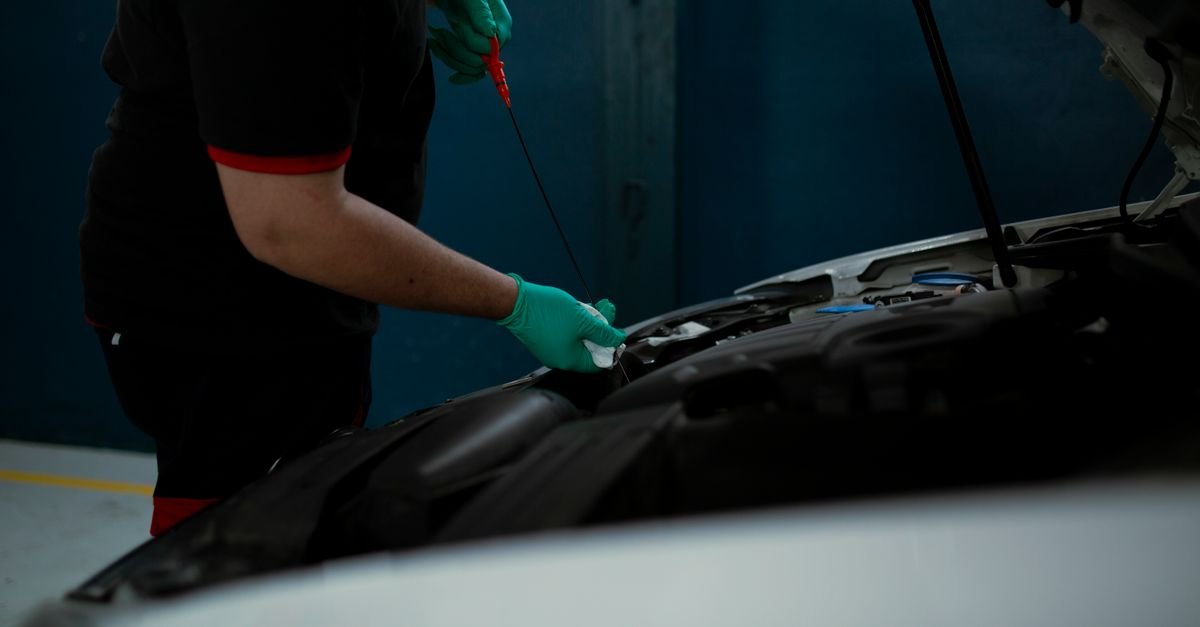
Most gas pressure washer engines carry a low-oil shutdown. Honda calls theirs Oil Alert and describes it plainly: “The system consists of an oil level sensor inside the crankcase. When the oil reaches a level that is too low for safe operation, the engine warns you or stops automatically” (Honda Engines, GX series). On most residential machines there is no warning stage. There is just a stop.
What makes it a diagnostic trap is that the sensor reads level, not volume. Three ways to trip it with adequate oil in the engine:
- The machine is on a slope. A driveway falls away from the house by design, so a machine sitting on it is tilted. Oil pools at one end of the crankcase and the sensor at the other end sees air.
- It was tipped or stored on its side. Oil migrates, and it may need a few minutes on a level surface to settle back.
- It is overfilled. Too much oil gets churned into foam by the crankshaft, and foam does not read as oil. Overfilling produces the same shutdown as underfilling, which surprises almost everyone.
Check the dipstick cold and level: wipe, reinsert fully, pull, read. Milky or grey oil means water in the crankcase, and the machine should not run until it is changed. If the level is genuinely right, the ground is genuinely flat and it still dies in three seconds, the sensor or its wiring is a fair suspect — they corrode.
Air Filters: Sometimes the Cause, Often the Alibi
A blocked air filter gets blamed for this symptom constantly, and it is the wrong diagnosis more often than the right one. A filter restricts air, which makes the mixture richer — the same thing the choke does. Choke-on-top-of-choke can stall an engine, but it is a rich fault, and rich faults announce themselves: black smoke, a sooty plug, a strong exhaust smell.
Where a dirty filter genuinely earns its place is the load version — the machine that idles happily and dies the instant you squeeze the trigger and the pump demands power. That is an airflow restriction showing up only when the engine needs its full breath.
Two things before you clean one. Foam elements are meant to be oiled; Briggs & Stratton is explicit that a foam-only filter traps dirt through motor oil held in the foam, and a dry one catches only the largest particles. Paper elements are neither washable nor tappable. The service routine and the 25-hour interval are in the pressure washer air filter guide.
Hold the element up to daylight. That test has never once been ambiguous.
FAQ
Why does my pressure washer start then die after a few seconds?
Because the choke is supplying the fuel the carburetor cannot. Close the choke and the mixture goes rich enough to run; open it and the engine has to draw through a blocked low-speed circuit, an empty bowl or a restricted supply line, and it stalls. Check the fuel valve, the fuel age and the cap vent before you open anything.
Why does my pressure washer only run with the choke on?
That is a blocked pilot or main jet nearly every time. The choke is compensating for a fuel passage that is partially closed by varnish. Clean the carburetor bowl and both jets with carburetor cleaner and compressed air. Running the machine permanently on half choke works, briefly, and fouls the spark plug while you do it.
Can a bad fuel cap really make a pressure washer stall?
Yes, and it is one of the most missed causes on this symptom. The cap has a vent that lets air in as fuel leaves. Block it and a vacuum forms in the tank that stops fuel flowing. Loosen the cap half a turn when the engine starts to falter; if it recovers with a hiss, the cap is the fault.
How do I know if the carburetor is clogged?
Take the bowl off and look. A brown-gold varnish film on the inside of the bowl, or water beads sitting separately from the fuel, is a positive result. Then hold the jets up to a light — if you cannot see daylight through the hole, that jet is blocked.
Will old petrol make a pressure washer start and then die?
It is the most common single reason. Honda states fuel can begin deteriorating in as little as 15 days, and Briggs & Stratton puts the stale line at 30 days. Anything left in a machine over a winter is well beyond both. Drain the tank and the carburetor bowl, then refill with fresh fuel.
Can low oil shut a pressure washer off immediately?
Yes. Most gas engines have a low-oil sensor that stops the engine within seconds. Because it reads level rather than quantity, a machine on a sloped driveway can trip it with correct oil in the sump. Move it onto flat ground and check the dipstick cold.
Does a pressure washer need water connected to run?
The engine does not, but the pump does. A gas engine will run dry without complaint while the pump destroys itself in under a minute, so connect the water and open the tap before starting — even when all you are doing is testing whether it stays running.
Chase the Fuel Path, Not the Spark
A machine that starts has already told you the ignition is fine. Everything left is the route the fuel takes: cap vent, valve, line, bowl, float, and two brass holes the size of a pinprick. Work that route in order and the fault is nearly always in the second half of it.
Do the free checks first — valve fully open, cap loosened, oil read on level ground, filter held up to the light — then go to the bowl, because the bowl is the lowest point in the system and everything bad in the fuel ends up there. If what is in it is a season old, you are not diagnosing a machine. You are diagnosing a fuel sample, and the sample has already failed.
Once it is running, the thing that stops this coming back next spring takes two minutes: stabilise the fuel or run the tank dry, then shut the valve. The machine that dies in three seconds in April was put away in September by someone who was nearly finished.