Last Updated on September 25, 2026 by Umar Farooq
Swimming pool algae stain removal is two separate jobs, and a pressure washer only owns one of them — the deck, the coping and the tile band at the waterline are flatwork and clean like flatwork, while anything living in the water itself is a chemistry problem belonging to whoever looks after the water.
This site is about machines that move water at pressure, not about the water in your pool, and I would rather draw that line early than half-cover both halves and leave you worse off on each. Free chlorine, cyanuric acid, shocking, algaecide dosing and filter runs are all real and all decisive, and none of them are here. What is here is the couple of metres of hard surface ringing the water, which behaves unlike any other flatwork you own and gets written about as if it were a driveway that happens to be damp.
A Pool Surround Stays Wet in a Way Nothing Else on Your Property Does
Every other slab you own dries out between rain events. A pool surround does not, and that single fact explains why it goes green first.
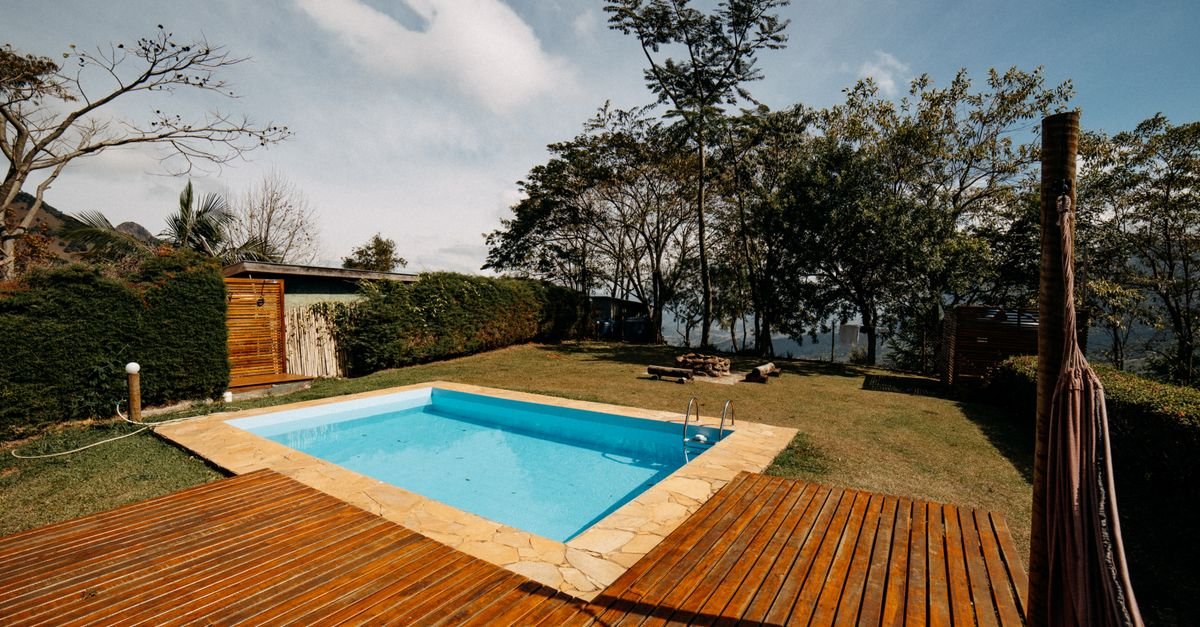
Three things stack up. The first is splash — a pool surround is the only flatwork on a domestic property with a permanent irrigation system operated by children. The CDC’s Model Aquatic Health Code even gives that strip its own name: the “perimeter deck” is “the hardscape surface area immediately adjacent to and within 4 feet (1.2 m) of the edge of the swimming pool,” also called the wet deck (CDC, 2024 Model Aquatic Health Code). Public health code draws a line four feet from the water because that is where a surface stops drying properly.
The second is shade. Pools get screened, fenced, hedged and umbrella’d, usually on the side you sit on. Green algae has no UV protection and no tolerance for drying out, which is exactly why it takes low-light, permanently damp surfaces first — the biology is covered properly in algae on siding cleaning and I am not going to re-run it here.
The third is the one people get wrong. The chlorine is in the water. It sanitises the water, and it does that job well. The deck gets the splash afterwards — thinned out on a hot slab, free chlorine gone in sunlight within minutes, dried down to whatever came with it: sunscreen, body oil, pollen, leaf litter and grit. The surround gets the moisture of a pool and essentially none of the sanitiser. That is a growing medium, not a treated surface.
The Half of This Problem That Belongs to a Pool Company
The diagnostic takes about ten seconds. Look at where the green actually is.
If it is under the water — haze on the plaster, fur on the steps, water gone from clear to cloudy to green — that is living algae in a body of water and it is a chemistry job. It comes back in days whenever the sanitiser runs short, and no amount of pressure fixes a sanitiser deficit. A pool professional or a decent pool-care site will take you through free chlorine, stabiliser, circulation and what to do with the filter afterwards. That is genuinely their trade.
If it is on dry hard surface — deck, pavers, coping, grout, the tile band above the water — it is a surface cleaning job and the rest of this article is about it. The awkward third category is the drained shell, which has its own section below because the answer there is mostly “don’t.”
Worth saying plainly: cleaning the deck will not fix the water, and balancing the water will not clean the deck. They are two systems that happen to share a postcode.
Reading the Band: Algae, Scale and Sunscreen Are Three Different Residues
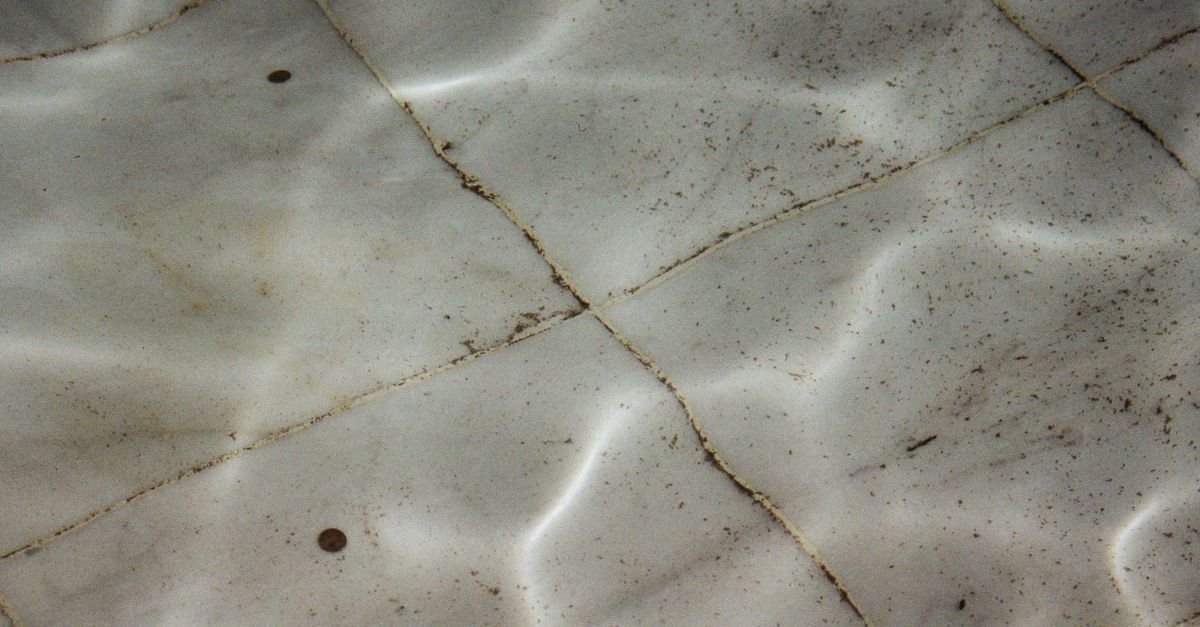
The waterline is where most people start and where most people reach for the wrong bottle, because several unrelated residues stack up in the same eight inches of tile.
| What you are looking at | What it actually is | What moves it |
| White or grey crust, rough to a fingernail | Calcium carbonate scale, left as water evaporates | Acid, or mechanical removal — never pressure alone |
| Greasy tan film just above the water | Sunscreen and body oil bound into a soap scum | A surfactant, warm water and a nylon pad |
| Soft green film on coping, deck or grout | Green algae | Sodium hypochlorite at flatwork strength, with dwell time |
| Hard, flat black discs on stone | Lichen, bonded into the top of the stone | Repeat hypochlorite over weeks. Nothing does it in one pass |
| Orange or rust-brown streaking | Iron, from fill water or a fixing | Neither chlorine nor detergent. Different chemistry entirely |
That top row catches everybody. Scale is not a stain and it is not alive, so bleach does nothing to it and pressure polishes it rather than removing it. The water evaporates at the surface line, the calcium does not evaporate with it, and it builds there faster than anywhere else in the pool.
The greasy row is the most under-rated. A surfactant lifts it in one pass, and people spend a weekend on chlorine instead, wondering why the tile still looks brown. Name the residue before you spray it — five things sitting side by side need five answers, and only one of them is algae.
Swimming Pool Algae Stain Removal on Deck and Coping, in Order
The green on flatwork is the easy part, and the order matters more than the pressure does.
One: sweep or blow the surround dry first. Wet leaf litter smeared across a deck has stopped being debris and started being a stain.
Two: work out what the deck is made of. Broom-finished concrete, stamped and coloured concrete, a sprayed acrylic “cool deck” coating, pavers, clay brick, travertine, limestone, sandstone or porcelain. Those do not take the same chemistry and they emphatically do not take the same pressure. If you cannot tell, patio cleaning solution has the drop test that sorts it in thirty seconds.
Three: chemistry first, and mean it. On plain concrete, pavers and clay brick, sodium hypochlorite at around 2% with a squeeze of dish soap as a crude surfactant kills the algae outright. Five to ten minutes of dwell, and do not let it dry on the surface — a mix that dries has stopped working and started staining. Test coloured or stamped concrete on a hidden corner, because hypochlorite fades pigment. On calcareous stone, drop the strength and read the next section first.
Four: rinse at the lowest pressure that lifts it. Here a pool deck departs from a driveway. General flatwork guidance sits at 2,500 to 3,000 PSI with a 15 to 25-degree tip, and a pool surround is usually more fragile than that number assumes: cool-deck coating is a sprayed knockdown texture a couple of millimetres thick, stamped concrete carries its colour in a thin surface layer, and pavers sit on jointing sand a narrow tip will excavate in about two seconds. Once the chlorine has done the killing you are rinsing a dead film off, not cutting a stain out. Start at 1,200 to 1,500 PSI with a 25 or 40-degree fan and move in only if you must.
Five: use a surface cleaner on anything over about ten square metres. It holds a fixed standoff distance, which is what stops the zebra striping; the technique in how to remove moss from concrete driveway transfers across unchanged.
The opinion, and the pool deck is the clearest case for it on this whole site: the pressure is not doing the cleaning. Algae is a soft living film with no mechanical grip on anything. If you find yourself fitting a 15-degree tip on a pool deck, the honest read is that the chemistry got skipped or the dwell got cut short, and you are now compensating with a tool that removes surface texture along with the green.
Why a Drained Shell Is the Worst Surface You Could Point a Wand At
An empty pool looks like the best pressure washing job you will ever be offered — a large drained bowl with nothing in it and stains visible from the top step. That is the trap.
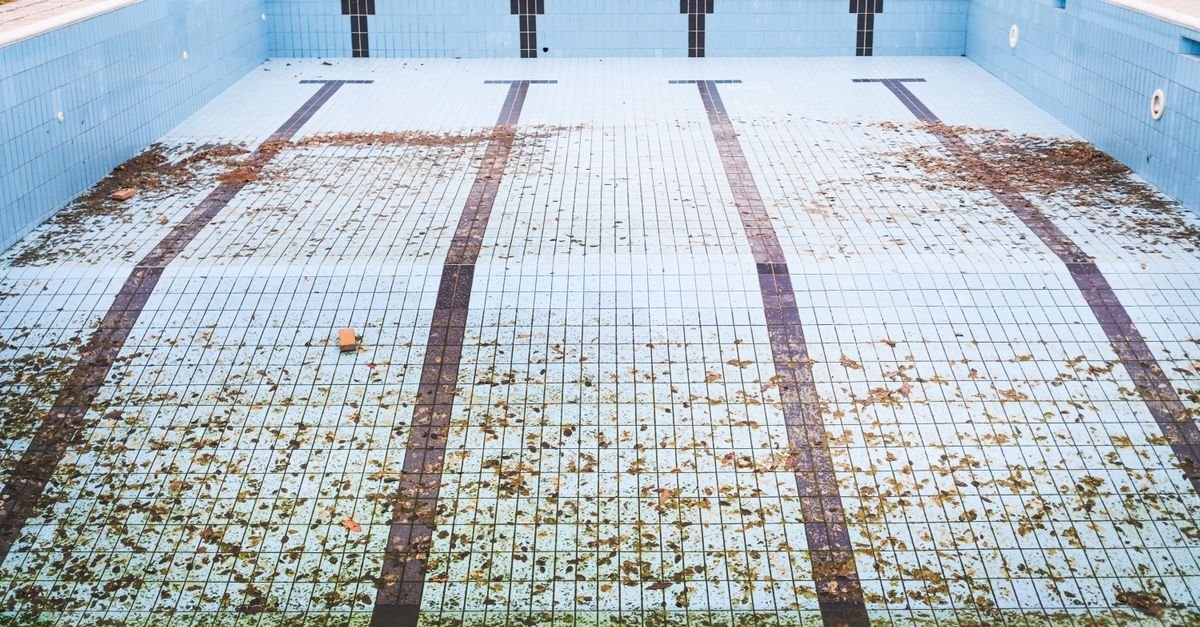
Each interior finish fails in its own way, and none of them fail gracefully.
- Plaster (marcite) is a thin cementitious coat troweled over the shell, and what gives it a smooth sealed face is the cream at the very top of that coat. A pressure washer erodes exactly that layer first. You get a shell that looks brighter for a fortnight and is now rough, porous and a considerably better home for algae than before you started.
- Pebble and exposed-aggregate finishes hold their stones in a cement matrix. Wash the matrix out and you have not damaged the surface so much as begun disassembling it, one pebble at a time, usually starting where you were standing.
- Vinyl liners are printed PVC membranes measured in mils — thousandths of an inch — welded at the seams and held in position partly by the weight of the water on them. The pattern scours off before the algae does, which is a detail I had to read twice myself before I believed it.
- Fibreglass is a gelcoat with a factory gloss. Pressure dulls it, and dull gelcoat holds soil.
Behind all four sits the reason a drained pool is not a weekend project at all. An in-ground shell full of water is held down by the weight of that water; empty it while the groundwater is high and hydrostatic pressure underneath can lift it out of the ground. Plaster left dry in sun and wind also cracks. Draining is a job with a weather window, a hydrostatic plug and a deadline, and it belongs to somebody who has done it before. If the interior genuinely needs work, the two real options are an acid wash by an insured professional or a resurface. The pressure washer is the fastest route from a cosmetic problem to a replaster.
Travertine Coping and the Acid You Were About to Buy
Coping is the capping course between deck and water, and in a large share of pools it is travertine, limestone or marble — chosen because pale calcareous stone stays cooler underfoot. That choice has a consequence almost nothing written about pool cleaning bothers to connect.
Calcareous stone is calcium carbonate. The white scale on your waterline tile is also calcium carbonate. They are the same compound in two arrangements, which means any acid strong enough to dissolve the scale is equally happy to dissolve the coping, and it will not be asked to choose. Acid does not lift a deposit off; it converts the carbonate into a soluble salt that rinse water carries away. Run it along a tile band with travertine sitting an inch above and you permanently etch the stone while you descale the tile. The full material-by-material picture is in patio cleaning solution; the short version is that on calcareous stone every acidic product in the shed is off the list, vinegar included.
What does work on the tile band:
- Pumice or a scale-removal block, worked wet by hand, on glazed ceramic tile only. Slow, effective, and it cannot run anywhere it should not.
- Bead or soda blasting by a specialist for a heavy band. That trade service exists precisely because an acid cannot be trusted next to coping.
- A pH-neutral stone soap and a nylon brush for routine coping, with hypochlorite at the weak end — around 1% — for organic growth, tested on a hidden corner first.
Nobody has ever regretted spending a Saturday not dissolving their coping.
Pool Shed Chemistry: Acid and Chlorine Under One Roof
This is not a formality section. A pool shed is the one structure on a domestic property that reliably holds both a concentrated chlorine source and a concentrated acid, within arm’s reach of each other, by design.
ATSDR states it without qualification: sodium hypochlorite “releases chlorine gas when it comes in contact with acids” (ATSDR, Medical Management Guidelines for Chlorine).
Now look at your actual shelf. Liquid chlorine, cal-hypo or trichlor on one side. Muriatic acid or dry acid for pH correction on the other. A tile scale remover, a rust stain product, and a bucket that has been used for everything. The scenario that warning describes is not a laboratory abstraction — it is somebody descaling the tile band on Saturday morning, deciding the deck needs doing too, and wetting the same stones with a bleach mix that afternoon while kneeling over them.
Three rules, and they are cheap:
- Never the same surface on the same day. If acid has touched a surface, rinse thoroughly and give it a full day before anything chlorinated goes near it.
- Never the same container. Not the sprayer, not the watering can, not the bucket.
- Never in an enclosure. Chlorine gas is heavier than air, and a screened pool enclosure or a pump shed is exactly the shape that holds it at ground level — which is where you are kneeling.
Clean Coping Is Sometimes Slipperier Than Dirty Coping
This is the part nobody warns you about, and it is the one that actually hurts somebody.
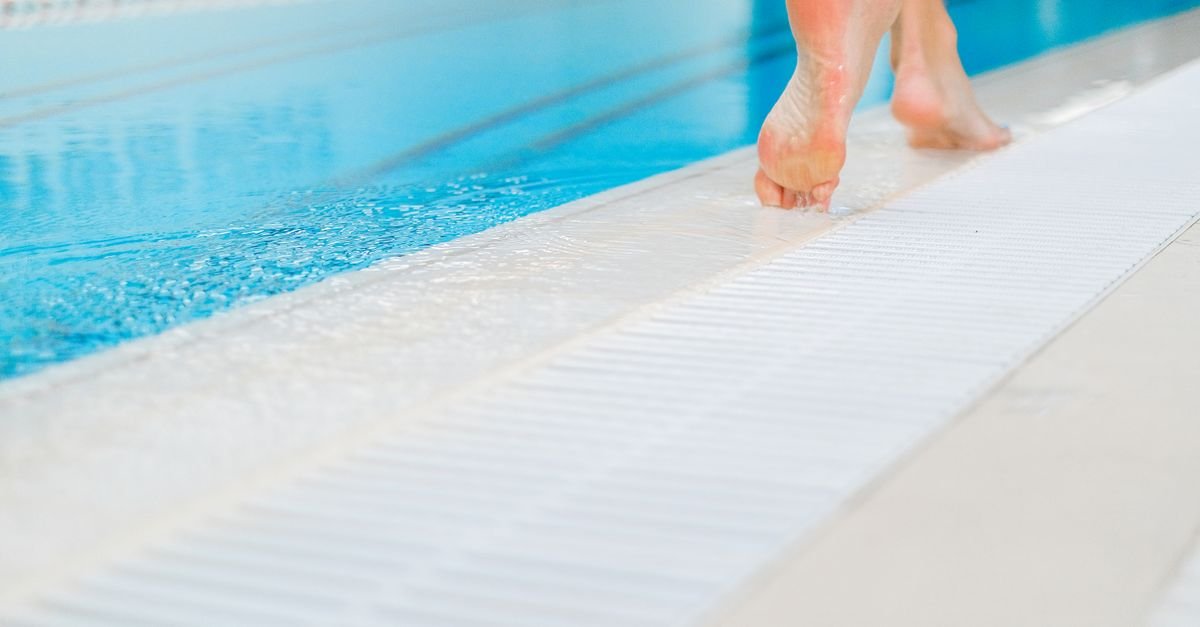
Algae is slippery, which is a genuine reason to clean a surround rather than a cosmetic one. What is less obvious is that the thing keeping you upright on a wet deck is not cleanliness but texture, and several methods that remove algae also remove texture. A surface cleaner run too close flattens the peaks of a broom finish. An acid wash takes the tooth off stone. A turbo nozzle polishes rather than roughens. And a glossy “wet look” sealer, over a deck people cross with wet bare feet, is the single worst finish decision available on a pool surround.
Public pool code treats this as a design requirement rather than a preference: “all DECKS shall have SLIP-RESISTANT, textured finishes, which are not conducive to slipping under contact of bare feet in wet or dry conditions,” with slip resistant defined as a minimum dynamic coefficient of friction meeting ANSI A326, measured by the DCOF AcuTest (CDC, 2024 Model Aquatic Health Code). Your back garden is not a regulated aquatic venue. The physics is unaware of that.
Test it barefoot and wet before you call the job finished. If it feels faster underfoot than it did before you cleaned it, stop escalating pressure, drop the gloss sealer, and if you are sealing at all use a matte penetrating product with a grit additive.
Rinse Water Has Two Destinations and Neither Is the Pool
Everything you spray runs downhill, and on a pool surround the downhill options are unusually bad.
The pool is the obvious one and the first to rule out. The Model Aquatic Health Code is blunt about it — “DECK drains shall not drain to the POOL, POOL gutter, or RECIRCULATION SYSTEMS.” The reason is not the chlorine; it is everything else the deck water carries. Dirt, dead algae, surfactant, leaf litter and sunscreen residue arrive in one slug, and the filter and sanitiser then deal with an organic load they were not sized for. A surfactant in particular will foam a pool for days. You spend more correcting the water than you saved by not diverting.
The other destination is the storm drain, which in most places discharges to a watercourse untreated. EPA’s national recommended criteria put chlorine’s acute freshwater value at 19 µg/L and the chronic value at 11 µg/L (US EPA, aquatic life criteria table). A 2% hypochlorite deck mix is 20,000 mg/L — roughly a million times the acute criterion. What reaches a creek has been thinned by rinse water, spent on organic matter and degraded by sunlight on the way, so that is a ratio rather than a prediction. The size of the gap is the point, and it is why “it will be fine, it is diluted” is not a plan.
What to do instead, in rising order of effort:
- Cover the pool, or at least the half you are working over, before anything goes down.
- Work away from the water. Start at the far edge and finish at the coping, so most of the runoff has already gone elsewhere by the time you are next to the pool.
- Let the chemistry break down before rinsing hard. Hypochlorite degrades in sunlight faster than anything else on your shelf.
- Wet the planting either side first. Damp soil absorbs less; dry soil drinks whatever lands on it.
- Divert with a sandbag, a length of pipe insulation or a rolled towel across the deck drain. Low-tech, and it works.
FAQ
Will a pressure washer remove algae stains from a pool deck?
It will remove the algae, but the pressure is not what kills it. A sodium hypochlorite solution at around 2% with a surfactant, given five to ten minutes of dwell without drying, does the killing; the washer then rinses a dead film off at 1,200 to 1,500 PSI with a fan tip. If a green mark survives that, it is probably not algae.
Can I pressure wash the inside of an empty swimming pool?
No, and this is the one hard answer here. Plaster loses its sealed surface cream, pebble finishes lose the matrix holding the stones in, vinyl liners are thousandths of an inch thick and lose their print, and gelcoat dulls. Draining at all carries a hydrostatic risk of the shell lifting. If the interior needs work it needs an acid wash by a professional, or a resurface.
What is the white line on my pool tiles at the waterline?
Calcium carbonate scale. Water evaporates at the surface line, calcium does not evaporate with it, and it deposits as a crust. It is not a stain and it is not alive, so bleach does nothing and pressure only polishes it. Pumice by hand on glazed tile, or a blasting specialist for a heavy band.
Can I use vinegar or muriatic acid on pool coping?
Not if the coping is travertine, limestone or marble, which covers most pale coping. That stone is calcium carbonate and acid dissolves it — the etching is permanent and needs resurfacing. Vinegar counts as acid here. On concrete or porcelain coping an acid has a narrow legitimate use, but it must never run onto adjoining stone.
Does pool deck cleaner hurt the pool water if it splashes in?
A little overspray is not a crisis, but deliberately rinsing deck water into the pool is a bad trade. The problem is the surfactant, the dead algae and the dirt rather than the chlorine — a surfactant will foam the pool for days. Cover the pool and work away from the water.
Why does algae keep coming back on my pool deck?
Because both things it needs are permanently available. The perimeter is wetted by splash every time somebody gets out, and surrounds are usually partly shaded. You cannot remove the light and you cannot remove the water, so the interval is set by drying hours. Cutting back planting on the shaded side and fixing a low spot that ponds move the date further out than a stronger mix will.
What PSI should I use on a pool deck?
Start at 1,200 to 1,500 PSI with a 25 or 40-degree tip and go up only if you must. That is deliberately below driveway guidance: cool-deck acrylic coatings, stamped concrete and paver joint sand all fail well before plain broom-finished concrete does. Travertine and limestone coping go lower still.
Treat It as a Patio That Happens to Be Next to a Pool
The useful mental model is that you own a small, permanently damp patio with an unusually fragile edge and a large open drain in the middle that you are not allowed to use. Everything follows from that: chemistry before pressure, less pressure than a driveway, no acid near calcareous coping, nothing chlorinated on the same day as anything acidic, and runoff sent anywhere but into the water.
The water itself is somebody else’s chapter, and a good one — go and read it from a pool-care source who does that work properly. My half stops at the tile band. If you have already got the wand out and the green is coming off faster than you expected, that is the chlorine you put down twenty minutes ago finishing its shift, and you can safely back off a metre and let it.