Last Updated on September 25, 2026 by Umar Farooq
Pressure washer inlet hose collapsing happens because the pump is asking for more water than the hose can hand over, the pressure inside the hose falls below the pressure of the air outside it, and the atmosphere squashes the hose flat. Nothing is sucking it. Nothing is pulling on the wall. The outside of your garden hose is simply winning an argument it has been quietly ready to win all afternoon.
That is a satisfying failure to diagnose, because the cause is visible from where you are standing and the fix costs less than a set of replacement nozzles. It is also a failure people misread badly — most of the advice you will find sends you inside the machine, and the machine is fine.
Pressure Washer Inlet Hose Collapsing Is the Atmosphere Winning
Start with what the pump is. A pressure washer pump is positive displacement: its plungers sweep a fixed volume every revolution and they will sweep it whether or not the water turns up. On the intake stroke the chamber gets bigger. Something has to fill it.
If the tap and the hose can deliver that volume, water fills it and the pressure in the hose stays somewhere near supply pressure. If they cannot, the chamber still gets bigger, and the only thing available to absorb the shortfall is the pressure in the hose itself. It drops. Once it drops below atmospheric, the hose is no longer a pipe with water in it. It is a thin rubber tube with a partial vacuum inside and the entire weight of the sky resting on the outside.
Put a number on the sky. Air pressure at sea level is about 14.7 pounds per square inch, and the crushing load on a hose is that difference multiplied by the hose’s projected area — bore times length. On a 5/8-inch hose that works out at roughly 110 pounds squeezing every single foot of hose, if the inside were pulled to a full vacuum. It never is. But you do not need it to be. Drop the inside just 2 psi below the air outside and you still have about 15 pounds pressing inward on every foot, which is more than enough to fold a soft hose that has spent three summers in a hedge.
Two things follow from that, and they are the whole article. The hose collapses where it is weakest, not where the pump is. And the collapse is a *symptom* of the supply being short before it is a *cause* of anything — though it becomes a cause within about a second, because a flattened hose delivers even less, which drops the pressure further, which flattens it harder. The mechanism has a nasty habit of finishing what it starts.
Reinforcement Resists the Outside, Not the Inside
Here is the part that surprises people who have thought about it a bit. A hose’s pressure rating tells you nothing at all about whether it will collapse. Those are different loads in opposite directions, and they are resisted by different parts of the hose.
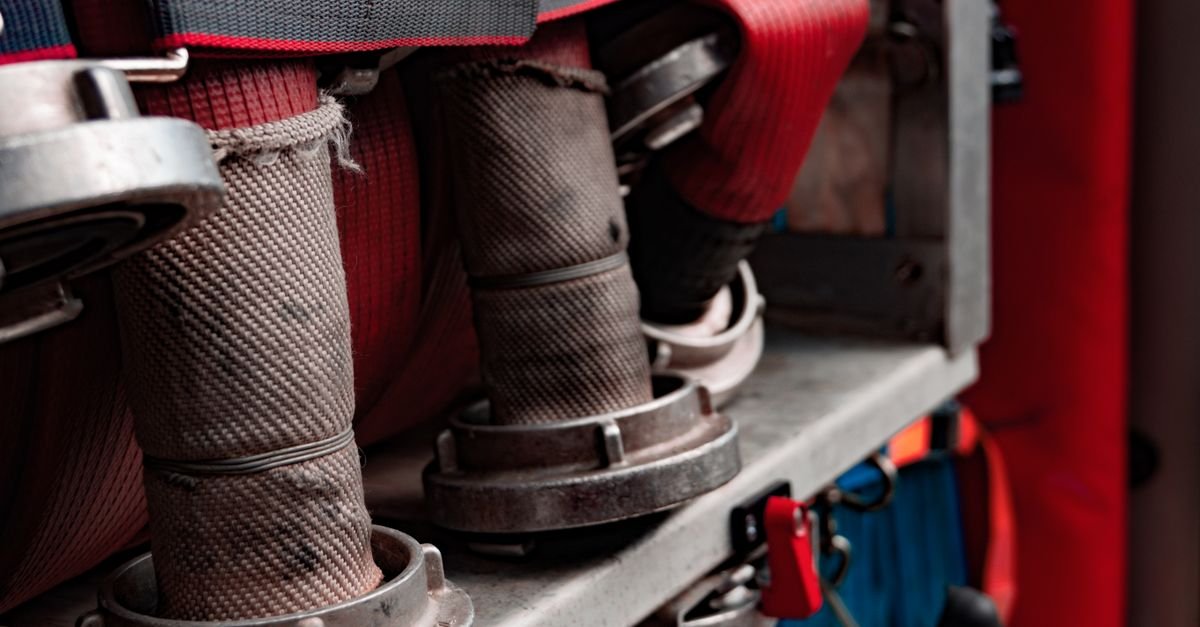
Internal pressure tries to stretch the wall outward, and that is resisted in tension — by braid, by woven yarn, by wire. Fibre in tension is extraordinarily strong, which is why a lay-flat fire hose with essentially no structure of its own holds hundreds of psi and then folds into a suitcase. External pressure does the opposite: it tries to buckle the wall inward, and tension reinforcement contributes almost nothing to that. What resists buckling is hoop stiffness — a wall thick enough and rigid enough to keep its own shape, or a helix running the length of the hose.
The hose industry treats these as separate specifications, and you can read them side by side. Kuriyama’s Tigerflex K Series suction hose is built from a “PVC tube with rigid PVC helix” and publishes a vacuum rating of 28 inches of mercury for every size from 3/4 inch to 2.5 inch (Kuriyama, Tigerflex K Series). Full vacuum is about 29.9 inches, so that hose is rated to be very nearly emptied. Parker’s 811 suction and return line hose gets there differently: its reinforcement is listed as “Multiple layers of fiber spiral and one helical wire,” and it is rated for vacuum service at 25 to 28 in/Hg (Parker Hannifin, Hydraulic Catalog 4400, p. A-30). Note what both constructions have in common and what the braid is doing. The fibre holds the pressure. The single wire or plastic helix holds the shape.
Now go and look for the vacuum rating on a garden hose. I did. There isn’t one, on any consumer hose I could find, because nobody who designs garden hoses expects a pump to be attached to the far end. A garden hose is specified to survive being driven over, left in the sun and stood on. Its ability to stay round with less than atmospheric pressure inside is an accident of how thick the wall happens to be.
Which is why the two hoses that collapse are the cheap flat-walled vinyl one and the old one. Vinyl without a meaningful reinforcement layer has no hoop stiffness to spare when new. And every hose loses stiffness with age as plasticiser migrates out and the wall takes a set — a hose that has been coiled on the same reel for six years is already half-persuaded to be oval.
Two Bores, Three Times the Pressure Drop
If the collapse is caused by the pressure inside falling, then anything that makes the pressure fall faster along the hose makes collapse more likely. That is friction, and friction in a pipe is dominated by one number: the hole.
People assume the relationship is proportional, so a 1/2-inch hose sounds like it should be about 80 percent as good as a 5/8-inch one. It is not remotely that. The Hazen-Williams relation used to build every irrigation friction-loss chart puts pressure loss at a given flow rate inversely proportional to diameter to the power of about 4.87. Run the sum for the two bores you can actually buy:
| Supply hose | Bore | Relative pressure loss at the same GPM |
| Cheap or old 1/2-inch | 0.500 in | about 3x |
| Standard 5/8-inch | 0.625 in | 1x (baseline) |
| Contractor 3/4-inch | 0.750 in | about 0.4x |
Three times the pressure drop, for a bore difference you cannot see from the coupling — because every garden hose in the US ends in the same 3/4-inch garden hose thread regardless of what is behind it. That is the whole game. The pressure at the pump end of a 1/2-inch hose is dropping three times as fast per foot, and the pressure at the pump end is precisely the number that decides whether the atmosphere gets to fold your hose.
Manufacturers set a floor here and it is worth quoting exactly. Pressure-Pro’s operations manual specifies that the supply hose “should be a least 5/8″ diameter and a length at least 15 feet,” and adds that failure to secure adequate water supply “will result in pump damage” (Pressure-Pro, pressure washer operations manual). Five-eighths is not the recommended option. It is the bottom.
So here is the opinion, and it is the one thing in this article that will save you buying the wrong hose twice. Wall thickness is what the packaging sells you and bore is what stops the collapse. A “heavy duty” or “kink resistant” 1/2-inch hose is a thicker jacket wrapped around the same inadequate hole, and you will have paid extra for the part of the problem that was not broken. The thicker wall buys you some hoop stiffness, which delays the fold. The narrow bore is still dropping three times the pressure per foot, which is what created the fold. Fix the hole first, then worry about the rubber around it.
Fifty Feet, a Full Reel and a Hot Afternoon
Length does the same thing as narrow bore, just linearly rather than brutally. Double the run and you double the pressure lost to friction, which brings the pump end that much closer to the point where the atmosphere takes over. Fifty feet of 5/8-inch is the usual published ceiling. A hundred feet of 1/2-inch is a hose that will go flat on a hot day and behave itself on a cool one, which is the most confusing possible failure mode.

There is a minimum too, and the reason is not friction. That same Pressure-Pro manual asks for at least 15 feet because “this 15′ length helps isolate the water supply from pulsations from the pump.” A plunger pump sends pressure ripples back up the inlet, and a short rigid connection has nowhere to put them. A three-foot jumper between the tap and the machine is a worse inlet than a twenty-foot hose, which is not intuitive and is printed in the manual anyway.
Three things make a marginal hose fail on one particular day:
- Coils still on the reel. A hose wound on a drum is a long tight bend, and every wrap adds loss. Worse, the wrap nearest the drum core has the tightest radius and the least support. Pull the whole length off before you start. There is more on drum geometry in hose reel pressure washing.
- Heat. PVC and rubber both soften as they warm, and a dark hose lying on a sunlit patio runs far hotter than the air. The wall that held its shape at 8am is measurably more compliant at 3pm. This is why the same setup collapses in August and not in April.
- Age. A hose that has taken a permanent oval set has already lost the round cross-section it needed. You will see it before you see anything else: a hose that lies on the ground looking slightly squashed when nothing is connected.
The Fold You Cannot See From the Tap
The version of this that wastes the most time is the partial one. The hose looks round for forty-nine feet. At one point, where it crosses a step or curls round a planter, the wall has drawn in and the bore has halved, and from anywhere else in the garden the hose looks completely normal.
You find it by walking the hose, not by looking at it. Start the machine, hold the trigger open, and run a hand along the full length from tap to inlet. A healthy supply hose under flow is firm and round and slightly cool. The fold announces itself as a soft flat patch that springs back the instant you release the trigger, which is the tell that separates it from a kink — a kink stays kinked with the machine off, a collapse does not. That single distinction saves people from replacing a pump.
Two more checks that take a minute between them:
1. Does it come back when you let go? Release the trigger. If the flat section fills out and rounds up immediately, the demand caused it. If it stays flat, it is a kink, a crushed section or a hose with a permanent set.
2. Does it move when you move the hose? Lift the flat spot off the ground and straighten that run. If the fold relocates to the next bend, the hose is generally too soft or too narrow and you are chasing it around the garden. If it always appears at the same spot, that section is damaged.
One boundary worth naming here, because the symptoms overlap and the fixes do not. If the hose is round and firm and the machine is still starving, the restriction is somewhere else in the water path, and the honest way to find out is measurement rather than inspection — that arithmetic, and the bucket test that settles it, belongs to pressure washer not enough water supply. The collapse case is the one where the hose itself is visibly deforming.
Drawing From a Tank Needs a Different Hose Entirely
Everything above assumes mains pressure at the tap, which is doing you an enormous favour you have probably never thought about. Forty or sixty psi of supply pressure is a constant outward push on the inside of the hose wall. It is the reason an ordinary garden hose survives being connected to a pump at all: the tap is holding it open from the inside.
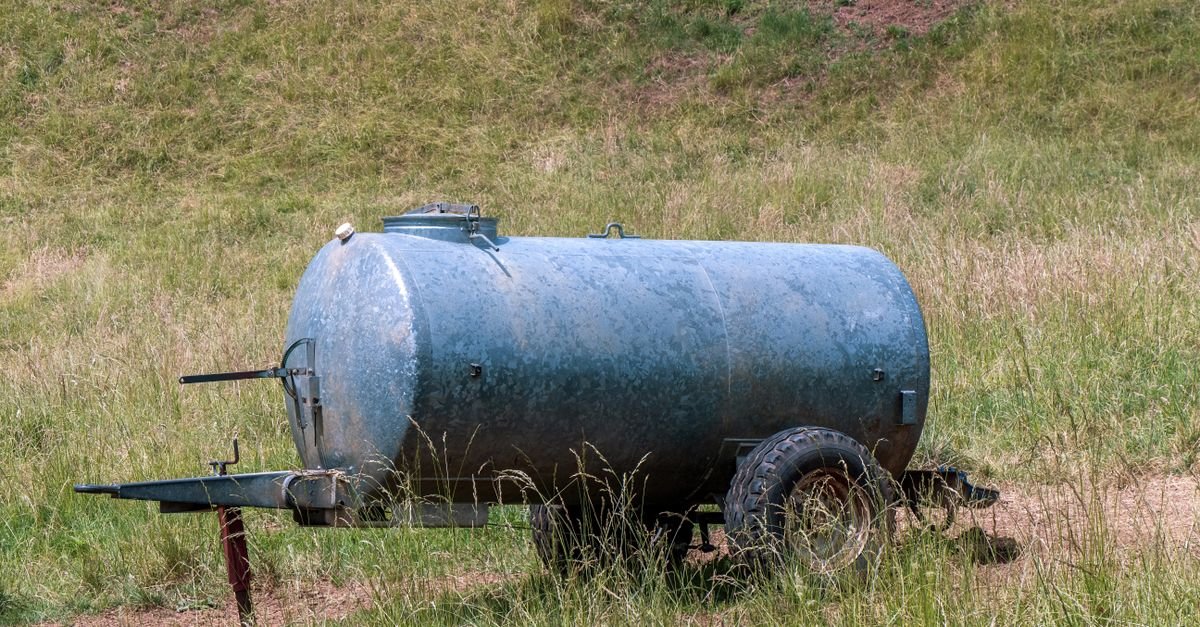
Take the tap away and that support goes with it. A tank, a rain butt or an IBC offers you the static head of the water column and nothing else — a couple of psi at best, and none at all if the outlet sits level with the pump. The inside of the hose is now at roughly atmospheric pressure before the pump has even turned over, so the very first intake stroke takes it negative. This is the one case where an ordinary hose is not marginal, it is wrong, and it is why the machines designed for tank feed ship with a thick ribbed hose that looks absurdly over-built for a garden.
If you are feeding from a tank, buy hose with a published vacuum rating and a helix in the wall — the 25 to 28 in/Hg class quoted earlier, sold as suction hose rather than garden hose. You will know it when you squeeze it, because you will not be able to.
The rest of running from a tank is geometry rather than hose: outlet height above the pump inlet, tank volume against the machine’s GPM, baffles, full-bore fittings. That is all covered where it belongs, in the tank section of pressure washer cavitation. The hose is the part people get wrong first and notice last.
Two Seconds of Flat, and the Pump Is Already Paying
A collapsed inlet hose is not a performance annoyance you can run through to the end of the driveway. The moment the pump cannot fill its chamber, the pressure in that chamber drops far enough for water to boil at whatever temperature it happens to be, and the vapour collapses again on the pressure stroke against the valve seats. That is cavitation, it is a metal-removal process, and the full account of what it sounds like and what it leaves behind is on the pressure washer cavitation page.
The part that belongs here is the timing. The hose goes flat, the machine starts hunting, and most people spend the next thirty seconds pulling the trigger to see whether it clears. It does not clear. Those thirty seconds are the damage.
Worth one sentence of separation, because these arrive at the same search box: a hose that goes flat under demand is a supply-side restriction, whereas a machine that will not prime at all, spits air continuously, or has a stuck check valve is a different fault with a different diagnosis, and a round, firm hose rules the collapse out immediately.
FAQ
Why does my garden hose collapse when the pressure washer is running?
Because the pump is demanding more flow than the hose can pass, so the pressure inside the hose falls below the air pressure outside, and the atmosphere pushes the wall in. The pump is not sucking the hose flat in any literal sense — it is lowering the pressure inside, and the 14.7 psi of air that was always pressing on the outside finally has nothing pushing back.
Can a collapsed inlet hose damage the pressure washer pump?
Yes, and faster than most people expect. A starved pump cavitates, which erodes the valve seats a fraction at a time and does not reverse. The hose itself is unharmed and pops back to round the moment you release the trigger, which is exactly why the damage goes unnoticed — the visible symptom repairs itself and the invisible one accumulates.
What size garden hose stops the hose being sucked flat?
Five-eighths of an inch is the published minimum on most machines and the practical answer for anything up to about 4 GPM. Go to 3/4 inch if the run is over 50 feet or the machine is a big one. A 1/2-inch hose loses roughly three times the pressure per foot at the same flow, which is what sets up the collapse in the first place.
Is my hose kinked or collapsing?
Release the trigger and look at the flat section. A collapse fills out and rounds up immediately, because the thing causing it has stopped. A kink stays kinked with the machine off and the tap running. That one test takes two seconds and separates a hose you need to straighten from a hose you need to replace.
Do I need a special hose to run a pressure washer from a water tank?
Yes. With no mains pressure holding the hose open from inside, an ordinary garden hose goes negative on the first intake stroke. Use hose sold as suction hose, with a helix in the wall and a published vacuum rating — commonly 25 to 28 inches of mercury. Ribbed, stiff and unpleasant to coil is the correct product here.
Will an expandable hose work as a pressure washer inlet?
No. An expandable hose works by having a slack inner tube that stretches when pressurised, which is the opposite of what an inlet needs. It has effectively no hoop stiffness and it relies on internal pressure for its shape, so it is the first thing in the water path to go flat when the pump asks for volume.
Does a collapsing hose mean my tap is faulty?
Not necessarily, and this is where the diagnosis usually forks. The collapse tells you the hose is the narrowest point in the supply, which can be true with a perfectly good tap behind it. Measure the tap’s delivery before you blame it. If the hose is fat, short, round and firm and the machine still starves, then the supply is the problem — otherwise the hose is.
Fatter, Shorter, Laid Flat
Five fixes, in the order they are worth trying. Go up a bore size to 5/8 or 3/4. Cut the run to 50 feet or less and pull every wrap off the reel before you start. Lay the hose out straight rather than dragging it from a pile. Replace anything old, soft or visibly oval, and ignore the word “heavy duty” unless the bore is right. And if the water is coming from a tank rather than a tap, buy actual suction hose, because the tap was doing structural work you had not credited it for.
There is something genuinely pleasing about a fault where the diagnosis is standing in front of you, the physics is sixth-form, and the repair costs less than a tank of petrol for the machine you were about to write off. Go and squeeze your hose.