Last Updated on September 24, 2026 by Umar Farooq
DIY concrete cleaning is worth doing yourself right up to the point where water flow, not effort, becomes the limit — and on a homeowner electric machine that point arrives at roughly 1.6 gallons per minute. Below that line you are the equal of any contractor on a patio, a path or a set of steps. Above it, on a full driveway, you are not slower because you are less skilled. You are slower because you are carrying less water.
That is an awkward thing to be told by a website, because the internet’s standard answer to a grey driveway is to send you shopping. This one is not going to. Most people reading this already own everything they need for the slab they actually care about, and a meaningful number of them should do nothing at all this year.
The Gallon Gap Between What You Own and What the Job Needs
A homeowner electric pressure washer lives in a narrow band: roughly 1,300 to 2,000 PSI at 1.2 to 1.6 GPM. A homeowner gas machine sits at 2,000 to 3,200 PSI and 2.0 to 2.8 GPM. The prosumer and commercial machines that contractors turn up with run 3,200 to 4,400 PSI at 3.0 to 4.0 GPM or more. Those three rows are the entire argument.
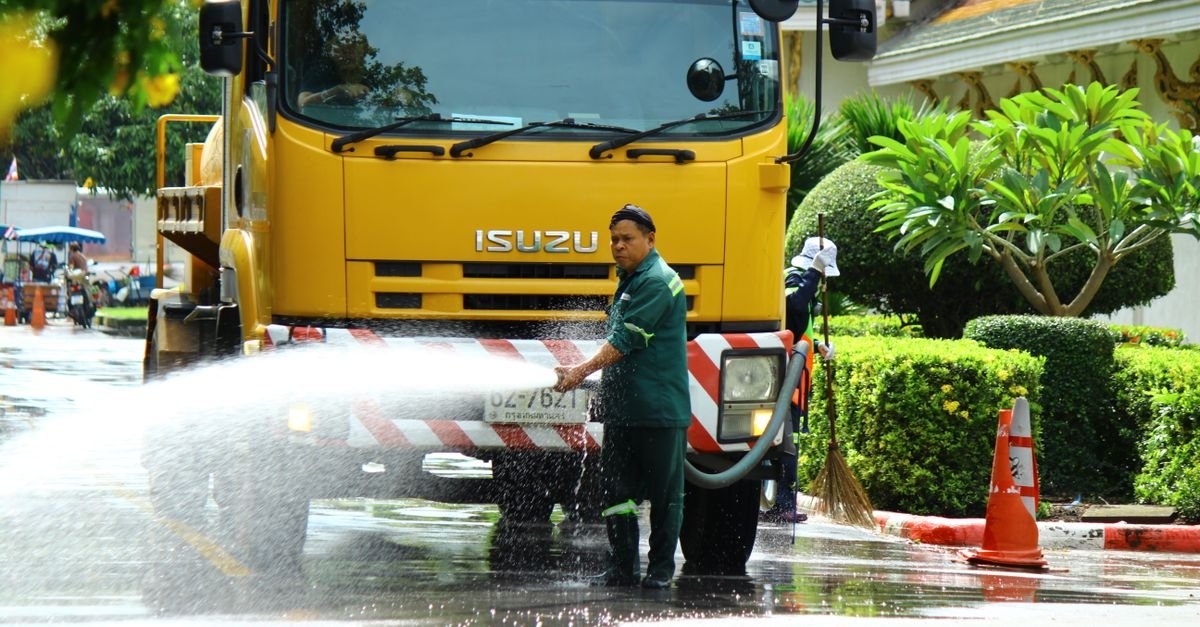
A surface cleaner — the disc on wheels that makes a driveway look professionally done — generally needs around 3 GPM to work properly. You can watch the manufacturers being tactful about this if you read the spec sheets. Kärcher’s 15-inch metal surface cleaner is published as suiting machines from 2,600 to 4,000 PSI and up to 4.0 GPM, and the page lists thirty-four compatible washers. Every one of them has a fuel tank. Manufacturers rarely write “your machine will not run this” in plain words. They publish a list and leave you to notice you are not on it.
Here is the part that decides things, and it is not the PSI number. Pressure is recoverable. If your machine is short on pressure you can close the distance, change the tip, or let a detergent do the loosening while you wait — chemistry and dwell time get you most of the way back. Flow is not recoverable. Nothing you own converts 1.4 GPM into 3.0 GPM. Half the flow means roughly double the passes, and double the passes means becoming acquainted with square feet of your own driveway you have never properly met.
So the honest position, and it is the one this site takes every time: do not buy a gas machine for a driveway you clean once a year. The electric you already own is the right tool for five other jobs and the wrong tool for this one. Buying a second machine to fix a single Saturday is how garages fill up. The full flow argument is laid out in what GPM pressure washer do I need, and the attachment itself gets pulled apart in pressure wash surface cleaner.
How Long Does a Two-Car Driveway Actually Take?
I went looking for a properly measured square-feet-per-hour figure for wand versus disc and did not find one. What exists is marketing copy claiming a multiple, and every one of those multiples traces back to whoever is selling the disc. That is not a source. So instead, here are two numbers from people who have to put money behind their estimate.
The first is the rental counter. Every major hire desk sells pressure washers in four-hour blocks before it sells them by the day. That block is not a rounding convenience. It is the trade’s own estimate of how long a domestic job runs, and they have priced thousands of them.
The second is the contractor’s minimum. Cost estimators put driveway power washing at $0.42 to $0.52 per square foot as of May 2026, with a two-hour minimum labour charge. A standard two-car drive of about 400 square feet lands at roughly $170 to $210, and that two-hour minimum tells you a crew with a 4 GPM machine and a wide disc expects to be there for most of a morning.
Now scale it to what you are holding. A wand cleans the width of fan you can hold steady and even, which is measured in inches rather than feet, and it leaves a seam wherever you overlap badly. A disc cleans its full diameter every pass and cannot stripe, because the bar is spinning. If a professional rig takes two hours, a machine with half the flow and a hand-held tip takes the afternoon — and the technique that keeps the finish even is in how to pressure wash a driveway.
DIY Concrete Cleaning With a Hose, a Brush and Some Patience
This is the section the shopping-led articles skip, and it is the one that applies to most readers. A stiff-bristled deck brush on a long handle, a garden hose with a decent trigger nozzle, a bucket, and a willingness to be bored will clean concrete properly. Not metaphorically properly. Properly.
Where it genuinely works: patios, garden paths, front steps, a garage apron, a landing, a bin store — anything up to about 150 square feet. At that size the machine’s advantage evaporates, because half your time with a pressure washer goes on dragging hoses, finding an outlet and coiling it all back up afterwards. You will have finished brushing the steps before the machine is primed.
Two tool notes worth more than they sound. Use a synthetic or natural bristle brush, never a wire one — wire leaves fine steel filings in the surface texture that quietly rust into a brown bloom over the next few damp weeks, and you have then traded a dirt problem for a stain problem. And warm water carried out from the kitchen tap does more than cold water does. Heat is the one variable a garden hose will never give you, and a homeowner machine does not have it either.
Where the brush stops working is arm hours. A 600 square foot driveway with a decade of biofilm on it is not a brush job. It is four brush jobs spread across a month, and by week three you will have made your peace with the grey.
Rent the Machine or Pay the Contractor?
Now the arithmetic that settles it. Pressure washer rental runs $45 to $136 a day at Lowe’s and $49 to $104 a day at Home Depot, averaging around $90 a day nationally, with a surface cleaner attachment adding $20 to $50 a day on top. Call a properly equipped rental day $110 to $150 once you have the disc, before fuel and before the two trips to the depot.

Against that, the contractor on the same 400 square foot drive is $170 to $210 and you are indoors for it. The gap is about $60 to $100 and one entire Saturday. Put that baldly, renting for a single driveway is close to a wash, and the deciding factor is not money — it is whether you would rather spend the day outside with a machine or spend it not doing that.
What flips it decisively is having more than one surface. The rental day is priced per machine, not per slab. Collect the jobs — the drive, the path down the side, the patio, the garage floor, the front steps, the wall your neighbour keeps mentioning — and do them all between morning and evening, and the same $130 covers work a contractor would quote in the high hundreds. That is the only version of renting that clearly wins.
If you take one number from this section, take the four-hour block. Booking four hours and finishing in three is a better day than booking the machine until six and discovering at half past four that you own considerably more concrete than you thought.
Three Jobs Where Doing It Yourself Is the Wrong Call
Some slabs are not a confidence problem. They are a scope problem, and no amount of care from a homeowner changes the outcome.
Concrete you cannot stand beside on level ground. Balconies, roof terraces, raised walkways, upper-storey landings. A pressure washer wand kicks, the surface underfoot goes slick within seconds of starting, and those two facts combine badly on anything with an edge. Hire it out, or clean it with a mop and a bucket as though it were a floor — which, from a safety point of view, it is.
A slab whose wash water you cannot steer. If the fall of your driveway sends everything into a storm drain, a pond, a vegetable bed or a neighbour’s garage, the practical difference between you and a contractor is not skill. It is that they arrive with berms, mats and a recovery pump, and they carry the paperwork for where the water ends up. That is a genuine reason to pay someone rather than a scare story.
Concrete that is already coming apart. Spalling, popouts, crazing, aggregate showing where it was never meant to show, or paver joints with the sand washed out. Pressure finds every weakness in a slab and makes it larger, and at that point you are not cleaning, you are excavating. Get the surface looked at before anyone cleans it — yours or theirs.
Skip It This Year and Nothing Bad Happens
Here is what nobody selling a machine will tell you: on most driveways, cleaning is cosmetic. Concrete does not mind being grey. Concrete is entirely indifferent to how you feel about it, which is among its better qualities. I went looking for a quantified figure showing that unwashed flatwork fails sooner — a service-life reduction, a maintenance interval from a standards body, anything — and came back with contractor blogs citing one another. If that number exists in the published literature, I have not found it.
There are four situations where it stops being cosmetic and starts being worth either the Saturday or the invoice:
- Something growing has made it slippery. Algae and moss hold water and turn a slope into a hazard, which is a real reason rather than a curb-appeal one. Moss in particular gets a grip on the surface texture and does not rinse off.
- You are selling, letting or photographing the house. Cosmetic is the entire point here, so cosmetic counts.
- You are about to seal or coat it. Nothing bonds to a dirty slab, so this is preparation, not maintenance.
- Something is actively soaking in. A fresh spill has a clock running on it. Grey does not.
If none of those four apply, the correct DIY concrete cleaning plan for this year is to sweep it, look at it from the pavement, and go back inside. That is not laziness. It is the only advice on this page that costs nothing and cannot damage anything.
FAQ
Can you clean concrete without a pressure washer?
Yes, and on anything under about 150 square feet it is often quicker overall. A stiff-bristled deck brush on a pole, warm water and a hose nozzle will clean a patio or a set of steps to the same standard, because at that size most of a pressure washer’s time advantage is eaten by setting the machine up and packing it away again.
Do I need a surface cleaner to clean a driveway?
You do not need one, but you need roughly 3 GPM to run one properly, and most homeowner electric machines deliver 1.2 to 1.6 GPM. Fitting a disc to an underpowered machine breaks nothing — the bar simply turns slowly and cleans a pale, patchy circle. If your machine is electric, plan on a fan tip and more passes instead.
Is renting a pressure washer worth it for one driveway?
Marginally, at best. A day’s rental plus a surface cleaner attachment comes to roughly $110 to $150, against about $170 to $210 for a contractor on a 400 square foot drive. Renting makes clear sense when you have several surfaces queued for the same day, because the rental price does not change and the contractor’s quote would.
How much does it cost to have a driveway professionally cleaned?
Current cost estimators put it at $0.42 to $0.52 per square foot with a two-hour minimum labour charge, which is about $170 to $210 for a typical two-car driveway. Quotes move with access, staining and whether hot water is involved, so treat that as the middle of the range rather than the price.
Will a 1,600 PSI electric pressure washer clean concrete?
It will, with a 15 or 25 degree tip, a detergent applied first and some patience. What it will not do is finish quickly or drive a surface cleaner. Work in overlapping passes and expect it to take considerably longer than the number on the box suggests.
Does dirty concrete get damaged if I leave it?
Not in any way I could find documented. The real arguments for cleaning are slip resistance where algae or moss has taken hold, preparation before sealing, spills that are still soaking in, and appearance. Absent those, leaving it for another season costs you nothing.
Do the Small Slab, Pay for the Big One
The line is not where people expect it. It is not skill and it is not the PSI on the box — it is gallons per minute against square feet, and those two numbers will tell you honestly which side of the decision you are standing on. Under 150 square feet, get the brush out and put the kettle on for a bucket of warm water. Over 400, either collect enough jobs to justify a rental day or let somebody with a 4 GPM machine be there for two hours instead of you being there for six.
And if you are on the drive right now with an extension cord in one hand, doing the sums: the slab will still be there next weekend. It is very good at waiting.