Last Updated on September 26, 2026 by Umar Farooq
Cleaning awning fabric comes down to one question you can settle in about ten seconds — is it a woven acrylic canvas or a coated vinyl sheet — because bleach, pressure and whether you owe it a re-proofing afterwards all follow from the answer.
Most people find that out in the wrong order. The awning gets its first proper scrub in six years, comes up looking magnificent, and then the first real downpour in August arrives straight through it as a fine mist. Nothing broke. The clean worked exactly as designed, and part of what it removed was the finish that had been making the fabric shed water.
That is printed in the manufacturer’s own care instructions, in a sentence most owners never read, because the awning came with the house.
An awning is also the one surface you clean by standing underneath it and looking up, which is the exact posture in which you discover what has been growing on the side you never see.
Cleaning Awning Fabric Begins With Telling Acrylic From Vinyl
There are two genuinely different products sold as awning fabric, and they are not variations on a theme. One is a cloth. The other is a sheet.
Woven acrylic canvas — Sunbrella, Dickson, Recacril — is yarn woven into cloth, with the water repellency added afterwards as a chemical finish. Glen Raven, who make Sunbrella, put it plainly in their awning care sheet: the fabric is “treated with a fluorocarbon finish, which enhances water repellency.” Treated. Not made of. The cloth breathes, which is why sitting under an acrylic awning does not feel like sitting in a tent, and it is also why the repellency is a layer on the fibres rather than a property of them.
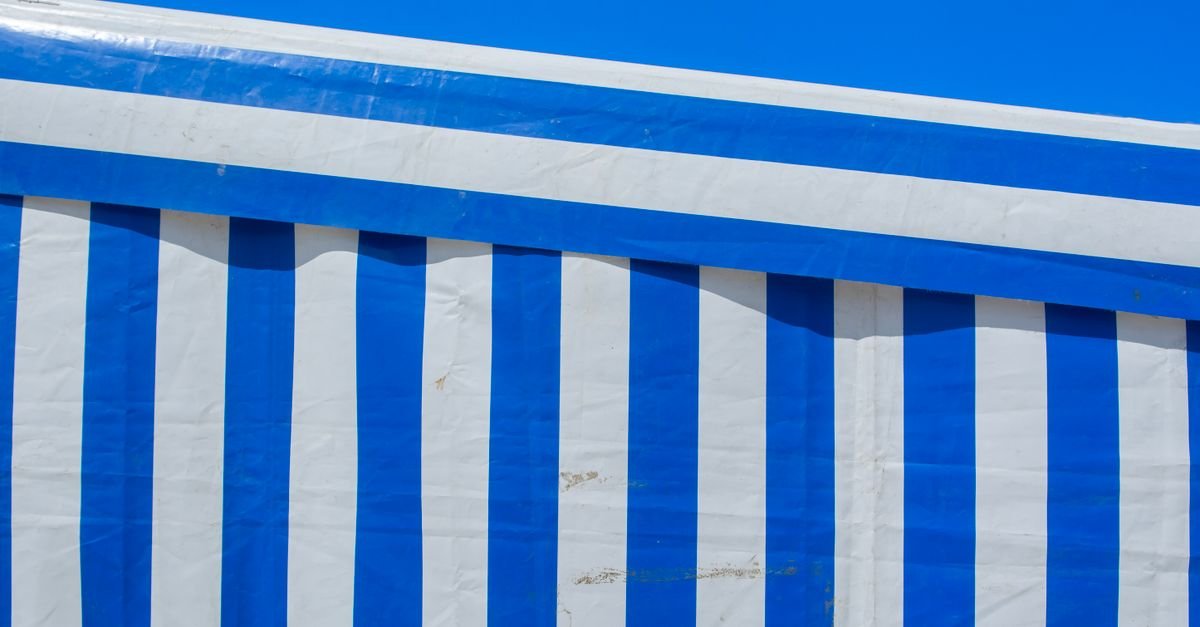
Vinyl, or laminated, or PVC composite is a different object. Herculite, who have been making awning and industrial vinyl for decades, describe the construction as “built around a fabric core” comprising “the base fabric or substrate and a formulated coating.” The strength is the scrim inside; the waterproofing is the coating over it. There is no finish to strip, because the coating is the material.
Three ways to tell them apart, none of which needs a ladder. Hold a corner up to the light — acrylic shows daylight between the yarns, a coated sheet shows a faint grid and no pinholes. Rub it between finger and thumb — canvas feels dry and textured, vinyl feels like a lorry curtain and squeaks. Compare the two faces — acrylic looks like fabric on both, vinyl usually has a fabric-ish back and an obviously smoother front.
There is a second fabric question — whether the colour is solution-dyed through the fibre or printed on one face — and that one decides chlorine on soft furnishings rather than overhead. It is worked through with the test in how to remove mildew from outdoor cushions. Awning acrylic is very nearly always solution-dyed, so it matters far more on a seat pad.
Two other things get sold as awnings. Polyester turns up on cheaper retractables and is usually vinyl-coated, which puts it in the second column. Aluminium and steel awnings are not a fabric problem at all — they are a painted metal panel and get treated like any other coated metal on the house.
The verdict: if light comes through the weave, treat it as acrylic and expect to re-proof it. If it does not, treat it as vinyl and stop looking for a finish that was never there.
Is Bleach Safe on Awning Fabric? Both Makers Say Yes
I opened the Sunbrella awning instructions expecting a prohibition on chlorine and found a recipe.
For mildew and stubborn stains on acrylic shade fabric, Glen Raven publish this: “Prepare a solution of 1 cup of bleach and 1/4 cup mild soap per gallon of clean water,” clean with a soft bristle brush, “allow mixture to soak into fabric for up to 15 minutes,” rinse thoroughly, air dry (Sunbrella, clean Sunbrella shade fabrics). They can publish that because the pigment is inside the fibre and there is no surface dye for chlorine to find.
The vinyl side surprised me more. Herculite’s awning guidance is not a ban either: “If you have a tough stain, try using a blend of 10 percent bleach and 90 percent water,” tested somewhere nobody looks first (Herculite, how to clean vinyl fabrics).
Do the arithmetic and the folklore falls over. A cup per gallon is one part household bleach in sixteen, call it six per cent of the bottle. The vinyl instruction is one part in ten. The fabric that supposedly cannot take chlorine is being given the stronger mix of the two by its own manufacturer.
The same manufacturer does not entirely agree with itself, and I am not going to pretend otherwise: Herculite’s separate page on marine vinyl says “Do not use bleach; this can deteriorate the fabric and its stitching.” Opposite advice, same company, different product page. If you have marine vinyl on a boat, follow the marine page. If you have a vinyl awning over a window, the awning guidance is the one written for your product — and the test patch adjudicates either way.
The casualty is the thread, not the panel
What reconciles those two pages is that both manufacturers point at the same victim. Glen Raven: “Use of bleach and/or advanced age of the fabric application may impact the deterioration of the sewing thread and other non-Sunbrella components.” Herculite name the stitching too.
That matters more than it sounds. An awning is a panel, a binding and a hem held together by polyester thread that is usually not the same material as anything else in the assembly. Awnings rarely fail in the middle of a panel. They fail along a seam, or where the hem is stitched round the front bar, and the repair is a trip to a canvas shop rather than a bucket. Bleach does not dissolve your awning. It quietly ages the one component nobody photographs.
Everything underneath needs protecting too. Sunbrella’s caution is that “bleach may discolor non-Sunbrella fabrics” — on a patio that means the cushions, the parasol and the rug sitting in the drip line. Glen Raven also advise against bleach where the run-off reaches a body of water. Mixing and handling are covered in sodium hypochlorite for pressure washing; the awning-specific part is that everything you own is downhill of one.
The water repellency is a consumable
Here is the sentence to take from the whole page, from that same Sunbrella document: “Retreatment of fabric for water and stain resistance will be necessary after using a bleach solution.”
Glen Raven’s printed awning care sheet is blunter about why. The fluorocarbon finish “is designed to last for several years, but must be replenished after a thorough cleaning,” because a thorough clean “typically removes the original finish and reduces the fabric’s water repellency.” Their re-treatment is 303 High Tech Fabric Guard, two thin coats rather than one heavy one, after a thorough cleaning or after five years of use, 15 ounces covering up to 50 square feet. The current web page softens this to fabrics you “may choose to refresh” and drops the five-year interval while keeping the after-bleach case as a requirement. Both versions are live and you will meet both; the mandatory one is the one that applies the moment you reach for chlorine.
Which gives the one opinion I will defend here. On an acrylic awning the monthly hose-down is the real maintenance, and the deep clean is a repair you pay for twice — once in an afternoon, once in a bottle. Glen Raven’s own schedule agrees: hose monthly with clean water, and “in most environments, a thorough cleaning will be needed every two to three years.” Skip the hose and you buy the deep clean, and the deep clean buys you the re-proofing.
Vinyl owes you none of that. The coating is the product, so there is nothing to replenish. That, not bleach, is the real asymmetry between the two materials. One exception before you generalise, because “coated” is not a brand boundary: Sunbrella Plus carries a coating on its underside, and for that face Glen Raven say the fabric “should only be sprayed and rinsed thoroughly” with bleach rather than soaked.
1,800 PSI and Twelve Inches, on the Vinyl Only
There is exactly one published pressure figure for awning fabric that I could find from anyone who actually makes the stuff, and it belongs to vinyl.
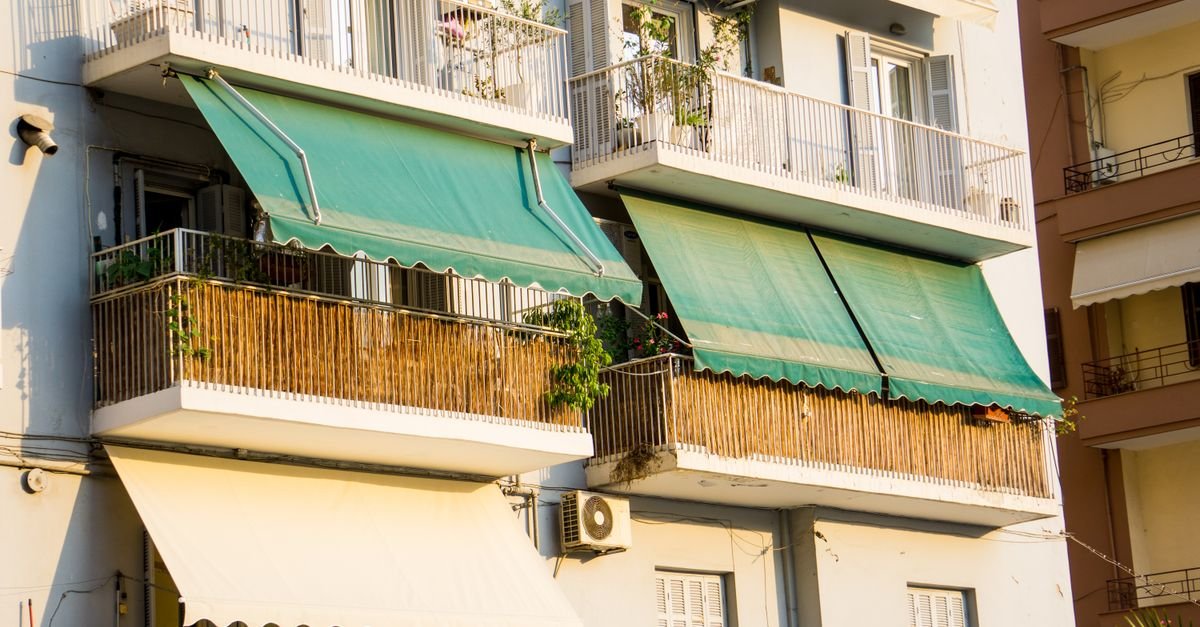
Herculite, on mildew on the underside of a vinyl awning: it “can be removed with a light-duty power washer (maximum 1800 PSI).” Then the distance, and then the consequence, in their words rather than mine: “maintain a minimum safe distance between the nozzle and the fabric surface of at least 12 inches,” because “you will put a hole in the material if you get too close.” I have read a lot of care sheets this year and that is the least ambiguous sentence in any of them.
Read 1,800 PSI as a ceiling, not a permission slip. It is roughly a mid-range electric machine, and it sits below every gas unit sold for driveways — so a 3,000 PSI machine is out of specification before you squeeze the trigger, and the throttle is not the adjustment. What you control is the tip, the distance and how fast you move. White 40-degree tip, well past the twelve inches rather than at it, wand always moving.
On acrylic I went looking for the equivalent number and came back with nothing. No acrylic awning-fabric maker I could find publishes a PSI limit. What Sunbrella publish instead is a method: brush off loose dirt, hose down, soft bristle brush, let the solution soak, rinse, air dry. That is not a prohibition and I will not dress it up as one — but it is the only process offered.
The mechanism argues the same way, and it is what makes an awning different from siding. An awning is unsupported fabric over a frame with nothing behind it. Everything a jet delivers has to be taken up by the panel in tension and dumped into the seams and the bar it is fastened to, because there is no wall to absorb it. Push upward into the middle of a fifteen-foot retractable and you are loading a cantilevered arm in the one direction nobody designed for. On siding the sheathing takes the hit. Up there, the stitching does.
And the growth is on the face you are not looking at. Herculite note that vinyl awnings suffer “dirt, mold, and mildew accumulations on the underside and topside if in a shady location” — the underside being the side that never sees direct sun, never dries quickly, and never gets inspected because you would have to lie down to do it.
The verdict: on vinyl, a light-duty machine at or under 1,800 PSI with a foot of air between tip and fabric, moving. On acrylic, a soft brush and a hose, because that is the only method its maker publishes and the seams are what you would otherwise be testing.
Rolling It Up Wet Is the Failure the Warranty Names
Everything above is about a panel. A retractable awning is a mechanism, and mechanisms fail differently.
The instruction is stated plainly by the people who sell them. Advaning’s owner’s manual for its Luxury Series retractable: “Allow the awning fabric to fully dry before retracting. Doing so will help prevent mildew from growing and prolong the life of the fabric. If you must retract the awning while wet, open the awning as soon as the weather permits.”
Then the part that shows how seriously the trade means it. Marygrove Awning Company’s published ten-year warranty lists what it does not cover, and item thirteen is this: “Mildew, mold or staining caused by the product being rolled up while wet are not covered by this Warranty” (Marygrove retractable awning ten-year warranty). A named exclusion, sitting alongside the usual acts of God. Retracting a wet awning is one of the cheapest ways to void the part of the cover you were most likely to want.
The mechanism is not mysterious. A rolled awning is one continuous panel with every square foot pressed against the square foot beside it, in the dark, wrapped round a cold metal tube, with no moving air anywhere in the assembly.
The third ingredient is the one that changes what the job actually is, and all three sources agree on it. Sunbrella: fabrics “do not promote mildew growth, however, mildew may grow on dirt and other foreign substances that are not removed from the fabric.” Herculite: “Mildew can grow on dirt but won’t attack the vinyl itself.” Marygrove, in the warranty: “Mildew and mold will only form on dirt and dust that have accumulated on the fabric due to a lack of cleaning.” You are not defending the fabric from an organism. You are removing the organism’s food, and the fabric is only where the meal is served.
Three consequences for cleaning day.
Pick a morning. The awning has to be extended, cleaned, and then left extended until it is dry to the touch on both faces. That rules out a late start and any day with rain forecast, which removes most weekends.
Keep water off the ends. The motor lives inside the roller tube, and the tube bearings, arm pivots and cassette end caps sit at the two ends where people habitually park a running hose while they move the ladder. Advaning’s manual says not to handle the plug or motor with wet hands or objects and not to disassemble the motor at all, and Marygrove warrant the motor for five years only where it has been “maintained, operated, used, and stored in accordance with the instructions contained in the owner’s manual.” Water on the fabric, not down the ends.
Stop using it as rain shelter, because it is not sold as one. Advaning are explicit: the awning “is designed to provide protection from the sun and is not intended for rain, snow or extreme wind,” and “the fabric is water repellent and is not intended to protect against the water elements.” Which will be news to everyone who has ever stood under one during a shower feeling rather pleased with themselves.
If the roll already smells and the fabric looks clean, that is a separate problem with its own chemistry — a gas the organism produced rather than the stain it left, and it outlasts both. It is worked through in how to remove mildew odour.
FAQ
Can you pressure wash an awning?
On vinyl, cautiously and within a published limit: Herculite specify a light-duty machine at a maximum of 1,800 PSI with the nozzle no closer than 12 inches, and warn that you will hole the material if you get closer. On acrylic canvas no manufacturer publishes a pressure figure at all, and the method every one of them does publish is a soft bristle brush and a garden hose. The fabric is unsupported over a frame, so a jet’s whole force ends up in the seams.
What is the best cleaner for awning fabric?
Mild soap and water, applied with a soft bristle brush and left to soak in before rinsing. Sunbrella name Woolite or Dawn as examples and specify no detergents for light cleaning on acrylic; Herculite specify a light non-detergent soap for vinyl. Both warn off harsh chemicals, and the vinyl guidance also rules out solvents and anything abrasive. Rinse until no soap residue remains — leftover surfactant holds dirt, and dirt is what the next colony comes for.
Will bleach ruin my awning?
Not the fabric, on either material; both makers publish a bleach mix. What bleach ages is the sewing thread and the non-fabric components, which is where awnings actually fail, and on acrylic it removes the water-repellent finish so re-treatment becomes necessary rather than optional. Test a hidden corner, protect whatever sits underneath, and rinse until all of it is gone.
Do I have to re-waterproof my awning after cleaning it?
On woven acrylic, yes after a thorough clean and definitely after bleach — Sunbrella state re-treatment “will be necessary after using a bleach solution,” and Glen Raven recommend 303 High Tech Fabric Guard in two thin coats. On vinyl, no. The coating is the material rather than a finish laid over it, so there is nothing to replenish.
How do you clean the underside of an awning?
Same solution, same brush, working in sections — and it matters more than the top, because the underside stays shaded and dries slowest. Expect the growth to be worse there. On a retractable, extend it fully first so the panel is flat and reachable, and do the underside before the top so run-off lands on fabric you have not finished with yet.
How often should an awning be cleaned?
Glen Raven’s published schedule for acrylic is a hose-down with clean water monthly, which stops dirt becoming embedded, with a thorough cleaning needed every two to three years in most environments. Herculite recommend occasional seasonal cleaning for vinyl. The monthly rinse is what decides the other, and it is the difference between ten minutes and an afternoon plus a bottle of re-treatment.
How do I get bird droppings off an awning?
Not dry, and not with the wand as the opening move. A dried deposit has to be softened before anything will shift it, and hitting it dry with a jet scatters it instead of lifting it — the wetting sequence, and why a hose nozzle is already too aggressive, are in removing bird droppings. On an awning: soften, then a grease-cutting dish soap and a soft brush, then rinse, from a position where the run-off is not going down your sleeve.
How do you clean an RV awning?
As vinyl, in almost every case, with the rig level so the panel extends fully and can be left out to dry. The rolling-up-wet rule is the whole ballgame on an RV, because the awning gets retracted to a schedule set by the drive home rather than by the weather. If you cannot dry it before you leave, extend it at the other end at the first dry opportunity.
Hose It Monthly, Dry It Before It Rolls
The two facts that decide everything here are dull and both printed. Mildew does not eat awning fabric — it eats the dirt that lands on it, and all three manufacturers say so in nearly the same words. And on acrylic, the repellency keeping the fabric dry is a finish rather than a property, so the harder you clean the more of it you take off.
Put those together and the job stops being an annual event and becomes a habit: ten minutes with a hose once a month, one honest deep clean every couple of years with a soft brush and a mild soap, a bottle of re-treatment on the shelf for after you have used bleach, and the discipline to leave a retractable out until the far side of the panel is dry.
Treating bleach as the routine and the monthly rinse as optional is the expensive way round. Both makers publish a bleach mix, and both say what it takes with it — the water-repellent finish on acrylic, and the sewing thread holding the panel together. The thread goes long before the fabric does, and re-stitching a fitted panel is a workshop job rather than a Saturday one.