Last Updated on September 23, 2026 by Umar Farooq
A garden hose high pressure washer setup only works in one direction: the hose feeds the machine, and the machine makes the pressure. Get the feed right — 5/8-inch bore, somewhere between 25 and 50 feet, delivering more gallons per minute than the pump is rated to pass — and the machine performs to its badge. Get it wrong and you slowly destroy a pump. Going the other way, hanging a nozzle on the hose and expecting 1,300 PSI, does not work at all, and the reason is arithmetic rather than opinion.
Both of those questions arrive at this page wearing the same three words, so this covers both. First the five things that actually matter on the inlet side. Then the attachment aisle, which deserves a straight answer nobody selling the attachment is going to give you.
What Your Machine Actually Drinks at the Inlet
A pressure washer is a positive displacement pump. It moves a fixed volume of water per revolution whether or not that water is there. It does not throttle back politely when the supply thins out — it keeps trying, and whatever it cannot get in water it gets in air.
So the inlet number that matters is flow, not pressure. Kärcher publishes the requirement for its electric range plainly: a water flow of 4 gallons per minute at a minimum of 40 PSI, through a garden hose of 5/8 inch or larger diameter and 50 feet or less in length (Kärcher, electric pressure washers FAQ). Note the shape of that spec. The pressure figure is a floor barely above what any working tap produces. The flow figure is more than double what a typical electric machine actually sprays.
That gap is deliberate. It is headroom.
| Machine class | Rated output | Tap flow to aim for | Minimum hose bore |
| Electric, homeowner | 1,300–2,000 PSI at 1.2–1.6 GPM | 3 GPM | 5/8 inch |
| Gas, homeowner | 2,000–3,200 PSI at 2.0–2.8 GPM | 4 GPM | 5/8 inch |
| Gas, prosumer | 3,200–4,400 PSI at 3.0–4.0+ GPM | 5–6 GPM | 3/4 inch |
The supply has to beat the machine’s rated GPM with room to spare, because flow at the tap is not constant. Someone flushes a toilet. The irrigation zone kicks in. The hose warms up and softens. If you are sitting at exactly the pump’s rated flow on a good day, you are below it on a normal one. Sizing the machine to the tap rather than the other way round is covered in what GPM pressure washer do I need, and if the honest answer is that your tap cannot keep up at all, a buffer tank is the fix — see pressure washing water tank.
Bore Beats Brand: 5/8-Inch Against 1/2-Inch
Every garden hose sold in the US ends in the same 3/4-inch garden hose thread. The coupling is identical on a 1/2-inch hose and a 3/4-inch hose, which means the fitting in your hand tells you precisely nothing about the hole behind it. The bore is printed on the jacket, or it is printed nowhere, and you find out by looking down the end.
Here is why it matters more than it sounds. A 1/2-inch bore has a cross-section of 0.196 square inches. A 5/8-inch bore has 0.307. That is 56 percent more room before you account for anything else.
Then account for something else. Water in a hose loses energy to friction against the wall, and a narrow hose has proportionally more wall for the water it carries. Standard pipe-flow relations put flow at a fixed pressure drop somewhere near the 2.6 power of diameter, which works out at roughly 80 percent more water through 5/8 inch than through 1/2 inch over the same run at the same tap pressure. The extra flow is not 56 percent. It is closer to double.
A half-inch hose is a lawn-watering hose. It is very good at tomatoes. It is not a supply line, and if it is the hose currently feeding your machine, that single swap will do more for your cleaning speed than any nozzle you buy this year. Three-quarter inch only starts to earn its weight and its price above about 4 GPM, or on runs past 50 feet, where the friction penalty grows faster than most people expect. Pressure washer low pressure carries the full flow-versus-length table if you want to see where your own run lands.
One thing to keep straight: this is the *inlet* hose, the soft one running from the tap. The stiff braided one between the pump and the gun is a different component with different rules, and it is covered in pressure washing hose.
There Is a Minimum Hose Length, Not Just a Maximum
Every article on this subject tells you to keep the supply hose short. Manufacturers do not entirely agree, and this is the detail that surprised me most while reading through their documentation.
AVA states it outright in its water supply guidance: “a pressure washer must have a minimum garden hose length of 7.5 meters” — about 25 feet — and separately caps inlet pressure at 7 bar, roughly 100 PSI (AVA, water supply requirements).
A minimum. On a component everyone treats as a necessary evil.
The reasoning is that a length of flexible hose is a shock absorber. A pump does not draw water smoothly — it draws in pulses, one per plunger per revolution, and its unloader valve slams flow around every time you release the trigger. Couple that directly to a rigid mains connection through a three-foot whip and those pulses have nowhere to go but back up the pipe. Twenty-five feet of soft hose swells microscopically with each pulse and gives it somewhere to land.
The inlet pressure cap is the other half of the same thought. US plumbing codes require a pressure-reducing valve above 80 psi static (IPC 604.8), so most homes sit comfortably inside the limit. Houses below a booster pump, or with a PRV that quietly failed some years ago, do not. If your outside tap makes the hose go rigid as a broom handle, measure it before you blame the machine.
The usable window, then: not less than 25 feet, not more than 50.
Kinks, Screens and the Missing Rubber Washer
A kink is not a partial restriction. For as long as it holds, it is a closed valve, and the pump on the other end has no way of knowing that. Lay the hose out flat before you start rather than pulling it straight from a pile, because a hose under flow will find its own kink the moment you walk away from it.
The rest of the inlet path is less obvious and just as capable of starving a pump:
Flow-stop and aquastop couplings. These clever connectors shut off automatically when you unclip the hose. AVA’s guidance says plainly that you cannot use aquastop with its machines, and the reason generalises: the internal check mechanism is a restriction sitting directly in the path of the thing that needs the most water in your garden. Take it off for pressure washing.
Y-splitters and inline valves. A brass Y with both legs open does not give you two full-flow outlets. It gives you one tap’s worth of water divided by two, and the pressure washer is only getting half of the thing it was already short of.
The coupling washer. A flattened, cracked or missing rubber washer in the hose end leaks, which costs you flow and soaks your shoes. Plastic couplings are worse than brass here — they crack around the seat, and once the seat is deformed a new washer will not seal it. This is a fifty-cent part that people replace with a wrap of tape and a shrug.
The inlet screen. Behind the hose connection on the machine is a small mesh filter catching grit before it reaches the pump. It clogs. A machine that suddenly gets nothing through a hose that visibly runs fine is very often a blocked screen, and that whole diagnostic path is in pressure washer no water coming out.
Sun on a black hose. Most cold-water machines cap inlet temperature at 40 degrees C, about 104 F. Fifty feet of dark hose lying on a hot driveway can beat that easily. Run it off into the grass for twenty seconds before connecting.
Starve the Pump and It Starts Eating Itself
When the pump cannot fill its chamber with water, it fills it with vapour instead. Those vapour pockets do not stay pockets. As they move into the high-pressure side of the stroke they implode, and each implosion is a microscopic hammer blow landing on the same valve seats and cylinder walls, thousands of times a minute. The pump is machining itself from the inside using its own water. That is cavitation, and it does not announce itself with a bang — it announces itself with a rattle like gravel in a tin, a pressure gauge that surges, and a machine that feels tired six months later.
Here is the part that turns this from a maintenance note into the one strong opinion in this article. Most homeowner machines use an axial wobble-plate pump, which is sealed and was never designed to be rebuilt. When its valves go, the pump goes, and the pump is most of what you paid for. So the inlet hose is not an accessory. On a sealed-pump machine, a 5/8-inch supply hose is the cheapest insurance you will ever buy for it — it costs a fraction of a replacement pump head and it is the only part of the water path you fully control. Buy the hose before you buy anything that screws onto the gun.
If your machine is already surging, fading or rattling, work the supply chain in order before you touch the unloader — the full sequence is in pressure washer low pressure.
Can a Garden Hose High Pressure Washer Attachment Replace the Machine?
Search this phrase and half the results are products rather than answers: hydro jet wands, turbo jet tips, brass twist nozzles, all sold under some version of “turn your garden hose into a pressure washer.” The listings quote figures. A 40 to 60 PSI hose, they say, becomes 250 PSI with the attachment fitted.
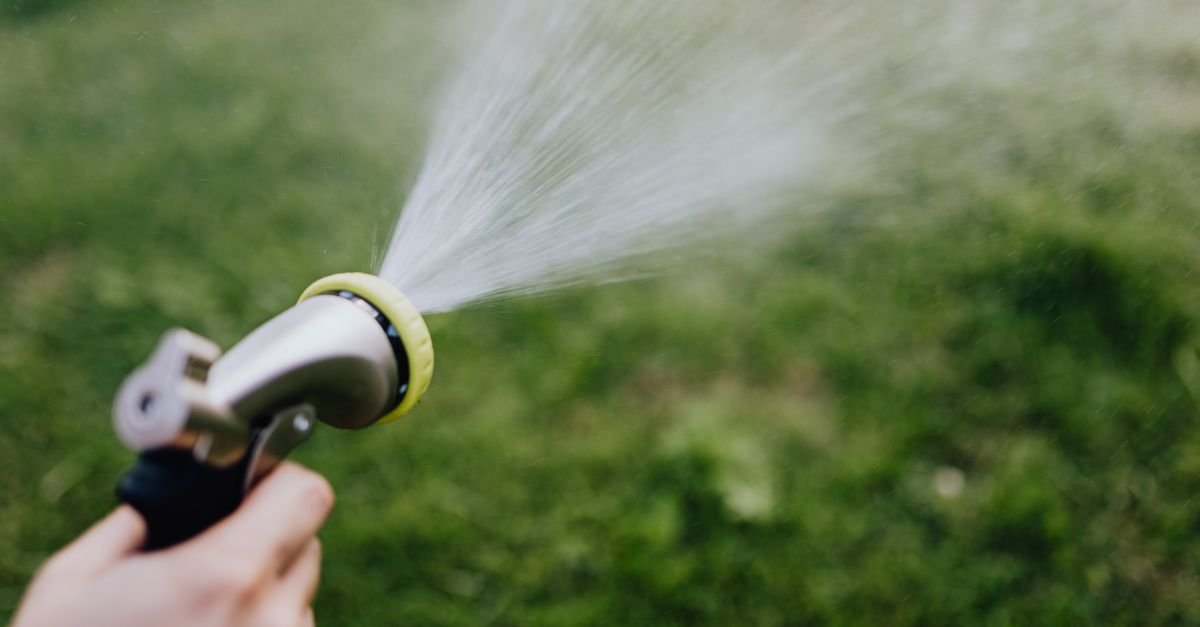
No. And the useful thing is that you do not have to take my word for it or anyone’s product review, because the claim fails on physics before it ever gets to performance.
“Turn your hose into a pressure washer” is a sentence with a missing pump. (The pump is the part doing the turning. It is also the part the attachment does not have.)
A Nozzle Cannot Make Pressure That Was Never There
Water leaving a tap carries a fixed amount of energy. A nozzle narrows the exit, and narrowing the exit trades pressure for speed — the stream gets faster, and the pressure inside the stream drops by exactly the amount the speed gained, minus whatever friction takes. Energy is conserved, not created. That is Bernoulli’s principle, and NASA’s Glenn Research Center has the clearest short explanation of it I have found (Bernoulli’s Equation).
Now follow the jet to the wall. When it hits and stops, that speed converts back into pressure. The ceiling on what it can convert back to is the pressure it started with. A 55 PSI tap can put at most 55 PSI on the siding, whatever is screwed onto the hose. A nozzle can only spend the energy in the water. A pump adds energy that was not in the water before.
The velocity numbers make the gap concrete, and they are not intuitive. Jet speed scales with the square root of pressure, so:
| Source | Pressure | Jet speed leaving the tip | Relative impact force |
| Garden hose | ~55 PSI | ~62 mph | 1x |
| Electric machine | ~2,000 PSI | ~370 mph | ~36x |
Thirty-six times the pressure buys six times the speed. Water is stubborn about that. But impact force tracks pressure rather than speed, so a modest-looking six-fold speed difference lands as a thirty-six-fold difference in force against the surface — which is the entire reason one of them strips paint and the other one does not.
What a good hose nozzle genuinely does is concentrate the same gallons into a tighter, straighter stream so more of your water arrives on a smaller patch from further away. That is a real improvement, and a firefighter-style nozzle is worth owning. It is a better hose nozzle. It is not a pressure washer, and no arrangement of brass on the end of a 55 PSI supply will make it one.
One practical caution while you are there: a restriction nozzle holds full mains pressure behind it whenever it is closed. On a twenty-year-old hose with sun-cracked ends, that is where the failure happens. Check the hose before you fit the shiny thing to it.
What 40 to 60 PSI Genuinely Cleans
None of this makes the garden hose useless. It makes it honest. Mains pressure handles anything held on by nothing much:
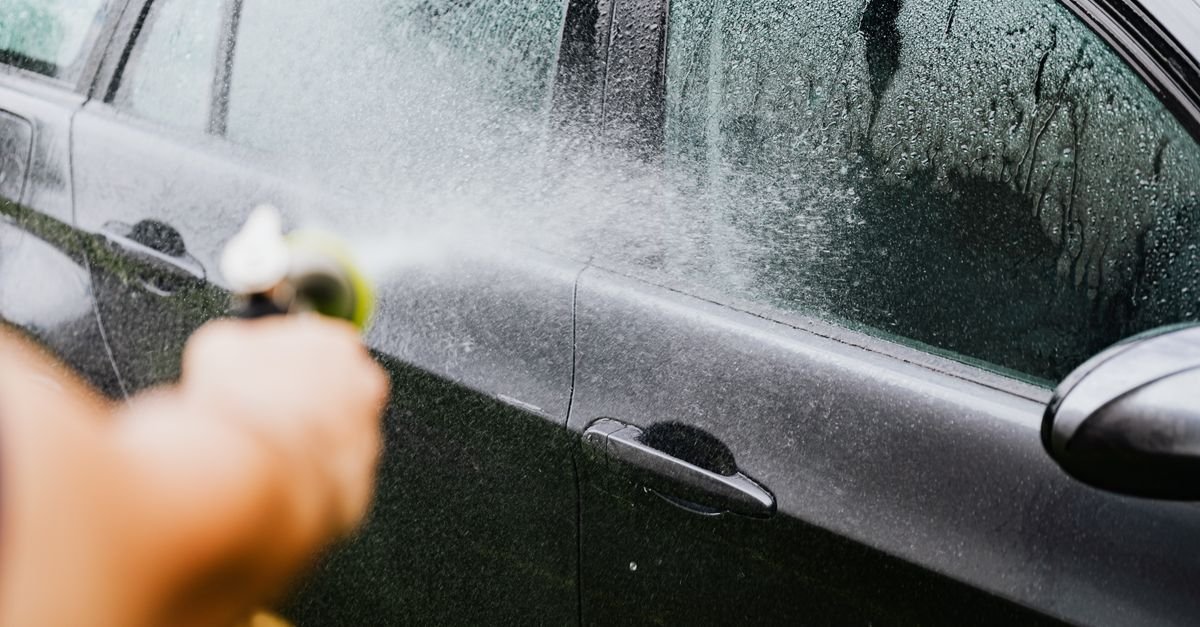
- Rinsing pollen, dust and road film off a car, before and after the wash mitt
- Garden furniture, plastic and resin, once the detergent has done the work
- Windows and glazing, which should never see a pressure washer anyway
- Fresh bird mess, before it has time to etch
- Flowerpots, tools, muddy boots, bins
- Clearing leaves and loose grit off a patio
What it will not touch: algae and biofilm rooted into the pores of concrete, oil stains that have soaked into slab, chalky oxidation on old siding, moss anchored between pavers, or paint of any age.
For those, the substitute for pressure is not a cleverer nozzle. It is chemistry and patience — the right detergent applied with a pump sprayer, five to ten minutes of dwell without letting it dry, then a rinse at whatever pressure you have. That is soft washing, it is what professionals use on surfaces too fragile for a machine, and it works at garden hose pressure by design rather than by hope. If you do not own a pressure washer and were hoping an attachment would stand in for one, a pump sprayer and a suitable cleaner will outperform it on every surface that actually needed cleaning.
FAQ
Can I use a regular garden hose with a pressure washer?
Yes, and that is exactly what a pressure washer expects. A standard 5/8-inch hose with good couplings and no kinks is the correct inlet. What you cannot do is run the high-pressure output through a garden hose — that side needs rated high-pressure hose, because a garden hose will burst well below the pump’s working pressure.
What size garden hose is best for a pressure washer?
5/8 inch for anything up to about 4 GPM, which covers essentially every homeowner machine. Kärcher specifies 5/8 inch or larger for its electric range. Move to 3/4 inch above 4 GPM or when the run goes past 50 feet, where friction losses start to bite.
How long can the garden hose be for a pressure washer?
Keep it to 50 feet or less, and keep it to at least 25 feet. The maximum protects flow; the minimum gives the pump’s pulsations somewhere to go. If you need to reach further, extend the high-pressure hose rather than the supply hose.
Do garden hose pressure washer attachments actually work?
They work as nozzles, not as pressure washers. They concentrate your existing flow into a faster, tighter stream with better reach. They cannot exceed your house’s supply pressure, so claims of 250 PSI from a 55 PSI tap describe something that is not physically happening.
How much PSI does a garden hose put out?
Whatever your house supplies, typically 40 to 60 PSI. US plumbing codes require a pressure-reducing valve above 80 psi static, so that is a practical ceiling for most homes. A pressure washer starts at roughly 1,300 PSI, which is about twenty-five times more.
Can I join two garden hoses together to reach further?
You can, but every extra coupling is a small step change in diameter and another washer to leak past, so two 25-foot hoses joined flow slightly less than one continuous 50-foot hose. Keep the total inside 50 feet and use brass couplings at the join.
Will a kinked garden hose damage my pressure washer?
It can. A kink cuts supply while the pump keeps trying to move its rated volume, and a pump running short of water cavitates. Brief kinks are survivable. Repeated ones wear valve seats and shorten the life of a pump you cannot rebuild.
Buy the Hose, Not the Nozzle
Two questions, one honest answer between them. If you own a machine, the supply hose is the cheapest part of it and the one most likely to be quietly ruining the expensive part — 5/8 inch, 25 to 50 feet, laid flat, with a brass coupling and a washer that is actually in there. If you do not own a machine, the attachment aisle will sell you speed and call it pressure, and your siding can tell the difference even if the packaging cannot.
Go and look down the end of the hose you already own. If you can see daylight through something the width of a pencil, that is your afternoon explained.