Last Updated on September 25, 2026 by Umar Farooq
A car cleaning jet wash is safe at 1,200–1,900 PSI with a 25- to 40-degree tip, and the order of operations matters more than the machine: wheels, pre-rinse, foam, dwell, contact wash, rinse, dry. Get the order wrong and a perfectly good machine will put fine scratches into your paint that no amount of pressure will take back out.
“Jet wash” is the British word for what Americans call a pressure washer, and also for the coin-operated bay behind the petrol station. Whichever you are standing at, the physics are identical and so is the mistake almost everybody makes: treating the lance as the thing that cleans the car. It is not. It is the thing that carries dirt away after something else has already let go of it.
Car Cleaning Jet Wash in Eight Steps
The whole procedure, before I explain any of it.
1. Park in shade. A hot panel dries foam and water before you can rinse either.
2. Wheels and arches first, with their own bucket, brush and cleaner. They are about to contaminate everything you touch afterwards.
3. Pre-rinse top down at 1,200–1,900 PSI, 40-degree tip, around 18 inches back.
4. Snow foam bottom to top, dwell 5–10 minutes, never let it dry.
5. Rinse the foam off, top down.
6. Contact wash with two buckets and a clean mitt, roof first, straight lines, rinsing the mitt after every panel.
7. Final rinse top down, then open the doors, boot and fuel flap and rinse the shuts.
8. Dry immediately with a plush towel, before the water dries itself and leaves the minerals behind.
Roughly forty minutes. The lance is in your hand for about twelve of them, which is the point of the whole article.
Touchless or Contact Wash: Which Does Your Car Need?
This is the first real decision and most guides skip past it.
A touchless wash is jet wash and chemistry only — pre-rinse, foam, dwell, rinse, dry, and nothing ever physically touches the paint. A contact wash adds the mitt. Both are legitimate; they are not interchangeable.
Go touchless when the car was washed within the last fortnight and carries dust rather than bonded film; when the paint is black or dark blue and shows swirls under every streetlight; or when it is winter and you mainly want road salt off the arches and underside.
Go contact when there is a tide line of road film along the lower doors that survives a foam and a rinse, or when anything organic has been on the paint for more than a day. Bird lime, tree sap and dead insects are bonded, not resting, and no amount of fan spray is going to persuade them.
The honest trade-off: touchless gets you 80 to 90 percent clean with essentially no risk of putting a scratch in. Contact gets you to 100 percent and carries whatever risk your technique deserves. Almost every swirl mark in the world was installed by a person holding a sponge, not by a jet of water.
Setting Up: Pressure, Tip and a Patch of Shade
The published safe window for cars and vehicles is 1,200–1,900 PSI with a 25- to 40-degree tip. Manufacturers land in the same territory from the other direction: STIHL’s car washing guidance puts the working range at 80 to 200 bar, roughly 1,150 to 2,900 PSI, and Kärcher’s car washing know-how tells you to keep at least 30 centimetres between nozzle and paint.
If your machine says 2,700 PSI on the side, you are not automatically over the limit. That figure is measured at the orifice with the correct tip fitted. What lands on your door is far lower, because a 40-degree fan spreads the flow across a wide sheet and distance bleeds the rest. Distance is the pressure dial you already own.
On tips I will be brief, because the full vehicle breakdown lives in pressure washer nozzle for car. Black for soap, white 40-degree for paint and glass, green 25-degree for wheels and arches only, red and turbo stay in the bag. The wider surface-by-surface reasoning is in what PSI pressure washer do I need.
Two details that are not about the machine at all. Shade is not a preference — a hot panel flash-dries snow foam into a film harder to remove than the dirt you started with. And where the water goes matters: a driveway drains to a storm drain, which usually runs to a river rather than a treatment plant. The EPA lists residential runoff as a nonpoint source of urban pollution precisely because it arrives untreated. Washing on grass or gravel is the better habit, and an easy way to find out whether your lawn was level.
The Pre-Rinse Is Not Optional and Not Quick
The pre-rinse is the most protective step in the whole wash, and almost everybody rushes it into thirty seconds.
Its job is to remove the loose grit — sand, brake dust, road salt crystals — before anything soft touches the paint. Every one of those particles is harder than clear coat. Trap one under a wash mitt, drag it two feet along a door, and you have made a scratch that will still be there when you sell the car.
So: 40-degree tip, 18 inches back, working top down. Roof, glass, bonnet and boot, then the upper flanks, then the lower doors and sills last, because they are filthiest and you do not want that water running back over clean paint. Give the arches and the lower quarter noticeably longer than feels necessary.
Keep the lance moving, and never hold it square-on to a panel edge, a badge or a rubber trim strip. Water going straight at a gap finds its way under things. Held at a slight angle, it runs across them.
Budget three or four minutes. Anything that leaves during the pre-rinse is dirt that never had to meet your mitt.
Snow Foam, Dwell, and the Sin of Letting It Dry
Here is my one strong opinion, and it applies to every jet wash on earth: the lance does not wash your car, it rinses it. At a paint-safe 1,200–1,900 PSI spread across a 40-degree fan at 18 inches, there is not enough impact force to shear bonded road film off a panel — but there is plenty to drive grit sideways into clear coat if grit is present. The cleaning is done by surfactants, which lift the film chemically, and by a mitt, which lifts what the surfactants loosened. Pressure is what people reach for because it feels productive.
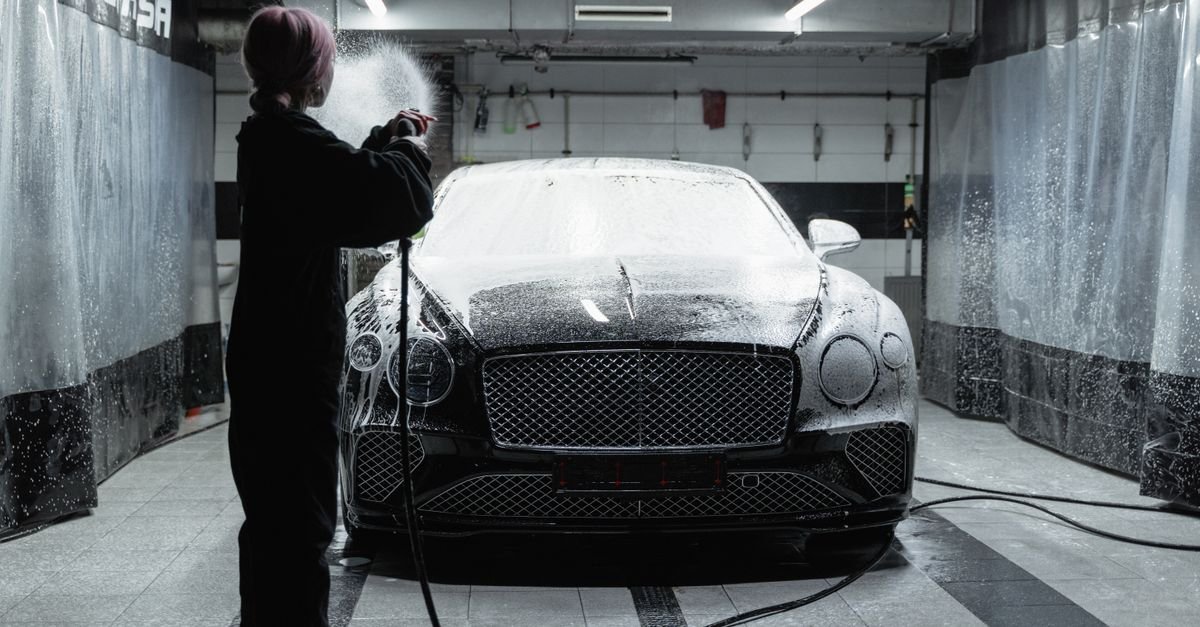
So the foam step is the wash. Treat it that way.
Apply bottom to top. Counter-intuitive and correct: foam applied upward cannot run down over dry paint and leave a streak that then sets. Rinse in the opposite direction.
Dwell for five to ten minutes. That is the working window for pressure washer detergents, and the one number people refuse to honour, because standing next to a foamy car doing nothing feels like a waste of a Saturday. It is not. That is the surfactant breaking the bond between film and paint, which is the only part of this process that actually cleans anything.
Never let it dry. A dried surfactant film is a new contaminant and can mark clear coat on a hot panel. If the foam goes matte and patchy at the edges, mist it or move to shade.
On applicators, a cannon runs off the lance and makes thick clinging foam, a gun runs off a garden hose and makes thinner foam — the full comparison is in foam cannon vs foam gun. Thickness mostly buys dwell time rather than cleaning power, which is why thin foam left on for eight minutes beats thick foam rinsed off after two.
Wheels First, and Never With the Paint Mitt
Wheels first, not last. This is the one sequencing question that genuinely splits guides, and “first” wins on contamination grounds.
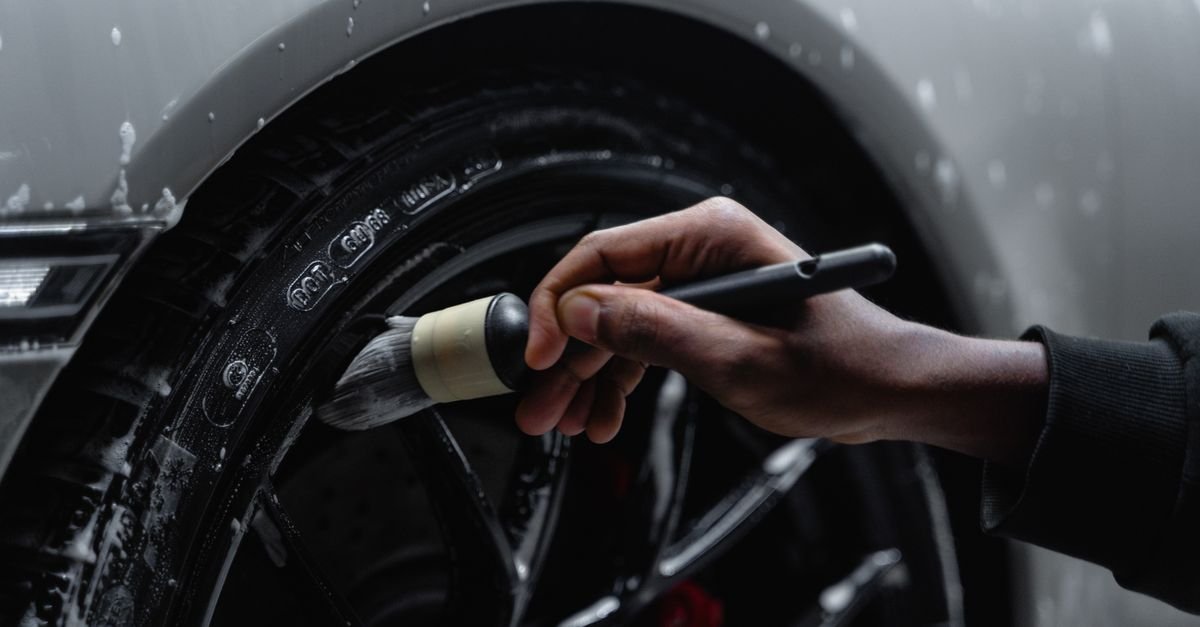
Brake dust is not dust. It is iron particles thrown off a disc hot enough to weld them onto whatever they land on. Cleaning wheels last means you have a spotless car and are now spraying iron-laden water and brush splatter across panels you just finished. First means all of that lands on a car about to be pre-rinsed and foamed anyway.
1. Green 25-degree tip, about 12 inches away, rinse the loose layer off the face, the barrel and the arch liner. Keep the green tip below the sill line. It is a different tool from the white tip, not a stronger version of it.
2. Dedicated wheel cleaner, then leave it for the five minutes it asks for. Iron removers need dwell exactly like snow foam does.
3. Agitate with a wheel brush and a barrel brush. A wheel brush is the cheapest upgrade in car cleaning, and nobody buys one until they have already ruined a mitt.
4. Rinse, again from about 12 inches.
Two warnings. Lacquered and powder-coated alloys have a finish of their own, and holding the jet still on one spot will cloud it. And whatever touched the wheels — brush, bucket, towel — does not go near paint for the rest of its life. A bucket that has held brake dust is a bucket full of abrasive.
The Contact Wash: Straight Lines and Two Buckets
If you decided the car needs contact, this is where the jet wash goes down and stays down for a while.
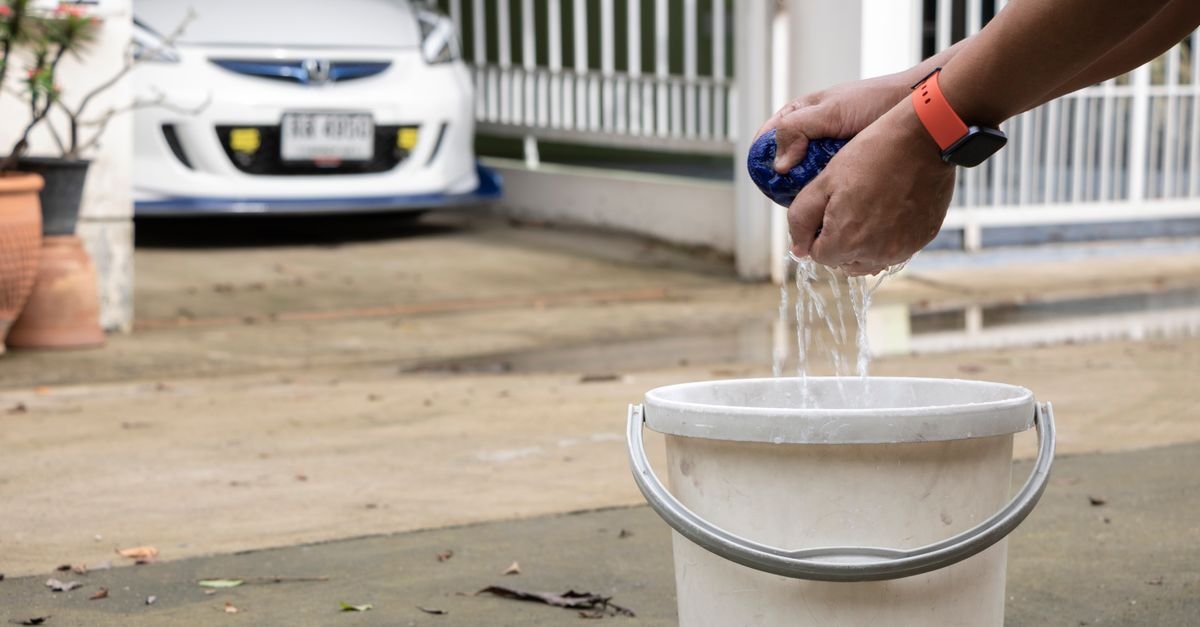
Two buckets. One shampoo solution, one plain water. The mitt goes: wash bucket, panel, rinse bucket, wash bucket, next panel. The rinse bucket is where the grit ends up instead of going back onto the car. A grit guard — a plastic grate that keeps settled dirt at the bottom when you dunk — costs very little and does exactly what it says.
One mitt, and it must be a mitt. Microfibre or lambswool, deep pile, so grit sinks into the nap instead of sitting on the surface. A flat kitchen sponge holds every particle it picks up flat against the paint and drags it. If your car has swirl marks and you have never used a machine polisher, a sponge put them there.
Straight lines, front to back. Not circles. Circles are how you get the spiderweb pattern that only shows up in low sun, which is a demoralising thing to discover on a car you have just spent an hour cleaning.
Roof down. Gravity moves dirt downward, so you work downward, and the filthy lower quarter gets washed with the dirtiest mitt at the very end.
Rinse the mitt between panels, top up the shampoo when the suds die, and if you drop the mitt on the ground it is finished. Not rinsed off. Finished.
Rinse Top Down, Then Open Every Shut
The final rinse is a sheeting rinse, and the trick saves you ten minutes of drying. Take the tip off the end of the hose entirely and let the water flow out in a broad low-pressure sheet. Start at the roof and let a flood run down the panels. Surface tension does the rest — the sheet drags most of the standing droplets off with it, leaving a car that is damp rather than beaded. Fewer droplets, fewer water spots.
Then open things. Doors, boot, bonnet, fuel flap. The shuts — the painted lips you only see when a door is open — collect everything, and a car that looks immaculate from ten feet away will have a grey tidemark down every door edge if you never rinse them. Low setting, at an angle, not straight into the seals.
One caution on the engine bay: leave it alone unless you know what is sealed under there. Modern bays are full of connectors that shed rain perfectly well and do not enjoy a direct jet. Rain falls at a few miles an hour. Your lance does not.
Drying Without Dragging Grit Across the Paint
Drying causes more fine scratching than the contact wash does, because by now the car looks clean and people get casual.
Dry immediately. Water that dries by itself does not vanish; it evaporates and leaves behind whatever minerals were dissolved in it. On a hot panel in a hard-water area, that stops being a cleaning problem and starts being a polishing problem.
Use a plush drying towel, not a chamois. Deep-pile microfibre absorbs into its thickness and lifts stray grit away from the surface. A flat chamois or a squeegee drags whatever is present along the paint. Same principle as the mitt: nap is safety.
Pat and draw, do not scrub. Lay the towel flat, let it soak, draw it straight across in one direction, lift.
Top down, and get the gaps. Mirror housings, grille slats, door handles and the strip under the rear bumper all hold water that runs out twenty minutes later and streaks a panel you have already dried. A blower — a leaf blower works, and is easily the most satisfying tool in the process — chases water out of the trim gaps a towel never reaches.
At a Forecourt Jet Wash, You Did Not Choose the Lance
Plenty of people searching for a car cleaning jet wash mean the coin-operated bay, not a machine at home. Same physics, different constraints.
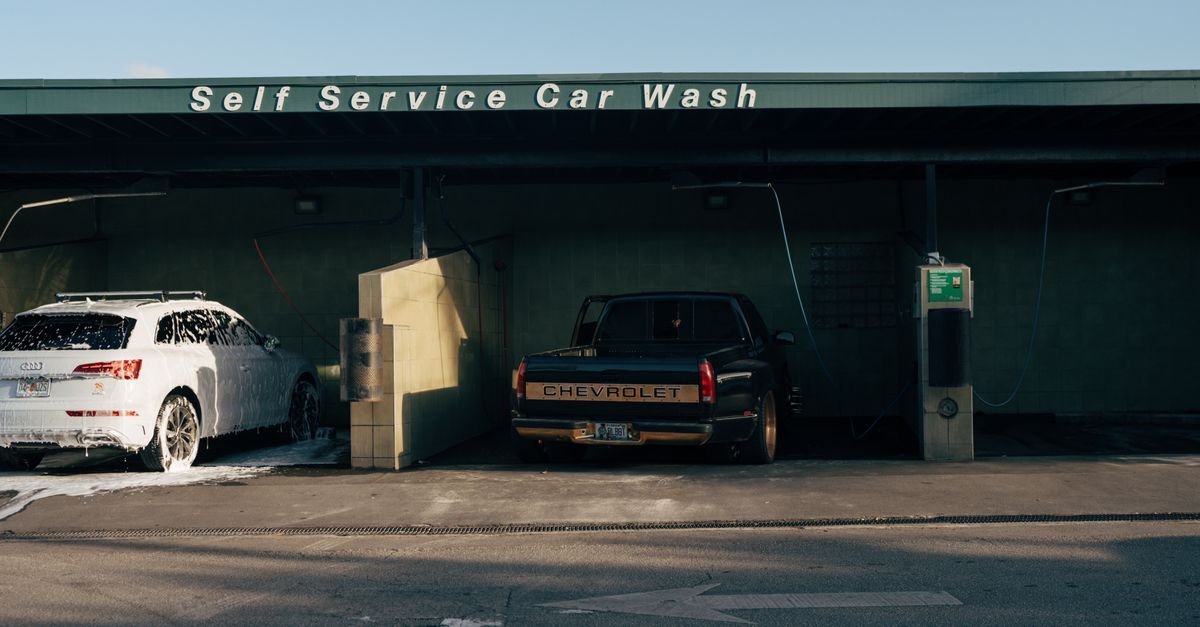
You cannot see the pressure or the tip. Forecourt machines commonly run higher than a domestic unit, and the lance is a fixed fan you have no control over. Your only adjustment is distance. Stand two to three feet back rather than eighteen inches, and test a lower panel first.
The brush is the hazard, not the water. That foaming brush on the second hose has been dragged across a hundred cars, at least one of which had been up a farm track. Grit lives in the bristles. Jet-rinse them hard before use, and keep the brush off paint entirely — bumpers and sills only.
The timer works against the chemistry. A pay-by-the-minute clock is the wrong incentive for a process whose most important step is standing still for five minutes. Foam on the machine’s time, then stop the clock and let it dwell while you do the wheels.
Bring your own drying towel. Nobody does, and everybody should. Driving away wet is how a clean car becomes a spotted car before you are home.
FAQ
Is a jet wash bad for car paint?
Not at sensible settings. Cars and vehicles sit safely at 1,200–1,900 PSI with a 25- to 40-degree tip at around 18 inches. Damage comes from narrow tips, close range and holding the jet still — not from pressure washing as such. Paint that is already chipped or lifting is the exception: a jet will find that edge and take more of it.
What PSI should I use to jet wash a car?
1,200–1,900 PSI. A domestic electric machine rated 1,600–2,000 PSI with a 40-degree tip is comfortably inside that window at normal working distance, because fan angle and distance both reduce what actually lands on the panel.
Should I wash the wheels first or last?
First. Brake dust is iron particles bonded on by heat, and cleaning wheels last sprays that contamination across panels you have already finished. Wheels first, with their own brush and bucket, which then never touch paint.
How long should snow foam dwell before rinsing?
Five to ten minutes, and never long enough to dry. Dwell time is what the surfactant needs to break the bond between road film and clear coat. A dried foam film is a new contaminant and can mark paint on a hot panel.
Can I jet wash a car without touching it at all?
Yes, and for a lightly soiled or dark-coloured car it is often the better choice. A touchless wash — pre-rinse, foam, dwell, rinse, dry — gets you most of the way with essentially no marring risk. Bonded contamination such as bird lime, sap or a heavy tide line still needs contact.
Can I jet wash the engine bay?
Not unless you know what is sealed under there. Modern engine bays are full of connectors designed to shed rain, which arrives at a few miles an hour rather than out of a lance. Leave it to a damp cloth and a dedicated degreaser.
Why does my car have water spots after a jet wash?
Because it dried itself. Evaporating water leaves its dissolved minerals behind on the paint. Dry the car immediately with a plush towel, do a low-pressure sheeting rinse first to reduce beading, and stay out of direct sun throughout.
Chemistry Washes the Car; the Lance Only Rinses It
If you take one thing away, make it the order — wheels, rinse, foam, wait, wash, rinse, dry — and the reason behind it: every step exists to get grit off the paint before anything solid touches it.
The lance is a rinsing tool with excellent reach. It is not a cleaning tool, and the moment anyone treats it as one they go narrower and closer, which is the direction that ends in a mark you cannot buff out. Set it to 40 degrees, stand eighteen inches back, and spend the time you save standing next to a foamy car doing nothing in particular.
That bit is the wash. It only looks like idling.