Last Updated on September 23, 2026 by Umar Farooq
Pressure washing engine bays works, but only at about a third of the pressure you would use on a driveway, with seven things bagged first, and with a cold block. Get any one of those wrong and the machine does not tell you. The car starts, the bay looks excellent, and the bill arrives three weeks later as a check engine light nobody can reproduce.
That delay is the whole problem with this job. Every other surface on this site fails in front of you — wood furs, mortar crumbles, paint lifts. An engine bay accepts the water politely and then corrodes a terminal in the dark over a fortnight. So below is the procedure, the mechanism behind each step, and a straight answer on whether you should be using a pressure washer here at all. (Spoiler, so you do not have to scroll: probably not, and the reason is cheaper than the alternative.)
The Seven Rules in One Table
| # | Rule | Why it matters |
| 1 | Cold engine, ignition off, key away from the car | Cold water on hot alloy and plastic is thermal shock; a running engine can pull water in |
| 2 | Bag and tape the intake, alternator, fuse box, ECU and any open connector | These are the parts that fail quietly, not loudly |
| 3 | Degreaser first, 5-10 minutes of dwell, never let it dry | Chemistry lifts oil film; water only moves what is already loose |
| 4 | 1,200-1,900 PSI, white 40-degree tip, never a rotary nozzle | This is the car range, not the concrete range |
| 5 | Two to three feet back, spray across, keep the wand moving | Impact pressure drops off sharply with distance |
| 6 | Never aim down into a spark plug well or a coil pack | Water sitting in a plug well is a misfire waiting for a cold morning |
| 7 | Dry it before the hood closes, then idle it for ten minutes | Trapped water is the mechanism behind every delayed fault |
Everything below is one of those seven, explained properly.
Your Engine Bay Is Sealed for Rain, Not for a Jet
Automotive connectors are sealed, and people take that to mean waterproof. They are sealed to a specification, and the specification usually describes standing water, not a jet.
The IP code — the two-digit rating you see written as IP67 or IP69K — is defined in IEC 60529. An IP67 part is protected against immersion in one metre of water for thirty minutes. That is a generous rating if your car is fording a flooded lane. It says nothing at all about a focused jet arriving at 2,000 PSI from eight inches away.
The rating that does cover a jet is IPX9K, defined for road vehicles in ISO 20653 and originally in DIN 40050-9. The test is specific and worth reading slowly: water at 80°C, delivered at 80 to 100 bar — that is roughly 1,160 to 1,450 PSI — at 14 to 16 litres per minute, from 100 to 150 millimetres away, held at four different angles for thirty seconds each.
Read that again and notice what it describes. It describes a pressure washer. The industry wrote a test standard specifically because people point pressure washers at engine bays, and it tops out around 1,450 PSI. A mid-range homeowner gas machine does double that.
I went looking for a list of which connectors in a given engine bay are 9K rated and which are merely 67. I could not find one for any mass-market car. That information lives in supplier drawings, not in your owner’s manual, which means you are working blind on every connector under that hood. Assume the worst one is the one you are pointing at.
The Bag-and-Tape List: What to Seal Before Water
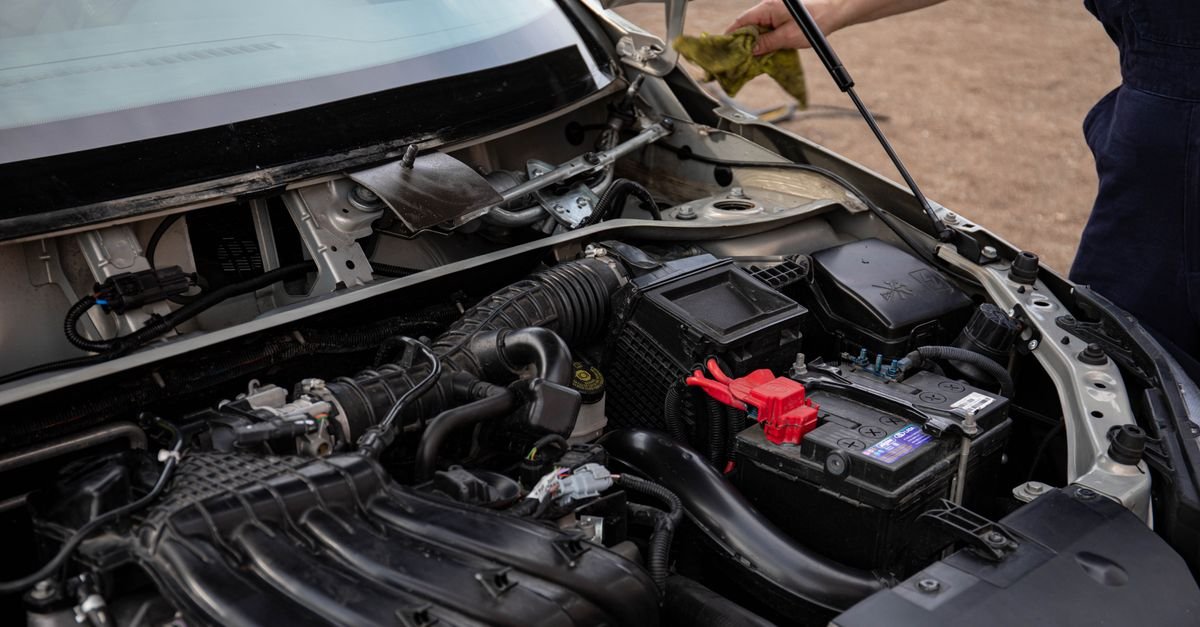
Ford’s own owner’s manual is unusually direct about this, and it is the best free checklist available. It tells owners to “cover the battery, power distribution box, and air filter assembly to prevent water damage when cleaning the engine,” and then adds a line most people have never read: “Never wash or rinse any ignition coil, spark plug wire or spark plug well, or the area in and around these locations” (Ford, Cleaning the Engine).
Spark plug wells are the one people miss. They are vertical holes in the top of the cylinder head with a coil pack sitting in each one. Water that gets past the coil boot has nowhere to go and no way to evaporate, and the symptom is a misfire on the first cold start after the wash.
| Component | Why it gets covered | How |
| Air intake and filter housing | Water into the intake can be drawn into a cylinder | Bag the snorkel opening, tape the seam |
| Alternator | Open-frame design with cooling slots straight through the windings | Bag it or shield it; do not aim at it under any circumstances |
| Fuse box / power distribution box | Lid is splash-rated, not jet-rated; corroded fuse legs cause phantom faults | Tape the lid seam |
| ECU and any exposed control module | Often firewall-mounted with a large multi-pin connector | Bag the whole unit including the connector |
| Coil packs and spark plug wells | Water sits in the well and will not evaporate | Do not spray them; cover if they are exposed |
| Battery and terminals | Wet terminals corrode fast and drop voltage | Bag it, or disconnect and remove it entirely |
| Any exposed or aftermarket connector | Unsealed splices from a stereo or alarm install are the weak link | Bag, tape, or dielectric grease |
Plastic grocery bags and painter’s tape are fine. The tape matters more than the bag — a bag that flaps open in the spray is decoration.
Cold Block, Warm Block, Hot Block
There are three states and only one of them is right.
Hot is the state to avoid. Ford puts it plainly: “Do not spray a hot engine with cold water to avoid cracking the engine block or other engine components,” and separately, “Never wash or rinse the engine while it is hot or running.” A cast exhaust manifold that has been working for forty minutes sits well above the boiling point of water. The realistic damage on a modern car is not a cracked block — it is a cracked plastic intake manifold, a warped composite cover, or a heat-shrunk sensor housing that lets water in later.
Cold is the safe state and the one everybody recommends. The only downside is that cold metal makes degreaser lazy — oil film at 10°C does not want to emulsify.
Barely warm is the one nobody writes about, and it is the useful compromise: start the car, let it idle for two or three minutes, shut it off, then leave it a further twenty to thirty minutes. You should be able to rest your palm flat on the rocker cover. The block is warm enough to help the degreaser and far too cool to shock anything.
If you cannot comfortably hold your hand on it, it is not ready. That beats any number I could give you, because “cold” means something different in a Phoenix driveway in August than in a Michigan garage in February.
Degreaser First, Dwell Second, Water Third
This is the opinion I will defend on every page of this site, and an engine bay is where it is most obviously true: the chemistry does the job, and the pressure washer is only the rinse.
What is actually on there is not dirt. It is road dust suspended in a film of atomised oil, power steering weep and years of condensation. Water at 3,000 PSI does not dissolve oil — it drives the top layer sideways and leaves the film behind. Degreaser breaks that oil into something water can carry.
So: spray a dedicated engine degreaser onto a cool-to-warm bay, bottom to top so it does not streak, and let it dwell five to ten minutes. Do not let it dry. If it starts going tacky in the sun, mist it with plain water and keep it wet. A dried degreaser leaves a haze that is genuinely harder to remove than the grease you started with.
Agitate the heavy spots with a soft brush while the chemical is still wet. Then rinse. Nine times out of ten the bay comes clean at pressures you would be embarrassed to admit to, because the degreaser already did the work and you are just carrying it away.
One practical note: all that oil and degreaser is going somewhere, and “somewhere” is the concrete under the car. Lay a tarp or wash on gravel if you can, and if you have already stained the slab, that is a separate job — see removing oil stains from concrete.
How Far Back Should You Stand?
Two to three feet, which will feel absurdly far away and is the correct distance.
The numbers that matter: vehicles generally sit in the 1,200-1,900 PSI band with a 25 to 40-degree tip, and for an engine bay you want the top of that fan range and the bottom of that pressure range. Fit the white 40-degree nozzle. If you are unsure which tip is which, the pressure washer nozzle chart has the colour code, and the PSI guide covers why the number on the box is not the number hitting the part.
Kärcher, who make the machines, are blunt about nozzle choice on vehicles: “Always wash your car with the flat jet and not with the rotor nozzle,” and they ask for a minimum of 15 centimetres from paintwork (Kärcher, car washing). A rotary or turbo nozzle is a 0-degree jet spun in a circle. It has the coverage of a 25-degree tip and the impact of a red tip, and pointing one into a wiring loom is how you strip insulation off copper in half a second.
Spray across components, not into them. Angle the wand so the water passes over a connector rather than square into its face seal. Keep the wand moving — a fan held still for three seconds on one spot delivers far more energy than the same fan swept across it. And never point upward into the underside of anything, because that is the one direction every seal in the bay was designed assuming water would not come from.
Why the Fault Shows Up Three Weeks Later
This is why “it started fine afterwards” proves nothing.
A sealed connector keeps water out with a silicone seal squeezed between the two halves. Force water past that seal and you have put a few drops into a small plastic cavity containing tin-plated copper terminals, with no drain and no airflow. It cannot evaporate. The car goes back in the garage.
What happens next is ordinary galvanic chemistry. The water carries dissolved salts. The terminals sit at different potentials because the circuit is live. Tin plating oxidises, and the oxide layer is a resistor. Now the connection is not open and not closed — it is slightly resistant, which is the worst possible state for a sensor signal measured in millivolts.
The symptoms are the ones every mechanic dreads: a check engine light that comes and goes, a sensor reading that drifts on cold mornings and behaves once the bay warms up, a misfire that will not reproduce on the lift. Intermittent faults are expensive to trace, and the repair can turn out to be a section of harness rather than a single part.
The timeline is the cruel bit. Corrosion needs days to build enough oxide to matter. By the time the light comes on, the wash is a fortnight in the rear-view mirror and nobody connects the two events.
Dry It Before You Close the Hood
Given the mechanism above, drying is the step that decides whether you get away with this. Remove the bags first, carefully, so the water pooled on top of them does not tip into what you were protecting. Then, in order:
1. Blow the bay out. A leaf blower is the tool most people already own and it is genuinely good at this. Compressed air is better for driving water out of connector faces and plug wells. Work systematically, low points last.
2. Towel the flat surfaces. Microfibre over the rocker cover, the strut towers, the top of the fuse box.
3. Check the plug wells. Look down each one with a torch. If there is water, get it out with compressed air before the engine turns over.
4. Reconnect the battery, then idle for ten to fifteen minutes with the hood open. Engine heat and air movement finish what the blower started.
Some detailers spray dielectric grease into connector faces afterwards. It is not a bad habit, but applying it to a connector that is already wet seals the water in. Dry first, grease second, or skip it.
Should You Be Pressure Washing Engine Bays at All?
The honest answer is that a garden hose with a trigger nozzle will clean an engine bay almost as well, will do it in about the same time, and carries a fraction of the risk. I would use the pressure washer only on a genuinely filthy bay — a farm truck, a decade of neglect, an oil leak that has been coating everything since the last administration.
The reasoning is arithmetic, not squeamishness. The degreaser is doing the cleaning. The rinse only needs to move loosened oil off the surface, and a hose at 40 to 60 PSI does that. Your machine contributes an extra 1,800 PSI you do not need, plus a real chance of exceeding the only jet-resistance standard the parts were ever tested to.
There is a decent middle path: use the machine with the black soap nozzle fitted the whole time. That tip has the widest orifice on the set and drops system pressure to a dribble, which is why it looks broken the first time you use it. On an engine bay that dribble is a feature. You get the reach and the trigger control of the wand with something close to hose pressure at the part.
And if any of this made you decide the bay can stay dirty — that is a legitimate outcome. A dirty engine bay costs nothing. An intermittent sensor fault costs a diagnostic hour at workshop rates before anyone touches a part.
FAQ
What PSI is safe for an engine bay?
Stay in the 1,200-1,900 PSI band that applies to vehicles generally, and work at the lower end with a 40-degree tip. Worth knowing: the automotive high-pressure jet standard, IPX9K, tests at 80 to 100 bar, which is only about 1,160 to 1,450 PSI. Anything above that is beyond what the parts were ever verified against.
Do I need to disconnect the battery before washing an engine bay?
It is the safest option and it takes two minutes. Disconnecting removes the electrical potential that drives corrosion in a wet connector, and it prevents a short if water bridges something live. Negative terminal off first, positive second. If you would rather not, at minimum bag the battery and both terminals completely.
Can I pressure wash the engine while it is running?
No. A running engine is both hot and drawing air, which are the two conditions you are specifically trying to avoid. Ford’s manual states it directly: never wash or rinse the engine while it is hot or running, because water in a running engine may cause internal damage. Ignition off, key out of the car.
What happens if water gets into the alternator?
An alternator is deliberately open-framed with cooling slots, so water goes straight into the windings and onto the slip rings and brushes. It often survives a soaking and then fails weeks later from rust on the slip rings or a corroded rectifier. Symptoms are a battery light, a whine that was not there before, or a charging voltage that sags. Cover it, and never aim at it.
My car developed a fault after I washed the engine bay. What now?
Open the hood and look for standing water, especially in the spark plug wells and around any connector you can reach. Blow everything out with compressed air and let the car idle with the hood up for fifteen minutes. Many same-day faults clear once things dry. If a light appears days or weeks later, tell the shop the bay was washed — knowing to look for connector corrosion can save hours of diagnostic time.
The Garden Hose Is Usually Enough
Bag the seven things that matter, let the degreaser do the actual cleaning, keep the water wide and far away and moving, and dry it properly before the hood comes down. Do all that and pressure washing an engine bay is a perfectly reasonable Saturday.
But if you read the IPX9K test and thought “that is about half my machine,” you were paying attention. The hose is not the timid option here. It is the one that matches the specification the parts were built to — and your car will not send you a bill in three weeks to explain the difference.