Last Updated on September 23, 2026 by Umar Farooq
The short version of how to pressure wash a driveway: sweep it dry, pre-treat the stains, coat the whole slab in concrete detergent and let it dwell for five to ten minutes, then rinse downhill in overlapping passes with a surface cleaner — or a 25-degree tip held 8 to 12 inches up if you do not own one.
A driveway is the easiest surface on the property to clean and the easiest one to visibly ruin. Concrete does not fur like cedar or soften like asphalt. It simply records. Every place you paused, every arc your elbow swung, every strip you missed by two inches — the slab keeps all of it, and it reappears a fortnight later when the concrete has weathered back to an even colour everywhere except where you were standing.
So this is a procedure, not a spec sheet. The pressure numbers and the concrete types live in how much PSI to clean a concrete driveway. What follows is the order, and the habits that decide whether the finish comes out even.
Start at the High Point and Work Downhill
Before anything gets wet, walk the slab dry and find the fall. Almost every driveway is poured with a slope so rain leaves it, and that slope decides your route: wash from the high end toward the low end, so dirty water runs onto concrete you have not reached yet rather than across concrete you just finished. Get it backwards and you spend the afternoon re-depositing a grey film over your own work, which is a demoralising way to learn about gravity.
Do the rest of the prep on the same walk:
- Move everything — cars, bins, the hose reel, the bag of compost you keep stepping over.
- Sweep or blow off the loose grit, which otherwise becomes a projectile the moment the jet reaches it, and will find your siding.
- Soak the beds and lawn either side before and after, so detergent runoff arrives diluted.
- Look at the concrete. Note cracks, spalling and any joint sealant that has already lifted — the wash will not cause those, but it will make them obvious.
Surface Cleaner or Wand: What Your GPM Decides
This is the biggest quality difference on a driveway, and it is not about pressure at all.
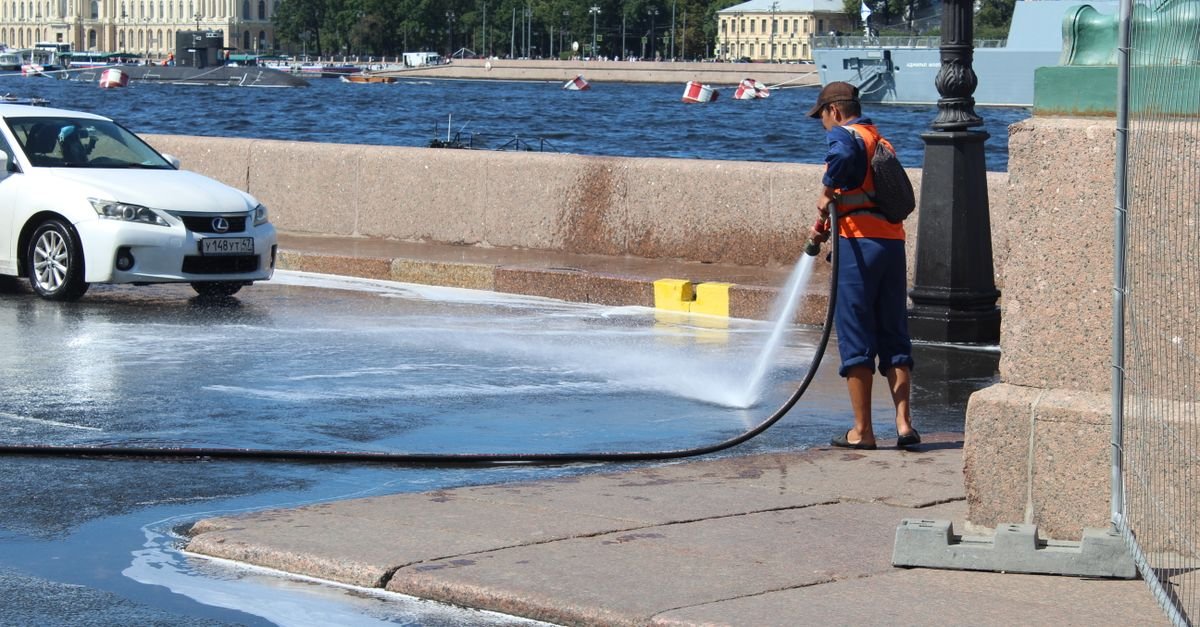
A surface cleaner is a shrouded disc with two jets on a spinning bar, covering twelve to sixteen inches a pass. The jets sit at a fixed height and sweep overlapping circles, so you cannot pause, swing an arc or change the height — the housing will not let you. A wand can do all three, and usually does. A wand leaves stripes on a driveway almost every time. A surface cleaner does not leave them at all.
The catch is flow. That bar is spun by water reaction force, so a surface cleaner is a GPM device wearing a PSI device’s clothing. Simpson publishes a recommended minimum of 2,200 PSI and 2.3 GPM for its 15-inch unit; Alkota’s sizing guidance is blunter, putting a 12 to 20-inch surface cleaner on a 4 GPM machine. Around 3 GPM is where they stop being a compromise.
So here is the opinion. If your machine cannot push about 2 GPM, do not buy a surface cleaner. Underfed, the bar turns slowly, the jets stop overlapping, and it writes arcs into the slab — the exact stripes you bought it to avoid, now applied automatically and at a constant rate.
Degreaser First, Bleach Second, Pressure Last
Three different messes live on a driveway and they answer to three different products. Pressure is only what carries the results away afterwards.
| What is on the slab | What removes it | Dwell |
| Oil, grease, tyre marks | Alkaline degreaser, brushed in | 10–15 min |
| Green film, black spotting, algae | Sodium hypochlorite solution | 5–10 min |
| General road grime | Concrete detergent, black soap nozzle | 5–10 min |
The black nozzle has the widest orifice in the set, which drops system pressure, and that drop is the only reason a downstream injector draws detergent at all. A machine that “will not pull soap” is very often a machine with the green tip still on it.
Dwell is not optional either. Detergent needs five to ten minutes of contact to break the bond between dirt and cement paste, and it must not dry, because dried detergent streaks and a warm slab dries it in about four minutes. Soap quarters you can rinse inside ten minutes rather than the whole driveway at once. Oil deserves more than a table row; the full sequence is in will pressure washing remove oil stains from concrete.
How to Pressure Wash a Driveway in Eight Steps
Timings are for a 600 square foot slab and a 2.5 to 3.0 GPM machine.
| # | Step | Roughly |
| 1 | Clear the slab, sweep off grit, soak the surrounding beds | 10 min |
| 2 | Walk the fall and pick your start and finish corners | 2 min |
| 3 | Spot-treat oil and organic staining, brush it in, leave it working | 15 min |
| 4 | Fit the black nozzle, detergent the whole slab, low end upward | 10 min |
| 5 | Dwell five to ten minutes, misting anything that starts to dry | 10 min |
| 6 | Rinse high end down, surface cleaner or 25-degree tip, overlapping | 30–45 min |
| 7 | Detail the perimeter and the last inch a surface cleaner cannot reach | 15 min |
| 8 | Final rinse in one direction to the drain, then rinse the plants again | 10 min |
Detergent goes on bottom-to-top and rinse runs top-to-bottom, which is not fussiness: soap running down dry concrete leaves visible tracks, and soap running down wet concrete does not. If your driveway is asphalt rather than concrete, stop here and read can you pressure wash an asphalt driveway — the numbers above will strip the binder out of it.
The Wand Habits That Leave Zebra Marks
Washing with a wand, three habits separate an even slab from a barcode.
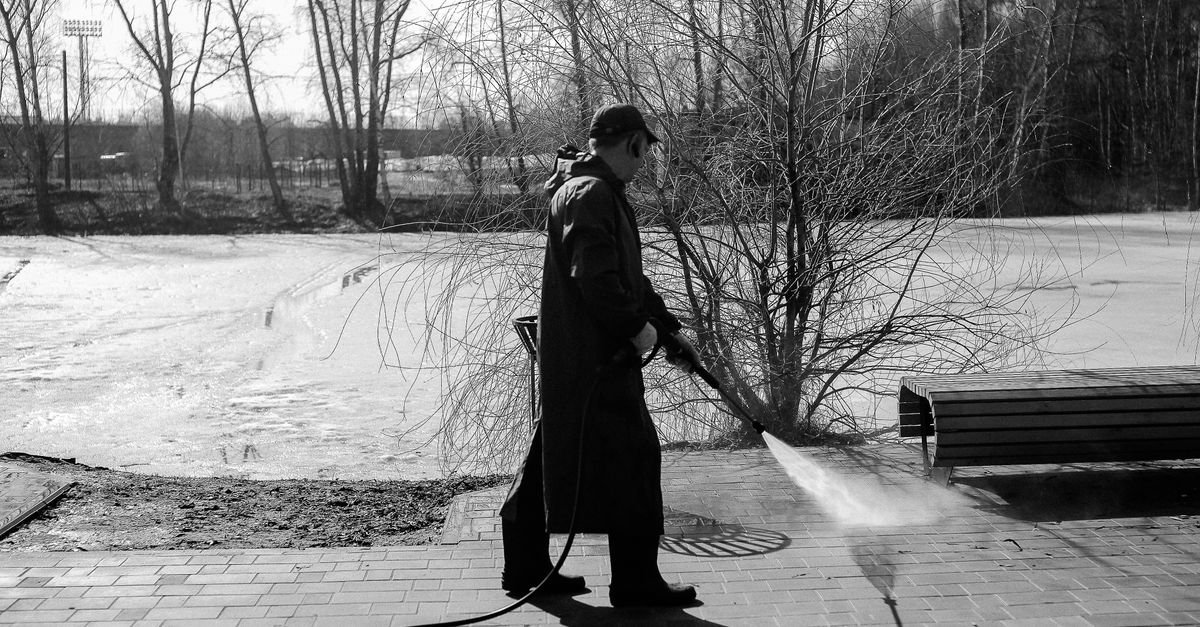
Constant height. Impact force falls off sharply with distance, so an inch of drift is a visible change in how hard that strip got cleaned. The usual culprit is pivoting at the elbow, which traces an arc — closest to the concrete mid-sweep, furthest at both ends. Move your whole arm and step your feet. Your elbow is a hinge, and hinges make curves.
Constant speed. Slowing at the end of a pass to admire it deposits more energy there. Keep the sweep metronomic and resist looking down.
Real overlap. Overlap every pass by 30 to 50 percent, not “a bit”. The edges of a fan are weaker than its centre, so two passes that merely touch leave a weak seam between them, and that seam is the dark line you see next week. And never pull or release the trigger over concrete you care about — on before the jet reaches the strip, off after it has left.
Keep the Jet Out of the Expansion Joints
The grooves running across the slab are control and expansion joints, and the filled ones are filled for a reason: a flexible sealant lets the concrete move with temperature without cracking somewhere of its own choosing, and it keeps water out of the sub-base.
A 25-degree tip run *along* a joint lifts that sealant out in one pass. A turbo nozzle does it faster. Once the filler is gone water gets underneath, and in a freeze-thaw climate that is how a tidy joint becomes an untidy crack. So cross joints at right angles and keep moving rather than tracking down them. If yours are already empty — on an older driveway they often are, long before you turned up with a machine — refill them once the slab is dry with a flexible self-levelling sealant made for the job. Sashco’s Slab is one of several and lists sidewalks, driveways, expansion joints as exactly its use case.
Let the Slab Dry Before You Judge It
Wet concrete is a liar. It looks darker, richer and far more evenly cleaned than it is, which is why so many people finish, feel pleased, and feel differently on Tuesday.
Give it a full day before deciding anything. If it dries patchy, re-wash the whole driveway rather than the patches — spot-washing adds a third tone and makes the map worse. A white haze appearing as it dries is efflorescence, salt carried up from inside the slab rather than dirt you missed, and it needs an efflorescence cleaner. Never seal over it. If you do plan to seal, wait for 24 to 48 hours of dry weather: sealing a damp slab traps that moisture under the film, and a cloudy sealer coat is much harder to remove than the dirt was.
FAQ
Do I need to wet the driveway before I start?
Yes, and it costs thirty seconds. Pre-wetting cools the slab, stops detergent soaking straight into dry pores where it cannot work, and buys dwell time before it dries out.
What is the best time of day to pressure wash a driveway?
Early morning on a mild, overcast day. Direct sun dries detergent before it has done anything, which wastes the product and leaves streaks. Cool and cloudy is worth waiting for.
Do I really need detergent, or will plain water do it?
Water alone rinses dust off. It will not lift the oily film binding road grime to cement paste, so you compensate with pressure and closeness, which is precisely how slabs get striped and etched. Detergent typically lets you clean 500 to 1,000 PSI lower.
Why did the tyre tracks stay dark after washing?
Tyre marks are rubber and oil pressed into the surface pores, not dirt sitting on top. They want a citrus or alkaline degreaser, a stiff brush and a second dwell cycle. More pressure just etches a lighter patch around a stain that is still there.
Can I pressure wash a driveway in cold weather?
Not below roughly 40°F. Runoff refreezes into an invisible sheet across the slab and the path to your door, detergents work poorly cold, and water left in the pump expands as it freezes and splits the housing.
How often should a concrete driveway be washed?
Once a year suits most, in spring or early autumn. Shaded or tree-covered slabs that grow algae may want twice. Beyond that it is wear for its own sake — every wash removes a little surface paste, and a slab has a finite amount of it.
Same Height, Same Speed, Every Pass
That is most of it. Let the chemistry do the first half of the work, use a surface cleaner if your machine has the flow to drive one, and if it does not, hold the wand level, move at one speed, and overlap far more than feels necessary.
And if you have already laid down one bright stripe and you are standing there deciding whether to commit to the other four hundred square feet — yes. You are committed. Start at the high end and work down.