Last Updated on October 6, 2026 by Umar Farooq
The best extension cord for pressure washer duty is fifty feet of ten-gauge outdoor cord or shorter, and the hard part of that sentence is the length rather than the gauge — I read 292 outdoor cord listings across 47 search phrasings, and while 277 of them print a wire gauge, exactly none of them prints a single figure for how many volts arrive at the other end.
That is a strange gap to find in an electrical product, so I went looking for how it got there. It turns out the listings are answering a question. It is just not the question your machine cares about, and the company that asked it is the company that built your pressure washer.
What follows is a census rather than a roundup. I read titles and feature bullets in full — the part you see before you start hunting for a PDF — and sorted the results by what they disclose. The thing a cord listing will not tell you turned out to be more consistent than anything it does.
Gauge on the Front, Nothing About the Far End
Here is what 292 distinct listings publish. The gauge is nearly universal, the current rating is close behind it, and then the shelf goes quiet.
| What the listing prints | Of 292 |
| A wire gauge, in AWG or in the 12/3 form | 277 |
| An amp rating | 241 |
| An amp rating and no gauge | 11 |
| A gauge and no amp rating | 43 |
| The pairing “15 A, 1875 watts” | 142 |
| Neither an amp nor a wattage figure | 47 |
| The words “voltage drop” | 10 |
| A voltage-drop figure at a stated length and current | 0 |
| The word “thermal” or the word “ampacity” | 0 |
| A shipping weight | 110 |
The first row is worth pausing on, because I expected it to read the other way. I went in expecting to count the cords that hide their gauge behind a bare amp rating, and the count is eleven out of 292. The shelf is not hiding the gauge. It prints the gauge in the title, in the bullets, and often twice in the same sentence, because the gauge is the thing buyers have learned to compare.
What disappears instead is the consequence. Ten listings in 292 use the words “voltage drop” at all, and not one of the ten follows the words with a number. The best of them is a hundred-foot ten-gauge cord from GEARit, whose second bullet reads that copper’s “high conductivity helps control resistance-related loss and voltage drop, supporting efficient delivery across the run when the connected equipment stays within the cord’s rated load.” That is a careful, accurate sentence with no quantity in it anywhere. An ISLEWIRE hundred-footer says its wiring is “designed to minimize voltage drop” and then gives the only figure in the bullet as “a full 15 amps (1875 watts)” — which is the other limit entirely.
And the length distribution is the part that decides this page. Sixty-six of the 292 are a hundred feet or longer. Sixty-three of those are a loose cord rather than a reel, and 52 of the 63 carry an amp or wattage rating. By gauge, those 63 hundred-footers run twenty at 12 AWG, eighteen at 10, seventeen at 16 and six at 14. A hundred feet is not a fringe of this category. It is where the category lives once you stop looking at the short stuff hanging by the tills.
Every Cord Here Answers the Question Your Manual Asked
I assumed the amp rating on a cord was marketing. It is not. It is the answer to a sentence printed in pressure washer manuals, and once you have read one of those sentences the whole shelf makes sense.
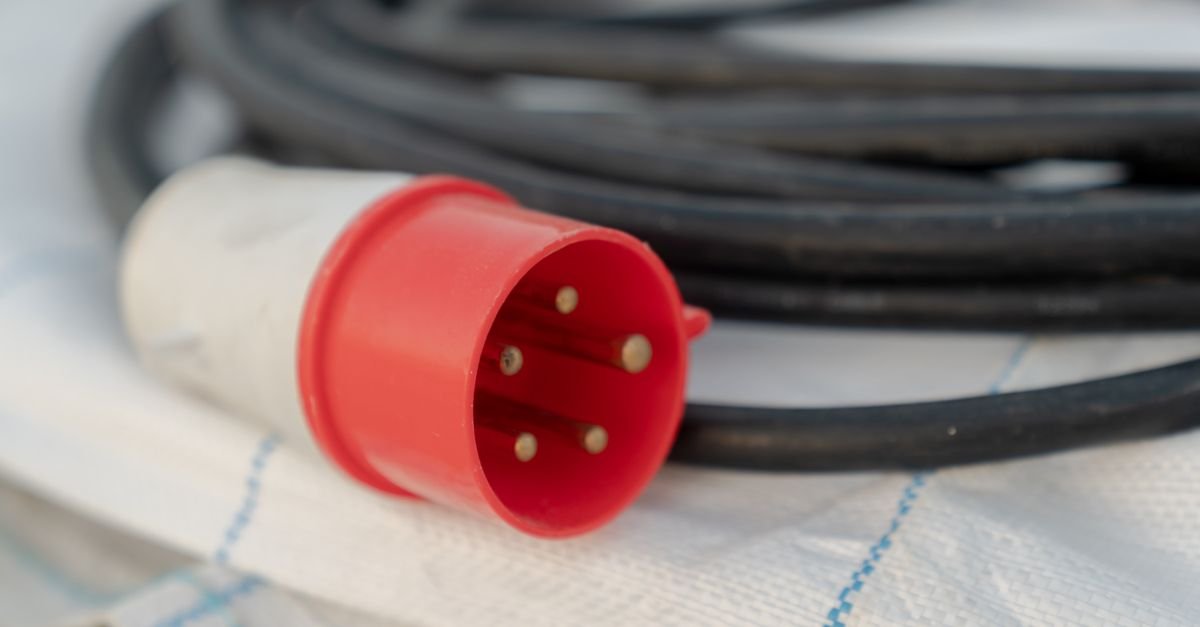
Simpson’s operator’s manual for its CM60976 electric machine runs a warning headed “Risk of electrocution” and then says: “DO NOT use an extension cord with this electric pressure washer. Your home’s electrical circuit receptacle or extension cord may not provide lifesaving ground-fault circuit interruption protection.” It then repeats the instruction on the start-up page, which is where people actually start reading.
The same manual then explains how to choose the cord it has just forbidden, and this is the sentence the market is built on: “Use only extension cords having an electrical rating not less than the rating of the product.” (Simpson CM60976 electric pressure washer operator’s manual)
An electrical rating not less than the rating of the product. That is an amps-against-amps test, and 241 of the 292 listings answer it on the front of the box. A Benchmark manual for a 14-amp machine puts the figure in brackets so there is no ambiguity — use cords with “an electrical rating not less than the rating of the product (15 A)” — and then caps the cable at fifty feet and 14 AWG. Ryobi’s manual for one of its 2,300 PSI electric machines gives the identical instruction and prints no gauge table at all.
So the shelf is compliant. Every one of those 142 cords printing “15 A, 1875 watts” satisfies the manual’s stated test for a 13- or 14-amp machine. A hundred-foot cord printing 15 A satisfies it exactly as well as a ten-foot cord printing 15 A, because length is not in the test.
Now the part that makes it worse rather than merely incomplete. Of the seventeen loose hundred-foot cords at 16 gauge in this census, thirteen do not print 15 A at all — they print 10 amps and 1250 watts. Two print 13 A and 1625 W, and two print nothing. A 13-amp pressure washer plugged into the commonest hundred-foot 16-gauge cord on the shelf is over that cord’s own published rating before anybody has argued about volts. The live article on what an extension cord costs a pressure washer motor warns that the amp figure on the packaging is a thermal rating that says nothing about the voltage surviving the trip, and that is exactly right — but the measured shape of the shelf is slightly different and a little bleaker. On the long thin cords the rating is often not even generous. It is simply lower than your machine.
Southwire Gives Away the Calculator Its Own Listings Ignore
Zero listings in 292 use the word “ampacity” and zero use the word “thermal”. So the distinction between how hot a cord gets and how many volts come out of it appears nowhere on this shelf, in any form, on any product.
It appears, in one sentence, on the website of the company whose name is on twenty-five of the 292 listings here. Southwire publishes a free voltage-drop calculator and a phone app for it, and the page describes the job plainly: it “determines wire size to meet specific voltage drop limits or calculates voltage drop for a specific conductor run,” and when sizing conductors, “calculations limits wire size to voltage drop and NEC ampacity” (Southwire voltage drop calculator; the grammar is theirs). Two limits, named in one clause, by the manufacturer. One of them is on every carton and the other is on a web page nobody buying a garden cord will ever open.
The reason the second limit is the one that matters to a pressure washer belongs to the extension cord article, which works through the square law and the current the motor draws to make up the missing torque. What I can add is a piece of arithmetic the listings already give you the inputs for, because American Wire Gauge is a geometric scale rather than an arbitrary list of numbers.
Each step down the gauge scale is about 26 per cent more copper in cross-section. Three steps is a factor of two. Six steps is a factor of four. That is a property of the scale itself, not a measurement, so you can do this on the back of the receipt: a ten-gauge conductor has about four times the metal of a sixteen-gauge one and therefore about a quarter of the resistance per foot. Resistance also scales directly with length.
Multiply those two together and you get the sentence I did not expect to be writing about the heaviest hundred-foot cord on the shelf: a hundred feet of ten gauge drops about the same voltage as twenty-five feet of sixteen gauge. Four times the length against a quarter of the resistance. They land in the same place.
Hold that against the manuals. None of them permits 16 AWG at twenty-five feet for a 13-amp machine — Craftsman’s published table starts at 14 AWG for that length and the manual says to go heavier if in doubt. So the heaviest hundred-foot cord in this category is, in volts lost, the cord every manufacturer already refuses at a quarter of the distance. No amount of copper converts a hundred feet back into a short cord; it converts a hundred feet into a worse short cord.
The honest limit on my own arithmetic, stated because it runs the other way: that comparison is about voltage drop only. Thermally the ten-gauge hundred-footer is a far safer object than a sixteen-gauge one, which is precisely why it can print a bigger amp number. Both numbers are real. They are answers to different questions, and the shelf only ever publishes one of them.
At Fifty Feet the Makers Disagree by Two Gauges
Before buying on gauge, it is worth knowing that the people who build these machines do not agree with each other about what gauge means at a given length — and the spread is wider than the spread between any two cords you are choosing between.
Take fifty feet and a machine drawing around fourteen amps, which describes a great many homeowner electric washers.
| Manufacturer’s published requirement at 50 ft | Minimum gauge |
| Benchmark, for its own 14-amp machine | 14 AWG |
| Craftsman, for any machine drawing 12 to 16 A | 12 AWG |
| Kärcher, for its 14-amp K 210 | 10 AWG |
Three documents, one length, one current, and two shelf sizes between the slackest answer and the strictest. On the gauge scale that is four numbers, which by the arithmetic above is about two and a half times the copper, so Kärcher is asking for a cord that loses roughly 40 per cent of the volts Benchmark would accept. The Kärcher figures and the rest of the Craftsman table are quoted on this site already — the gauge tables in full are on the extension cord page, and Kärcher’s outright prohibition and its dedicated-circuit instruction are in pressure washer tripping breaker — so I am not going to reprint them. The point here is narrower and it is a buying rule: when three manufacturers give three answers for the same length, buy the strictest one. It costs you nothing but weight, and the strictest answer at fifty feet is ten gauge.
And here is the opinion this whole census has been walking toward: the gauge is the only part of this purchase the shelf lets you get right, and the gauge is not the part that fails you. You can stand in front of 292 listings and pick the heaviest copper on offer in perfect confidence, and still buy a product that no manual for any machine you own will sanction, because the number that disqualifies it is printed in the title and nobody treats it as a specification. A hundred feet is a length, and a length is not a rating.
The Cord That Names Your Machine Is Three Feet Long
Fifteen listings in 292 mention a pressure washer. I expected those fifteen to be the long contractor cords, since that is who the category is sold to. Seven of them are something else entirely: short ground-fault leads, three to fifteen feet, from DEWENWILS and Keroyal, 12 AWG, auto-reset, UL listed.
Once you have read Simpson’s reason for banning the cord, that makes complete sense. Its objection is not voltage at all — it is that your receptacle or your cord “may not provide lifesaving ground-fault circuit interruption protection.” Your machine’s own GFCI sits in its plug and watches everything downstream of itself, which means it watches the machine and not the cord feeding it. Put a ground-fault device at the wall and the extension cord moves inside something’s field of view for the first time.
So if your outdoor socket is a plain receptacle and a new circuit is not happening this weekend, the useful purchase is a short auto-reset GFCI lead at the wall with the extension cord plugged into it. There is no button on that recommendation, and the reason is that the honest version of it is a specification rather than a product: twelve gauge, as short as reaches, auto-reset, UL listed, outdoor rated. Half a dozen listings meet that description and nothing meaningful distinguishes them, which is a restful thing to be able to say about a purchase.
Two caveats, because this is the kind of advice that gets repeated carelessly. A GFCI lead is not a substitute for the grounded three-wire cord behind it — it is an addition to it. And you will now have two ground-fault devices in series, yours and the machine’s, which works fine but makes fault-finding confusing, a complication worked through on the tripping breaker page.
The Two I Would Actually Plug a Machine Into
Fifty feet of ten gauge is where the manufacturer tables stop and where this category still sells a plain cord rather than a reel. Within that, I chose on disclosure: what does the listing tell you beyond the two numbers everybody prints? Thirteen other fifty-foot ten-gauge cords exist in this census and most of them publish a gauge, a length, “15 A, 1875 watts” and a temperature range, and then stop. These two publish something you can act on.
Southwire Polar/Solar 50 ft, 10 Gauge, SJEOW. The jacket is the reason. The letters moulded into a cord’s jacket are a construction code, decoded in full elsewhere on this site — S for a flexible service cord, J for the 300-volt junior rating, T for thermoplastic, O for oil resistance, W for weather — and this is the one cord in the group whose code reads E instead of T. E is a thermoset elastomer, a rubber compound rather than a vinyl one, and Southwire publishes what it bought with it: a jacket that “remains flexible and will not crack or deform in extreme temperatures from -58⁰ F to 221⁰ F”. Nine listings in 292 publish an elastomer designation, 181 publish the thermoplastic one, and 102 publish no jacket code at all. A cord that goes stiff in February gets dragged round corners instead of laid out, and a cord that has been dragged round a corner is a cord with a nick in it. It is UL and cUL listed and the marketplace puts it at 10.5 pounds, which is a decent sanity check on fifty feet of three-conductor ten gauge.
The limitation, and it is the same one that disqualifies most of this aisle: it prints “15 AMP, 1875 watts, 125 volts” and no voltage-drop figure, so it is disclosing exactly what every other cord discloses on the question that matters. And fifty feet of extension plus the thirty-five-foot lead already moulded to most electric machines is eighty-five feet of combined cord, which is over the sixty-foot combined cap Sun Joe prints in its own manual. If your machine is the one with that cap, this is already too long and you want the twenty-five-foot version of the same cord.
DEWALT 50 Foot 10/3 SJTW, Click-to-Lock. This one earns its place on a feature I did not find anywhere else in 292 listings. Five listings in 292 print the phrase “ground continuity”, and they are the only five listings this maker has in the census. The description: an amber LED in the male plug “indicates power from the outlet and through the extension cord while a green lit LED on the female end indicates ground continuity in the cord and circuit.” Every manual in this article demands a three-wire grounded cord because the ground conductor is the low-resistance path a fault is meant to take instead of taking you, and this is the only cord on the shelf that will tell you that path is actually intact before you pick up a wet trigger. The locking collar on the female end is the other genuinely useful part, since the connection that pulls apart mid-job is the one lying in your own runoff.
Two limitations. Its own bullet says the cord “works in temperatures as low as -58°F to -40°F”, which is not a range so much as two numbers that have fallen over, and it is the only cold-weather claim in the listing. And the same bullet says the cord “does not overheat” with no current and no length attached — which, on a page whose whole argument is that a cord’s limits depend on both, is a claim I would not repeat on its behalf. Thermoplastic jacket rather than elastomer, too. I checked both of these brands against the federal recall database before linking either; neither has a recall on an extension cord.
Well-Made Cords at a Length Nobody Sanctions
Most of what failed here failed on one axis, and it is not quality. These are competent cords from competent makers, and every one of them is longer than any pressure washer manual I have read will permit, or ends in a plug your machine cannot use.
GEARit 100 Ft, 10 Gauge, SJTW. The hardest one to leave alone, because on disclosure it is the best listing in the entire census. It is one of only ten to use the words “voltage drop”, one of only fifteen to name a pressure washer, and the only listing that does both — it lists “heavy-duty shop vacuums and pressure washers” in its first bullet. It is also the heaviest gauge the category offers at that length on a household plug. And it is a hundred feet, which by the arithmetic above is electrically the same trip as twenty-five feet of sixteen gauge, a combination no manual permits. The listing that understands the problem best is selling the product the problem rules out. No button.
IRON FORGE CABLE 100 Foot, 12/3 SJTW. Its title sells the amp rating as the credential — “15 AMP – Great for Garden and Major Appliances” — and its bullets give “12-AWG heavy-duty wire, 100 foot extension cord length, 15 amp, 125 volts, 1875 watt” in a single breath, four correct figures with the relationship between the first two deleted. Craftsman’s table marks a hundred feet “Not recommended” for any machine in the 12-to-16-amp band without naming a gauge at all, because at that length the gauge has stopped being the variable. Reviewed, no link.
K KASONIC 100 FT, 16 AWG, 12 outlets. A hundred feet of sixteen gauge with twelve moulded outlets, and its own second sentence undoes its title: “100 feet total length (50 feet* 2 Pack)”. So it is two fifty-foot cords, which is a different object from a hundred-foot cord, and joining two cords does nothing for gauge — Craftsman’s wording is that each individual extension must separately meet the minimum wire size. It publishes no amp rating anywhere. Its suggested uses are Christmas lights, Halloween decorations and stage power, which is honest of it, and none of those is a 13-amp motor.
Masterplug 100ft Metal Cord Reel, 12 AWG. A hundred feet of twelve gauge wound on a steel drum, which is the two things this article refuses arriving in one carton. Sun Joe’s manual states flatly that “power cords on drums should always be completely unwound to prevent the cord from overheating,” and a conductor buried under four more layers of itself has nowhere to put the heat it makes. Twenty-two listings in 292 are reels or retractables, nine of them at ten gauge, and they are a genuinely good answer for a drill in a workshop. A continuous 13-amp motor load is the one job in the garage where the convenience works against you. No link.
PLUGTUL 100FT 20 AMP, NEMA 5-20, 12 Gauge. This one fails before any of the above, at the wall. A 5-20P plug has a horizontal blade and will not enter the 5-15 receptacle outside your house, and its own bullets name “electric vehicles, generators, air conditioners, RV, welders” as the market. Twenty-six listings in 292 are on connector standards a household outlet does not accept, including 40-amp welder cords on a 6-50 plug and 50-amp power-distribution splitters. They are not pressure washer cords and the category search returns them anyway, which is worth knowing before you buy on gauge alone.
One more pattern, with no single product to pin it on. Forty-seven listings in 292 publish neither an amp nor a wattage figure, and that group is not the bottom of the market — it includes a Southwire hundred-footer and a Yellow Jacket whose entire disclosure on the subject reads “Gauge: This flexible electric cord has a 12 gauge measurement for convenient use.” A gauge measurement for convenient use. I read that bullet four times looking for the rest of it.
FAQ
What is the best extension cord for pressure washer duty?
Fifty feet of ten-gauge outdoor cord, or shorter, three-conductor, with a weather-rated jacket and nothing wound on a drum. Ten gauge is the strictest of the three answers the manufacturers give for that length, and buying the strictest costs you only weight. Then check your own manual before you use it at all, because several makers prohibit a cord outright and the one you own may be one of them.
Can I use a 100-foot extension cord with a pressure washer?
Not on any manufacturer’s published table I have read. Craftsman marks a hundred feet “Not recommended” for machines drawing 12 to 16 amps and does not name a gauge that rescues it; Sun Joe caps the combined length of factory cord and extension at sixty feet. Going to ten gauge at that length buys you back real voltage, and it still leaves you with roughly the loss of a twenty-five-foot sixteen-gauge cord, which is also not permitted. Move the machine and add water hose instead.
Does the amp rating on an extension cord tell me if it will run my pressure washer?
It tells you the cord can carry that current without cooking its own jacket. It says nothing about how many volts reach the motor, and no listing in the 292 I read draws that distinction — the words “thermal” and “ampacity” appear zero times across the whole census. Treat the amp figure as a floor you must clear and the length as the thing that actually decides it.
Is a cord reel a bad idea for a pressure washer?
A reel is fine if you run the whole cord off it every time, which nobody does, and that is the problem rather than the hardware. Sun Joe’s manual requires drums to be completely unwound to prevent overheating, because the inner turns have no way to lose heat. Twenty-two of the listings I read are reels, several at ten gauge and the right length, and they remain the wrong buy for a continuous motor load.
What does SJEOW mean on an extension cord jacket?
It is the jacket’s construction code. S is a flexible service cord, J the 300-volt junior rating, O oil resistance and W weather resistance and outdoor use. The letter that varies is the fourth one: T is thermoplastic, a vinyl compound, and E is a thermoset elastomer, which is rubber. Nine of the 292 listings publish an elastomer code, 181 publish the thermoplastic one, and 102 publish no code at all. Elastomer stays flexible in the cold, which matters mostly because a stiff cord gets dragged rather than laid out.
My machine’s manual says not to use an extension cord at all. Is that just legal cover?
Simpson’s version sits under a heading reading “Risk of electrocution” and gives a specific reason: your receptacle or your cord may not provide ground-fault protection, and the machine’s own device cannot see upstream of itself. That is a real mechanism rather than boilerplate, and the fix is a ground-fault device at the wall. If the manual permits a cord, it will also give you a maximum length and a minimum gauge, and both of those are conditions rather than suggestions.
Will a longer cord damage the motor or just slow it down?
Both, in that order. A motor turning at reduced voltage draws more current to make the same torque, which drops more voltage in the cord, which raises the current again, and the heat from all of that lands in the windings. If the motor cannot break away from standstill at all it sits at locked-rotor current, which is its own diagnosis and has its own shortlist of five causes. The gentler version is simply a machine that cleans worse than it did last year, which is where low pressure on an electric machine starts.
The Last Honest Length Is Fifty Feet
Fifty feet of ten gauge is the end of the range the manufacturers will stand behind, and it is also the last point on this shelf where the product you are buying is still a cord rather than a distance. Past that the category changes what it is selling. It keeps printing the gauge, because the gauge is what people compare, and it prints the amp rating because a pressure washer manual asked for one — and then it adds fifty more feet, which is the one variable in the transaction that no listing in 292 will put a number on.
So buy the heaviest gauge at the shortest length that reaches, put a ground-fault device between it and the wall, and if fifty feet does not get you there, the answer is on the water side of the machine rather than the power side. That argument is already made properly in electric versus gas, which puts it in one line worth keeping: hose costs you a little pressure while cord costs you motor life. The cord aisle will sell you the other hundred feet quite happily. It has simply never told anybody what the extra distance takes out of the motor.