Last Updated on September 26, 2026 by Umar Farooq
Removing tire marks concrete begins with one question, and it is not which degreaser to buy: does your slab have a film on it or not? Bare concrete takes the mark down into its pores. Sealed or coated concrete takes it into the sealer instead, which is a different job with a different worst case at the end of it. The chemistry arriving is identical in both cases. What happens to it afterwards is not, and nearly every disappointing afternoon with a brush comes from treating the two the same way.
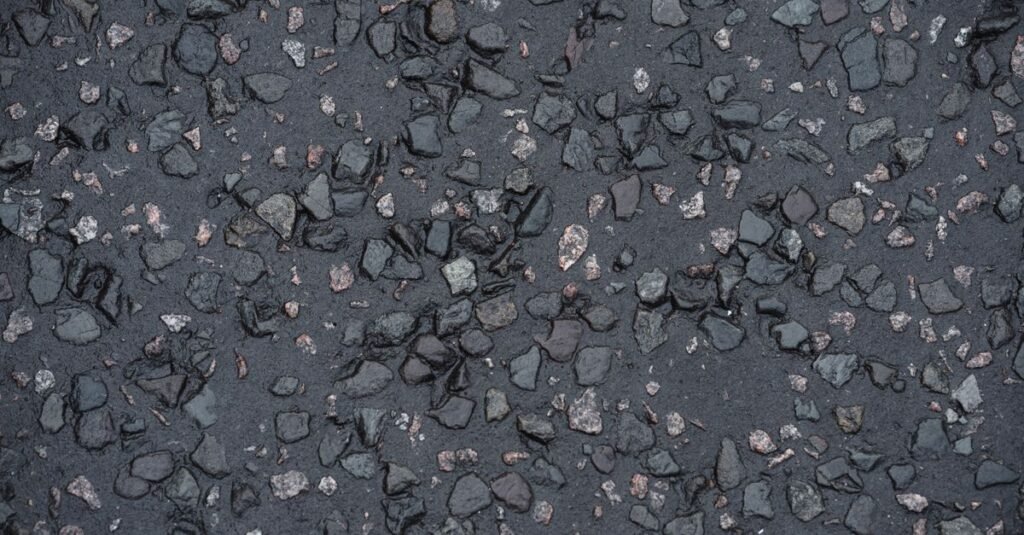
The mark itself is not what most people think. It is not rubber worn off the tread, and it is not road grime that has gone stubborn. It is liquid that has come out of the tire and gone into the slab — which is why it usually turns up as four dark ovals where the car stands still rather than as a smear where the tire scrubbed. If the marks in your driveway are exactly where the wheels sit, that is the mechanism confirming itself, not a coincidence.
Two things this page assumes you have already sorted out. If you are not certain the mark is a tire mark at all, the stain families and the water-drop test that separates them live in cleaning stains from concrete. And if the slab in question is a garage bay, the drainage question comes before any of this, because thirty gallons of rinse water in a room with one exit is its own problem — that is covered in cleaning garage floor concrete. (UK readers searching for tyre marks are in the right place too. Same oil, different vowel.)
The Mark Is Plasticiser, and the Tire Is Full of It
A tread compound is not simply rubber. It is rubber plus carbon black plus silica plus sulphur plus a quantity of liquid oil that was never chemically bonded to any of it, and that last ingredient is the one staining your driveway.
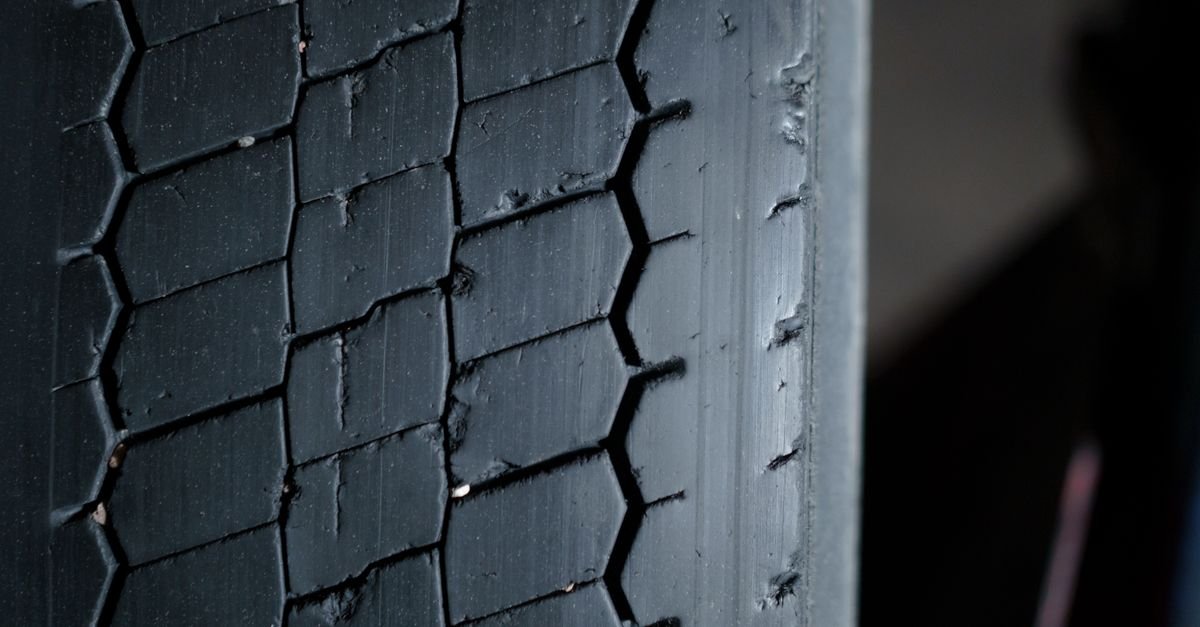
Those oils are plasticisers, and they are added deliberately. A study of bio-based plasticisers for tire tread rubber published in *Polymers* worked at a standard loading of 25 phr — twenty-five parts of liquid plasticiser for every hundred parts of rubber. The researchers give the reasons plainly: plasticisers “reduce rubber viscosity and thus improve the processing properties and filler dispersion, enhance the elasticity, and reduce processing energy consumption.” Without them a tread compound would be difficult to manufacture and unpleasant to drive on.
What makes that paper genuinely useful here is what the authors were trying to fix. Their whole purpose was to develop a modified soybean oil that can “graft onto the rubber molecular chain” — chemically attach itself — because conventional petroleum plasticisers are small, free molecules that do not stay where they are put. A whole line of rubber-chemistry research exists because the oil in a tread has a habit of leaving. Your driveway is not being singled out.
The concrete industry has a name for what happens next. Euclid Chemical’s technical bulletin on tire marking and pickup of concrete sealers opens by naming it: tire marking is “caused by a phenomenon called ‘plasticizer migration’,” where plasticisers “soften and leach out of the rubber” and then “migrate into and discolor the sealer/coating.” A concrete products manufacturer and a polymer chemistry journal describing the same molecule from opposite ends is about as well-triangulated as a home-maintenance mechanism gets.
This is also the whole reason scrubbing underperforms. A deposit sits on top of a surface and mechanical effort removes it. A migrated liquid is already inside the surface, below the level your brush reaches, and the bristles are working on concrete that is merely stained rather than dirty. You can scrub a tire mark for twenty minutes and lift the top of it, which looks like progress right up until the slab dries.
Heat Makes the Mark, and the Better Tire Makes It Worse
The trigger is temperature, not friction. Euclid states the sequence directly: “When the car is driven, the tires heat up, causing the plasticizers to soften and leach out of the rubber. When a hot tire is driven (especially in a turn) or parked on concrete sealed with a cure & seal, the plasticizers migrate into and discolor the sealer/coating.”

So the worst case is not a wheelspin. It is a twenty-minute drive home followed by a warm tire standing on the same square foot of slab for fourteen hours while it cools. Heat mobilises the plasticiser, weight presses the tread into contact, and time does the transferring. That is why the marks appear under the parking spot rather than at the turn into the drive, and why they are shaped like a tread pattern rather than like a skid.
Then there is the finding I did not expect and had to read twice. Euclid: “The better the tire quality, the higher the quantity of plasticizer — and the greater the chance for hot tire marking. Lower-quality tires are harder and contain less plasticizer, so they usually result in less hot tire marking on coatings and sealers.”
Read that as a homeowner and it is faintly outrageous. The soft, grippy, expensive tires that stop your car properly in the wet are the ones marking your driveway hardest, and the cheapest hardest set on the rack would mark it least. The only prevention advice the rubber industry implicitly offers is to buy worse tires, which is not advice anyone should take. It does mean that if your marks got noticeably worse after a new set went on, nothing is wrong with your concrete and nothing is wrong with the tires.
The same bulletin adds a warning that quietly undoes the most popular prevention tip on the internet. Euclid’s technical support group has fielded complaints about “rubber mats, rugs with rubber backing, weatherstripping on the bottom of garage doors, and rubber vacuum cleaner tires” doing exactly the same thing. On bare concrete, putting something between the tire and the slab genuinely helps. On a sealed or coated floor, a rubber parking mat is another rubber item sitting on a film, and it can mark the floor in the shape of the mat instead of the shape of the tread. Swap the improvement for a genuine one.
How Deep Does It Go? Nobody Has Published a Number
I went looking for a migration depth. If plasticiser moves millimetres into cement paste, that figure would settle every argument on this page — how many cycles to expect, when to stop, whether a poultice is worth the day it costs.
There is no such figure. Not from a tire manufacturer, not from a concrete institute, not in a standards document, not in the polymer literature. Euclid speaks about depth only inside the coating — “if the discoloration has migrated deep into the sealer or coating” — which is a statement about a coating measured in thousandths of an inch, not about a slab. Every consumer page that implies a depth is implying it.
So judge by behaviour instead, which is less satisfying and more reliable. Run a full cycle of chemistry and dwell, let the slab dry completely, and look. A cycle that lightens the mark means there is more to get and another cycle is worth doing. A cycle that changes nothing means you have reached the limit of what acts on the surface, and the remaining work is extraction rather than cleaning — drawing the oil upward out of the pores over hours or days, which is the method set out in whether pressure washing removes oil stains from concrete.
One useful asymmetry falls out of the absence. On a coated floor the mark physically cannot go deeper than the film, so the job has a floor to it and a guaranteed worst case: strip and recoat. On bare concrete there is no such boundary. The surface with nothing protecting it is the one where nobody can tell you when to stop.
Three Surfaces, and Only One of Them Has a Film to Lose
Three substrates, and the difference between them is entirely about whether the plasticiser meets a polymer film on the way in.
| Surface | Where the plasticiser ends up | What actually shifts it | The real limit |
| Bare broom-finished concrete | Into open pores, printed with the tread pattern | Detergent and hot water, real dwell, stiff nylon brush, then repeat | No film to lose, but no defined depth either — expect two or three cycles and a ghost |
| Sealed or coated concrete | Into the sealer or coating film, which discolours or lifts off with the tire | Degreaser first; solvent or full strip if it has gone through the film; recoat where the tire took the coating with it | This can stop being a cleaning job and become a coating job |
| Concrete block paving and pavers | Into the dense top face of the unit, with runoff collecting in the joints | Detergent and hot water, then steam; low pressure held at a shallow angle | Jointing sand, which washes out long before the mark does |
The coating column deserves the detail, because it is where the money is. Euclid explains that “most discoloration from plasticizer migration occurs on acrylic or styrene/acrylic cure & seals, because the acrylic polymers have minimal ‘crosslinking’,” and that “the greater the extent of crosslinking, the denser the product and the more resistant it will be to discoloration.” Crosslinking is how tangled the polymer chains are with each other. A loosely tangled acrylic has room for a small oil molecule to move in. A densely crosslinked one does not.
That ranks the options, and it also traps you. Epoxies and urethanes are far more crosslinked and mark much less — but the same bulletin says they “are not recommended for use on concrete outdoors” because of concrete moisture, sunlight, weathering and freeze-thaw. So the coating that resists tire marks best is the one you should not put on a driveway, and the coating you can put on a driveway is the one that marks.
Which leaves the answer almost nobody reaches for, and it is the position I would argue hardest for here: if tire marks are the reason you are sealing a driveway, do not buy a film-forming sealer at all. Euclid’s own recommendation is a penetrating silane or siloxane, because those “do not form a film on the concrete surface, and do not react with plasticizer in tires.” There is nothing on top to dissolve into and nothing to peel away on a hot afternoon. You lose the wet-look gloss that sells cure and seals, and you lose the annual argument with four dark ovals. Anyone selling you a glossy acrylic as the fix for hot tire pickup is selling you the substrate that Euclid names as the most susceptible one.
Pavers are their own case, mostly because of what sits between them. The unit face is dense and the mark stays shallow, but aggressive rinsing takes the jointing sand out and an open joint is a slower, more expensive problem than a stain — the full treatment for block paving is in how to clean brick patio pavers.
Removing Tire Marks From Concrete Starts With Heat, Not Pressure
Here is the gap that changed how I would approach this job. Consumer pages ranking for this query recommend a citrus degreaser, a stiff brush and a pressure washer, and our own numbers put concrete flatwork at 2,500 to 3,000 PSI. Then I opened the aftercare guide published by a company that actually manufactures paving, and its stain matrix does not mention pressure or degreaser for this stain at all.
Marshalls’ Patio & Driveway Aftercare Guide lists “Tyre marks” as its own stain category. Basic cleaning advice: “Use detergent & hot water to remove the stain.” If that is not enough, the additional product required is not a stronger chemical. It is “Hot water & steam clean.” The manufacturer’s escalation path for a tire mark is from warm water to hotter water.
That is coherent with what the mark is. You are trying to move a viscous oil that was mobilised by heat in the first place, and temperature is the variable that mobilises it again — the temperature effect on oil in concrete is the same physics at work on the same class of contaminant. Pressure does nothing to viscosity. It just arrives faster.
The same guide is equally unflattering about the machine. It warns that “if used in excess the power of the water pressure can damage your patio or driveway,” and its instructions from there are all restrictions: a low pressure setting, no oscillating lance, a test on an inconspicuous area first, and the lance held at a shallow 30-degree angle rather than aimed down at the slab. Every one of those reduces what the jet does to the surface. Not one of them is about getting the mark out.
So the honest limit, stated plainly: the pressure washer rinses. It does not extract. The plasticiser is below the surface the water strikes, so the machine’s actual job is carrying away spent detergent and loosened residue — and a hot-water machine does more for this stain than a cold machine at double the pressure. If what you own is a cold electric unit, the chemistry and the dwell are doing all of the work and the trigger is the last thirty seconds of it.
The general routine for a concrete stain — sweep, pre-wet, apply, dwell, agitate, rinse, assess once it has dried — is given in order in cleaning stains from concrete and none of it changes here. Four things about it are specific to a tire mark, and they are the four worth getting right.
1. Raise the temperature rather than the pressure. A kettle emptied into the bucket is a legitimate technique on this stain and it contributes more than a larger machine would. Warm solution on a warm slab, in the middle of the day rather than at dusk.
2. Move the car off the spot the day before. You are working on a patch of concrete that has had a warm tread parked on it most nights for a year, and you want it cool and settled before you start. It also stops the obvious ending, where a freshly cleaned oval gets a hot tire put back on it four hours later.
3. Brush to renew contact, not to abrade. There is no crust here to scrape off, so the bristles are not doing mechanical work in the usual sense — they are pushing fresh warm solution down into the grooves of the tread print, where the first application has already gone cold and stopped doing anything. That is why two minutes of steady brushing per square metre outperforms twenty minutes of leaving it to soak. Use nylon, never a wire brush.
4. Rinse up the slope, not down it. The water leaving this job is carrying dissolved plasticiser and spent detergent, so on a sloped drive it wants to go from the bottom upwards. That is backwards from the way almost everything else on this site gets rinsed, and the reason it inverts is argued properly in removing graffiti.
On a coated floor, follow Euclid’s ladder instead of inventing one: degreaser first, then a solvent or a full strip if the discolouration has gone through the film, then mechanical removal, and recoating where the tire has taken the coating away with it. Note the shape of that ladder. It ends in replacement, because a mark inside a film is a fault in the film.
And the one bottle not to reach for at any stage: acid. A tire mark is oil, and acid has no reaction to offer an oil. What it will do is take calcium out of whatever it lands on, so the slab around the mark comes back lighter and rougher while the mark itself sits there unbothered. From the pavement that does not read as a repair. It reads as though someone has outlined the thing in a highlighter.
FAQ
What removes tire marks from concrete?
Detergent in hot water, held wet on the mark for a full five to ten minutes, worked with a nylon brush, and then repeated. A paving manufacturer’s published escalation for this exact stain goes from detergent and hot water to hot water and steam, not to a stronger chemical. A citrus or solvent degreaser does help on bare concrete because the mark is oil, but it is the heat and the dwell doing most of the work, and expect two or three cycles on anything older than a season.
Will a pressure washer remove tire marks on its own?
No. A jet only ever works on the surface it lands on, and the plasticiser is below that surface, so the machine rinses rather than removes. It earns its place at the end of the job carrying away spent chemistry, and a hot-water machine contributes far more than a cold one at higher pressure. Turning the pressure up instead of the temperature produces a lighter, rougher patch of concrete with the mark still faintly in it.
Do tire marks come out of a sealed or epoxy garage floor?
Sometimes, and the job is different. On a coated floor the plasticiser has gone into the film, not the concrete, so the sequence is degreaser, then solvent or stripping if it has gone deep, then mechanical removal, then recoating any area where the tire lifted the coating off. Acrylic and styrene-acrylic cure and seals are the most affected because they are the least crosslinked. Epoxies and urethanes resist it better, but they are not recommended outdoors.
Why do tire marks keep coming back in the same place?
Because the conditions that make the mark occur on every single journey home, not on the rare one. A daily driver reloads the same four ovals nightly. A mark that reappears a week after a good clean is not a failed clean — it is a new mark. The only interventions that change that are removing the contact (something non-rubber between tire and slab, on bare concrete) or removing the film the plasticiser wants to dissolve into.
Does a rubber parking mat stop tire marks?
On bare concrete it stops the transfer to the slab. On a sealed or coated floor it can cause the same problem in a new shape: Euclid Chemical names rubber mats, rubber-backed rugs, garage door bottom weatherstripping and even rubber vacuum cleaner wheels as things its technical support group gets complaints about. If your floor has a film on it, choose a mat that is not rubber-backed.
Are tire marks on concrete permanent?
Rarely permanent, frequently not fully reversible. Bare concrete usually gives up most of a mark to two or three cycles of hot detergent and dwell, then holds a faint ghost that keeps fading over a season of weather. Nobody publishes a migration depth for plasticiser in concrete, so there is no honest way to predict which marks clear completely. A coated floor is the more certain case, because the worst outcome is known in advance: strip the film and put a new one down.
No Film, Nothing to Pick Up
Two facts carry this whole page. The dark ovals under your car are twenty-five parts of oil per hundred parts of rubber finding somewhere cooler to be, and they will keep arriving for as long as the car does. And the only surface treatment that refuses them outright is the one with no film for them to dissolve into — a silane or siloxane that soaks in and leaves nothing on top to discolour, and nothing to peel away with a warm tread on a July afternoon.
A set of good tires will mark your driveway worse than a cheap set did, and that is not a fault in either one. It is an ingredient doing precisely the job it was put in the compound to do, on the way to somewhere it was never meant to go.