Last Updated on September 26, 2026 by Umar Farooq
Cleaning a motorcycle is the one vehicle job where the manufacturer answers the question for you: Yamaha’s cleaning NOTICE puts high-pressure washers first on the list of things not to use, and names wheel bearings, brakes, transmission seals and electrical devices as what excessive water pressure deteriorates. Honda says the same thing in fewer words. Two of the largest motorcycle makers on earth, both publishing a flat prohibition, on a site that exists to tell you how to use a pressure washer.
So this article is not a step-by-step wash. It is the five things a jet actually damages on a motorcycle and the mechanism behind each one — because a car is mostly a box with the interesting parts hidden inside it, and a motorcycle is the interesting parts, bolted to a frame, with a fuel tank balanced on top as a gesture towards bodywork.
The full paint-safe sequence for a vehicle — wheels first, snow foam bottom to top, 40-degree tip at eighteen inches, rinse the shuts — belongs to the car jet washing page and it holds for a fairing and a fuel tank. What follows is everything a car does not have.
What Is in the Firing Line When Cleaning a Motorcycle?
Point a lance at a car and it meets painted steel, glass, a plastic bumper and a tyre. Almost everything that would object is behind a bonnet, inside a wheel arch or under an undertray. Point the same lance at a motorcycle and about half of what is in the fan is a seal, a bearing cover, an electrical connector or a brake. No engine bay, no wheel arches, no undertray, and the chain out in the open at roughly hip height, which is also roughly wand height.
The clearest evidence that this is a different job comes from Yamaha’s own pre-wash list. Step two, before any water: “Make sure all caps, covers, electrical couplers and connectors are tightly installed.” Step three: “Cover the muffler end with a plastic bag and a strong rubber band” (Yamaha MT-07 owner’s manual). A car manual does not ask you to check that your electrical connectors are plugged in before you wash the car. It could not — you would never reach them.
Here is the map. Every page on the first results page for this query publishes a list of parts to avoid; none of them publishes what each one costs.
| Part | Where it sits on a motorcycle | Why the jet is the problem |
| Drive chain | Outside the machine, left side, wand height | Every link has a rubber seal holding factory grease in |
| Wheel bearings | Inside each hub; the rear pair sits inches from the sprocket | Retention seals, not pressure seals |
| Steering head bearings | Top and bottom of the head tube, right behind the front wheel | The one bearing on a bike that already fights the weather |
| Fork seals | Where the slider meets the tube, dust seal facing upward | Built to keep oil in and road spray out, not a jet |
| Brake discs and pads | Bare, bolted outboard of the hub, nothing in front of them | Water costs bite; oil or degreaser costs a set of pads |
| Ignition switch and instrument cluster | On top of the yoke and above the tank, facing the sky | Sealed against rain falling at rain speed |
| Battery, fuses, control units | Under the rider seat, behind a seat pan and a foam gasket | A jet under the tail is aimed at all three |
| Muffler outlet | Wand height, pointing backwards, wide open | Water in it rusts from the inside, or stops the engine starting |
| Air cleaner intake | Under the tank or behind a side panel | A soaked element will not pass air |
Five of those get a section below. The rest are covered in passing, because a map is more use than nine separate warnings.
Every Link in a Modern Chain Has a Rubber Seal Inside It
A drive chain looks like a solid object and is not. It is roughly a hundred and ten small plain bearings in a row, each one a hardened pin turning inside a bushing, each one packed with grease at the factory, and each one closed off by a rubber ring squeezed between the bushing and the side plate. Depending on the maker that ring is an O-ring, an X-ring or a Z-ring, named for what its cross-section looks like.
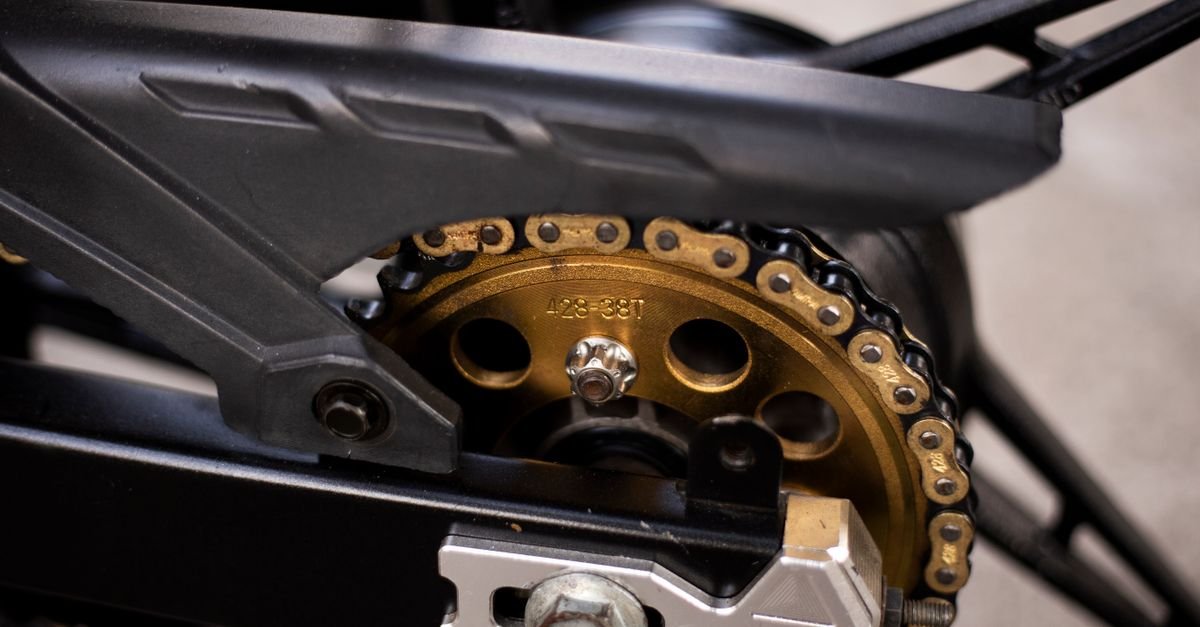
You are allowed to service none of those bearings. Chain lube goes on the rollers and the side plates; the grease that keeps a pin and bushing alive was sealed in before the chain left the factory.
Yamaha says the rest, in a NOTICE inside the drive chain maintenance procedure, verbatim: “To prevent damaging the O-rings, do not clean the drive chain with steam cleaners, high-pressure washers or inappropriate solvents.” The same manual is equally specific about what you put back on afterwards — “Do not use engine oil or any other lubricants for the drive chain, as they may contain substances that could damage the O-rings” — and carries a second NOTICE that tells you what the maker thinks a wash is equivalent to: “The drive chain must be lubricated after washing the motorcycle, riding in the rain or riding in wet areas.”
Washing the bike is filed under the same heading as riding it through a storm. That is a fair summary of what has just happened to the chain.
Now the part where I have to correct the version of this argument that circulates everywhere. The popular mechanism is that the jet blows the factory grease out past the seal and you can never put it back. I went looking for a chain manufacturer that publishes that and could not find one.
What the chain makers publish is about the seal, not the grease. D.I.D., which supplies chains to most of the Japanese factories, says: “To protect X-Ring, never use steam, thinner or such volatile solvents as gasoline or benzene, and a wire bush as well,” and explains its objection to kerosene as a cleaner in mechanical terms — it “would cause deformation of the seal ring” (D.I.D chain FAQ). RK’s maintenance guidance reads the same way: do not use kerosene, mineral spirits, diesel fuel, brake cleaner, motor oil or any caustic chemical, “because that can damage the seals”, and no wire or hard-bristle brush, because “the wire or hard bristles can damage the seals reducing the life of the chain”. Neither company names a pressure washer in its chain guidance at all. RK’s only pressure-washer line is about cleaning rims.
So the prohibition at the chain comes from the motorcycle manufacturer, not the chain manufacturer — and the failure mode both chain makers describe is worse than the one the internet describes. A one-off grease washout is a bad afternoon. A deformed sealing ring is a chain that keeps admitting water and grit on every ride from then on, and no published procedure repairs it. You replace the chain, usually with the sprockets, because a worn chain eats new sprockets.
D.I.D’s own method needs no machine: wipe the chain with a soft cloth dampened with a seal-safe cleaner and dry it completely, every 300 miles or 500 kilometres, then lubricate with a seal-safe lube. Yamaha’s is the same shape. A rag, a brush and five minutes — nobody’s favourite Sunday, but shorter than fitting a chain and two sprockets.
Bearings Behind Seals, and None of Them Under Bodywork
Yamaha’s NOTICE names wheel bearings before it names anything else, and it is worth reading the sentence in full: “Excessive water pressure may cause water seepage and deterioration of wheel bearings, brakes, transmission seals and electrical devices.” Seepage, then deterioration. Two steps, neither of them visible.
Why a grease seal cannot hold a jet out is a general argument about small machines, and this site has already made it properly on the lawn mower page, using a mower’s spindles and its crankshaft seal. It applies here without amendment and I am not going to re-derive it. What is worth adding is motorcycle-specific, and it is about geography.
Wheel bearings. Two per hub, behind a seal on each side. The rear pair sits within a few inches of the sprocket — which is to say, in exactly the place you were standing when you aimed at the chain. Yamaha’s check for them is a feel test rather than a measurement: “If there is play in the wheel hub or if the wheel does not turn smoothly, have a Yamaha dealer check the wheel bearings.” By the time either is true the bearing is finished.
Steering head bearings. Two races, at the top and bottom of the frame’s head tube. The lower one sits directly behind the front wheel and spends its whole life catching whatever the front tyre throws up, which makes it the bearing on a motorcycle that is already losing to the weather before you go anywhere near it with a lance. It is also the one that a jet aimed upward at the headstock hits square on. Yamaha’s test is to raise the front wheel, hold the lower ends of the fork legs and try to move them forward and backward — any free play and it goes to a dealer.
Fork seals and the swingarm pivot. A fork’s dust seal faces upward by design, because everything it is meant to keep out arrives from below and behind. A jet aimed down at the fork leg comes from the one direction the seal stack was never drawn for. The swingarm pivot is the same story lying on its side.
None of these has a grease nipple on a normal road bike, so there is no flush-and-repack step available to you even if you want one. Keeping water out is not a precaution here; it is the whole strategy. And one more line from the same manual, because it catches people who are careful about water and careless about chemistry: “Do not use degreasing agent on areas requiring lubrication such as seals, gaskets, and wheel axles.”
The honest gap: no manufacturer I read publishes a figure for how much water a motorcycle wheel bearing tolerates, or a pressure at which its seal gives up. What exists is a prohibition and a symptom, which is less satisfying and still enough to act on.
An Ignition Switch That Points Straight Up
What water does inside an electrical connector — the seepage, the oxide film, the intermittent fault that arrives a fortnight after the wash and cannot be reproduced on a lift — is fully worked through on this site’s engine bay page, and none of it changes because the vehicle has two wheels. What changes is how much of it is within arm’s reach.
A car’s loom is behind a bonnet. A motorcycle’s is cable-tied to the frame in open air, and the components hanging off it are sited for cooling and packaging rather than for shelter:
- The ignition switch usually sits on top of the top yoke, facing directly up at the sky, with a keyway leading into it. Honda’s washing guidance tells owners to protect it from water, which is a strange instruction until you notice that it is the highest and most upward-facing electrical part on the machine.
- The instrument cluster is above the tank with its loom entering from behind through a rubber boot. Yamaha: “Avoid spraying water directly into the muffler, instrument panel, air inlet, or other inner areas such as underseat storage compartments.”
- Under the seat is where the density is. Yamaha’s own manual locates the battery there, and on most machines the main fusebox and at least one control unit share the space, behind a seat pan and a foam gasket that exists to stop road spray rather than a lance. A jet aimed up under the tail is aimed at all of it.
Honda’s sentence on the machine itself is the bluntest of the lot: “High-pressure water cleaners can damage moving parts and electrical parts, rendering them inoperable.” Note the stated outcome. Not degraded, not shortened — inoperable. Honda’s published washing advice also names the two openings people forget: “Do not direct water at the muffler”, because “water in the muffler can cause it to rust or prevent the engine from starting”, and “Do not direct water at the air cleaner”, because “water in the air cleaner can prevent the engine from starting.”
The muffler is the one that separates a bike from a car. A car’s tailpipe points at the ground behind a bumper and you would have to work at hitting it. A motorcycle’s silencer is at wand height, aimed backwards, open. Which is why Yamaha’s procedure reaches for a supermarket bag and a rubber band, which is the only piece of motorcycle equipment nobody has ever bragged about owning.
On the intake side, what happens when a paper element soaks and the water carries on into a carburettor or a cylinder is sourced in detail on the mower page linked above, on an engine of exactly the same class. Older bikes with carburettors have the extra problem that a float bowl vent and an airbox drain are open to atmosphere on purpose. They are not seals you can defeat. They are holes.
Keep Degreaser Off the Discs and the Pads
A motorcycle’s front discs are the most exposed friction surfaces on any road vehicle. They are bare steel, bolted to the outside of the hub, outboard of the fork leg, with nothing whatsoever in front of them. On a car the rotor is inside a wheel, inside an arch, behind a splash shield. On a bike you can rest a wand on one without bending down.
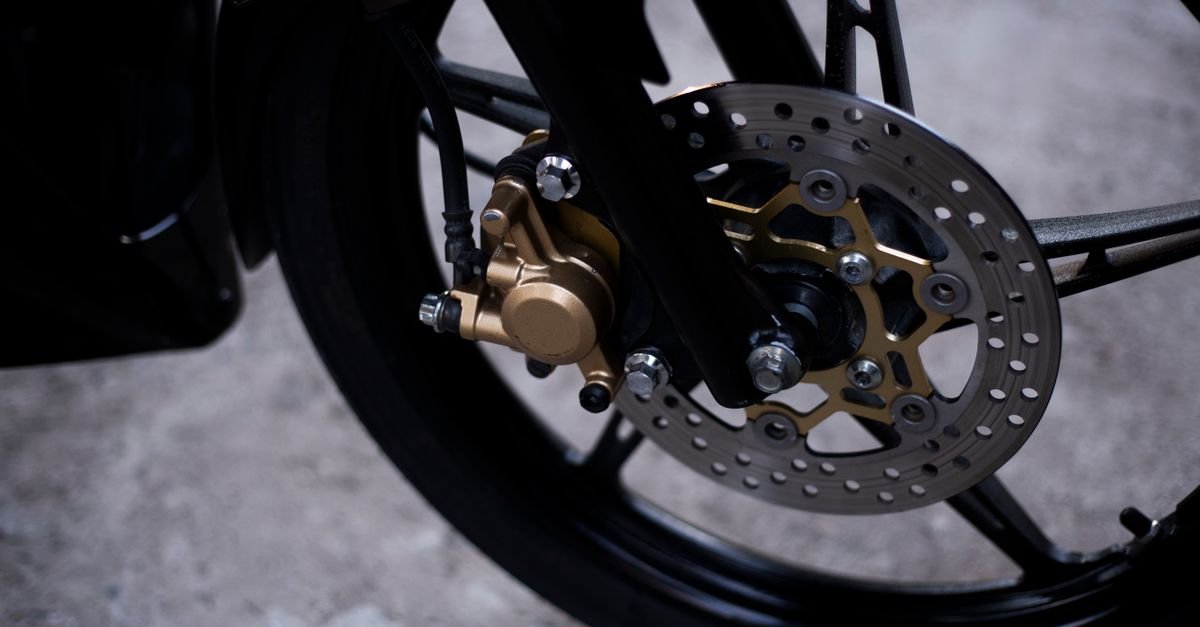
Two different things can go wrong here and they are not the same size of problem, so it is worth separating them before anyone panics.
Water on a disc is temporary. Honda’s washing advice states the effect and the fix in two sentences: “Water adversely affects braking effectiveness. After washing, apply the brakes intermittently at low speed to help dry them.” That is it. Neither maker I read publishes a figure for how much braking is lost on a wet disc, and I am not going to invent one. What matters is the timing — the first stop after a wash is usually at the end of the driveway, and a motorcycle has no second axle to fall back on if the front does not bite when you expect it to.
Contamination is not temporary. Brembo publishes fitting instructions for motorcycle and scooter brake pads, and the general warning in them is unusually specific about what counts as a contaminant: “Do not allow the friction material of the pads, discs, calipers or brake lines to come into contact with grease, oil or other mineral oil-based lubricants or degreasing products because this could affect proper functioning of the braking system and cause physical injury or property damage. Replace these parts in the event of contamination.” Elsewhere in the same document: “Ensure that the friction surfaces do not become greasy; if so, replace any such contaminated components with new products.” Brembo also asks for a non-mineral-oil-based detergent on caliper parts, and no compressed air or hard brushes on brake components at all.
Read that again and notice that degreasing products are in the list, next to oil. Friction material is porous by design — it has to be, to wear — so a solvent does not sit on the surface waiting to be rinsed off. The published remedy is not cleaning. It is replacement.
Which puts two ordinary wash products in an awkward position. The degreaser you spray on the engine cases is a few inches from the disc and has no idea which part you meant. And the chain lube you apply afterwards is an aerosol, fired at a spinning object, with the rear disc bolted to the same hub about an inch away. Honda’s line on that is “be careful not to get oil on the brakes or tires”, and in the original it is the only sentence on the page that ends in an exclamation mark.
Wheel cleaner deserves a sentence of its own, and it is a geometry point rather than a chemistry one. On a car you can spray the face of an alloy quite freely, because the rotor is behind the wheel. On a motorcycle the disc is on the outside of the hub, in front of the spokes, so anything you mist onto the wheel lands on the braking surface first. Yamaha’s list of things not to use includes “harsh chemicals, including strong acidic wheel cleaners, especially on spoke or magnesium wheels” — and acid presoaks on vehicles have their own documented hazards, which the two-step cleaning page covers properly.
Rust Starts Before the Bike Is Dry
The fifth fault is not something the jet does. It is what you leave behind when you walk away, and on a machine with several hundred exposed fasteners and no undertray it starts working immediately.
Yamaha’s after-washing list is three items long and every one of them is a step people skip. Dry the machine with a chamois or an absorbent towel, preferably microfibre terrycloth. Then, on a chain-drive bike: “Dry and then lubricate the drive chain to prevent rust.” Then Honda adds the third, which is to use the wash as an inspection and check the moving and sliding parts for rust while you have them in your hands and the light is good.
Two instructions in the same manual are worth more than the routine, though, because they are counter-intuitive and nobody repeats them.
The first is about temperature: “Use cold water if the vehicle has been exposed to salt. Warm water will increase salt’s corrosive properties.” Everyone’s instinct after a winter ride is a bucket of warm water, because cold hands. The manual says the opposite, and the reason is ordinary chemistry — corrosion is a reaction, and reactions go faster when you heat them.
The second is about where the salt is. Yamaha’s winter guidance is that de-icing salt “can stay on the roads well into spring, so be sure to wash the underside and chassis parts after riding in such areas”, and that “wheel spokes, bolts/nuts and other unpainted metal parts can be especially vulnerable to corrosion from road salt”, with an anti-corrosion product applied after washing and drying.
That gives the pressure washer the only job on a motorcycle it can honestly claim, and here is my one strong opinion on this page: the machine’s entire legitimate use on a motorcycle is the underside, the chassis rails, the inside of the mudguards and the wheels after a salted road — and it has no business anywhere you can actually see. Everything above the axles is reachable with a sponge and a bucket in about twenty minutes, so the machine buys you nothing up there while putting a jet within a foot of a chain seal, a hub and two brake discs. Below the axles a cloth genuinely does not reach, and salt genuinely does not rinse off by itself.
If you do that job, do it the way the engine bay page argues for: fit the black soap nozzle and leave it on, so the pressure at the part is close to hose pressure. Stand two to three feet back, spray across the frame rather than into it, and never aim up into the headstock, the swingarm pivot, a hub or the chain run. For the tips themselves, the vehicle nozzle guide has the colour code and the two that never come out of the bag.
Then roll the bike out and use Honda’s last step before you need it: brakes on and off at walking pace until they feel normal again.
FAQ
Can you pressure wash a motorcycle?
Both manufacturers I read say no. Yamaha’s cleaning NOTICE lists high-pressure washers and steam-jet cleaners first among things not to use, because “excessive water pressure may cause water seepage and deterioration of wheel bearings, brakes, transmission seals and electrical devices”, and it extends the warning to “high-pressure detergent applications such as those available in coin-operated car washers”. Honda states that high-pressure water cleaners “can damage moving parts and electrical parts, rendering them inoperable”. If you use one anyway, the underside and chassis after a salted road is the only part of the job that a bucket cannot do.
What PSI is safe for washing a motorcycle?
No motorcycle manufacturer publishes one, and that absence is the answer. The figures circulating for this query — most often 800 to 1,200 PSI — appear on blogs and product pages and trace back to nothing. The vehicle pressure window this site uses elsewhere, 1,200 to 1,900 PSI, is a limit set by what marks clear coat, and a motorcycle’s problem is not paint. A rubber sealing ring in a chain link does not care what number is on the side of your machine; it cares about distance, fan angle and how long you held still.
Which parts of a motorcycle should never be sprayed?
The drive chain, every wheel hub, the steering head, the swingarm pivot, fork seals, brake discs and calipers, the muffler outlet, the air cleaner intake, the instrument cluster, the ignition switch, and anything under the seat. Yamaha’s own procedure tells you to bag the muffler end with a plastic bag and a rubber band before you start, and to check that every cap, cover and electrical coupler is tightly installed first.
Do I have to lubricate the chain after every wash?
Yes, and the maker treats it as non-negotiable. Yamaha’s NOTICE reads “The drive chain must be lubricated after washing the motorcycle, riding in the rain or riding in wet areas” — washing is grouped with a wet ride. Dry the chain first, then use a lubricant made for O-ring chains. Engine oil is specifically ruled out because it “may contain substances that could damage the O-rings”.
Is degreaser safe to use on a motorcycle?
Not near two places. Yamaha says not to put degreasing agent on “areas requiring lubrication such as seals, gaskets, and wheel axles”. And Brembo’s brake pad instructions list degreasing products alongside oil as contaminants of friction material, with replacement rather than cleaning as the published remedy. On a motorcycle the discs are bare and outboard, a few inches from the engine cases, so a degreaser aimed at the cases lands on a brake more easily than it does on a car.
What should I clean a motorcycle with instead?
Two buckets, a soft mitt, a motorcycle or automotive detergent, a soft detail brush, a garden hose on a gentle setting, and a microfibre towel. Yamaha’s own washing steps ask for no more than a hose with “only enough pressure to do the job”. Pre-soak insects and bird droppings with a wet towel for a few minutes rather than scrubbing at them. The chain gets its own cleaner, its own soft brush and its own lube, and none of them touches the brakes.
The Underside Is the Only Part That Needs the Machine
Yamaha wrote the sentence that settles this and put it in a NOTICE rather than a tip: high-pressure washers named first, and wheel bearings, brakes, transmission seals and electrical devices named as what goes. Nothing on that list tells you when it has happened. A chain with one deformed sealing ring runs round the sprockets exactly as it did yesterday, a hub with water in it turns smoothly for another two thousand miles, and a set of pads with degreaser soaked into the friction material still stops the bike — just not as well, and not in a way you find out about until you are asking for all of it. The plastic bag and the rubber band are the two cheapest items in the whole procedure, which is presumably why they are the two everybody leaves out.