Last Updated on September 26, 2026 by Umar Farooq
Removing bird droppings is a soaking job before it is a cleaning job: wet the deposit at low velocity, give it ten minutes, lift it off, and only then rinse — because a jet aimed at a dried dropping scatters it as dust instead of washing it away.
That order of operations is the mistake in the title, and almost nobody leads with it. Search this and you get a list of surfaces and a bottle of something. The list is genuinely useful. It is also the second half of the job.
I went looking for the first half in places that have to get it right — a university environmental health procedure, NIOSH on where the fungus actually lives, the conservation literature on guano and limestone — and all three land on the same sequence: water first at low velocity, then wait, then remove it by hand. A pressure washer has a role here. It is not the role you were about to give it.
Wet It Down First, and Not With the Wand
Missouri State University’s environmental management procedure for bird droppings says the counter-intuitive part out loud: “Although droppings are usually easier to clean up when they are dry and crusted, saturating them with water prior to removal is recommended to prevent the debris and any pathogens from becoming airborne.” (Missouri State Environmental Management, Bird Droppings)
Dry really is easier. That is the trap. The crust that lifts cleanly is the same crust that goes into the air when you disturb it, and the document says so: droppings “are most dangerous when they are dry and subject to becoming airborne as a fine dust, particularly when disturbed by sweeping or scraping.”
Then comes the line that decides where the machine goes in the sequence. The wetting “should be done with a low-velocity mist spray. Using high pressure and/or a concentrated stream, such as from a hose nozzle, may scatter the droppings before they can be adequately wetted.” A hose nozzle was already too much. The recommended applicator is mundane: “A portable, hand pressurized sprayer is satisfactory for applying limited amounts of water.”
A pressure washer exists to convert water into velocity in a small area. For the first ten minutes of this job, velocity is the least useful property water can have.
The same page draws the honest line on scale: “Small amounts of fresh droppings may be cleaned up by scraping or hosing with water, however, care must be taken when cleaning large areas or waste that dried.” Specifically, “hosing may be used for removing small amounts of recently deposited droppings from sidewalks and pavement.”
So: four droppings on a paving slab this morning, hose them. A crusted band under a roost that has been building since spring is a different job, and the next section is about how different.
What the Health Agencies Actually Say, and What They Do Not
Here is where I expected to confirm a frightening claim and had to scale it back instead.
The story everywhere online is that bird droppings carry histoplasmosis, so cleaning them dry is a respiratory hazard. The first half of that is not what CDC’s NIOSH material says. Verbatim: “Birds themselves are rarely infected with _Histoplasma_.” What droppings do is feed the fungus in the ground beneath them — “_Histoplasma_ grows especially well in soil or other environmental material containing large amounts of bird or bat droppings” — and bats are the real exception: “Unlike birds, bats can become infected with _Histoplasma._ They may also be able to excrete it in their droppings.” (CDC/NIOSH, Histoplasma in the Environment)
That changes the shape of the risk. The fungus is not in the dropping on your railing. It is in soil a roost has been fertilising for years, and disturbing that soil is what caused the documented outbreaks — barn lofts, chicken coops, abandoned attics, excavation under old roosts. A dozen droppings on a patio table is not that.
The other two names survive better, with conditions. *Cryptococcus neoformans* does live in soil contaminated with bird droppings, pigeon in particular, but it overwhelmingly causes disease in people whose immune systems are already compromised. Psittacosis is the one where dried dust is exactly the described route — infected birds shed the bacteria, the secretions dry, the dust is inhaled — but the exposed population in the literature is people around cages, aviaries and poultry, not people cleaning a driveway.
Bird-control suppliers like to say droppings can carry any of sixty transmissible diseases. I went looking for the paper behind that number, found the number many times, and the paper never. Sixty is a very specific figure to have nothing attached to it.
So, honestly: wetting first is not a biohazard ritual, it is the technique that happens also to be the safe one. Where the precautions genuinely step up — a years-old accumulation, an enclosed space, a coop, any sign of bats — you are already past the point where a pressure washer belongs in the conversation, and the guidance becomes a HEPA-filtered respirator rather than a dust mask, disposable coveralls, and in serious cases a contractor.
Urate Salts, Not Uric Acid
Every article on this subject says uric acid. The chemistry is slightly more interesting than that, and one part of it changes what you actually do.
Start with the number that holds up. The Building Conservation Directory’s guidance on guano puts it plainly: “Guano contains high levels of uric and other acids resulting in a pH of 3-4.5. These acids can attack calcium carbonate and other ‘binders’ in natural stone, artificial stone and even concrete.” It also names the damage route people forget: “Guano contains high levels of phosphates, ammonium, potassium, chlorides and other materials. These and the salts resulting from acid corrosion can result in severe problems of efflorescence and spalling.” (Bird and Bat Guano and its Effect on Conservation and Maintenance, The Building Conservation Directory)
pH 3 to 4.5 is roughly household vinegar to orange juice. Not dramatic. What makes it matter is dwell, and the same source explains why: these chemicals “generally need to be dissolved in water for their direct effects to be significant.” A splash that dries in the sun does very little. A deposit sitting on one square inch through three weeks of dew cycles — wetting at dawn, concentrating, drying, wetting again — runs that reaction over and over in the same place, and every dry-down leaves salt behind to crystallise in the pores. The mechanism is residence time, not acid strength.
Then the part that made me go back and re-read. A 2019 re-evaluation of avian urinary excreta by Crouch, Clarke and Lynch in the *Journal of Ornithology* analysed six species spanning the major bird groups and found no uric acid in what the bird had actually excreted — ammonium urate and struvite instead, gut bacteria having broken the uric acid down first. So the white part is a urate salt rather than the free acid, and “uric acid” is a shorthand that is useful and not quite right.
Not trivia, because uric acid and its urates are both near-insoluble in water. PubChem puts uric acid’s solubility at about 60 mg/L at 20 °C — six thousandths of one per cent. You cannot rinse that off, because rinsing is dissolution and there is almost nothing there to dissolve. Water’s job is softening the organic matrix that holds the crust together.
Hence the one opinion on this page. The pressure washer is the last tool in this job, not the first. Velocity scatters a dry deposit before it wets it, and the material is barely water-soluble anyway, so pressure solves neither problem. Against that, the only cleaning pressure any authority publishes for masonry is 300–400 PSI (US National Park Service, Preservation Brief 1), below the floor of almost every machine sold.
Fresh Is a Rinse. Dried Is a Soak.
This really is two jobs, and the honest split is by hours rather than by surface.
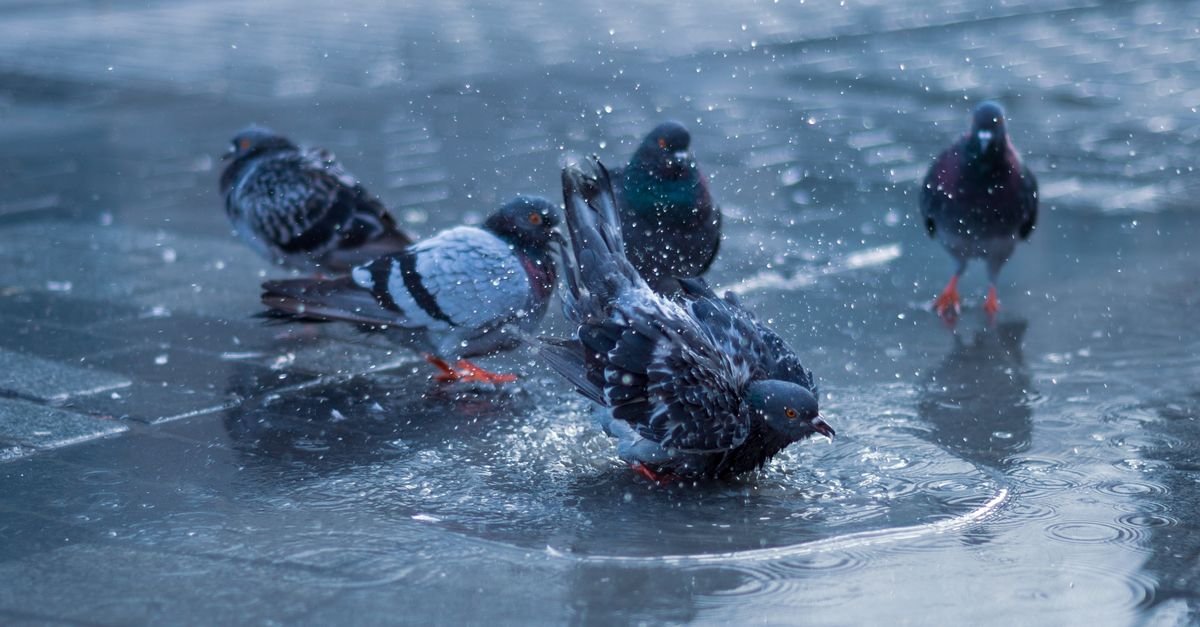
Fresh, meaning the same day. Still mostly water, the matrix has not set, and nothing aerosolises from something wet. Hose it at garden pressure and move on. This is the case the Missouri State procedure explicitly permits, and the case where people overthink it and reach for a chemical they do not need.
Dried, meaning anything older. The crust has set and the colour has started moving into a porous surface. The failure mode is applying water for fifteen seconds, seeing nothing happen, and escalating to force. Fifteen seconds is not a soak. You want the deposit continuously wet for ten to fifteen minutes, which on a sunlit or vertical surface means re-misting every couple of minutes, or laying a wet cloth over it and walking away. The standing dwell rule applies exactly here: five to ten minutes minimum, and never let it dry out mid-job.
Then lift, with a plastic scraper, a nylon brush or a folded cloth. Nothing metal. Preservation Brief 1 warns against metal bristles that “can abrade the surface and leave metal particles that can stain the masonry” — solving the stain by adding a rust stain is not a trade anyone wants.
Only once the bulk is off does the machine come out, and then only for the residue.
(If you are standing over a dried dropping right now with the trigger half-pulled, put a wet cloth on it and go and make a coffee. That is the step. It is not a satisfying step.)
Four Substrates, Four Different Traps
The soak-then-lift sequence is universal. What changes is what the surface will forgive afterwards.
Concrete and pavers: the stain outlives the dropping
Two different marks get left behind and people treat them as one. The dark or purple shadow is berry pigment that has soaked into the cement paste, and it responds to a detergent and time. The pale patch is the acid having taken a little of the carbonate binder, and that is not a stain at all — it is a change in the surface. Concrete flatwork tolerates 2,500–3,000 PSI with a 15–25° tip, so you have room to work, but holding a narrow tip on one mark to chase the shadow removes paste and leaves an etched halo that is permanently lighter and permanently dirtier than the slab around it. Keep the tip moving, or use a surface cleaner and accept a faint shadow.
Painted timber: the coating is thinner than the crust
Painted wood sits at 500–800 PSI with a 40° tip, and on weathered paint the real risk is not the acid at all. The dropping is resting on a film a few thousandths of an inch thick, and after a few seasons of sun that film’s grip on the wood is the weakest bond in the stack. Scrape a dry crust off it and the paint comes with it in a flake the size of the dropping. Soak longer than you think you need to, lift with a plastic edge, and rinse at distance with a wide tip. A turbo nozzle on painted wood is a paint-removal tool that happens to be pointed at a stain.
Limestone, marble and calcareous sandstone: the one place acid is the trap
This is the substrate where the wrong bottle costs real money. Guano at pH 3–4.5 attacks carbonate binders and leaves a salt load that drives efflorescence and spalling, so the surface has already been chemically softened before you arrive. Adding vinegar or a patio acid is not a cleaning step, it is a second dose. The National Park Service’s acid-sensitive list is worth memorising: limestone, polished and unpolished marble, calcareous sandstone, glazed brick and glazed terracotta, polished granite. Water, time, a nylon brush and a neutral or mildly alkaline detergent, at the lowest pressure that does anything. If the mark turns out to be an etched pit rather than a deposit, that is a masonry repair and no washing reaches it. Identifying the stone first is not fussiness — sandstone and limestone are easy to confuse and only one is acid-sensitive. Cleaning a flagstone patio goes through that properly.
Vehicle clearcoat: the etch is in the paint, not in the dropping
Cars sit at 1,200–1,900 PSI with a 25–40° tip, which is fine for the rinse and irrelevant to the removal. The trade’s explanation for why the mark survives the wash is a compound one: the mildly acidic deposit does some damage, and separately the clearcoat softens and expands in direct sun while the dropping hardens on top of it, then contracts around that hardened texture as it cools, leaving an imprint after the dropping is gone. I went looking for a peer-reviewed measurement of that second half and did not find one, so treat it as the detailing trade’s mechanism rather than a published finding. The timescale is not in dispute though — hours in hot sun, not weeks — so this is the surface where acting the same day genuinely pays. Soak with a wet microfibre for two or three minutes, lift in one pass, and never rub a dry crust across clearcoat: there is grit in that matrix. Jet washing a car covers where the machine belongs on paint.
One surface deserves its own answer rather than a line here: solar panels, where an opaque dropping shades a cell and the electrical cost is wildly out of proportion to the two square inches involved. That argument lives on solar panel cleaning.
FAQ
Can you pressure wash bird droppings off a driveway?
Yes, once the bulk is off. Soak the deposits, lift them with a nylon brush or a plastic scraper, then pressure wash to clear the residue. Going straight in with the wand on dried droppings scatters dry material rather than removing it, and a narrow tip held over one mark will etch the concrete while chasing a shadow that a detergent would have lifted.
Is removing bird droppings with a pressure washer dangerous to breathe in?
For a few fresh droppings on a patio, no — and NIOSH is the reason to be calm about it, since birds are rarely infected with *Histoplasma* and the fungus grows in soil that droppings have enriched over years rather than in the droppings themselves. The picture changes with a large dried accumulation, an enclosed space, a coop, or any sign of bats. There, wet everything at low velocity first, wear a HEPA-filtered respirator rather than a dust mask, and keep the machine out of it until the bulk is bagged.
Does vinegar remove bird droppings?
It softens them, and on concrete or plastic a diluted vinegar solution is a reasonable soak. On limestone, marble, calcareous sandstone or glazed brick it is the wrong choice — those are acid-sensitive, and guano has already been attacking the same carbonate binder. Plain water and time do most of what vinegar does here, because the job is softening a crust rather than dissolving a mineral.
How long before bird droppings damage car paint?
Hours rather than days, and heat is the accelerator. A dropping on a dark panel in direct sun is the worst case, because the clearcoat is softest exactly when the deposit is hardening on top of it. Same-day removal with a wet cloth is the whole preventative measure, which makes a spray bottle and a microfibre in the boot more useful than any polish.
Why is some bird mess purple, red or dark brown?
Diet. Birds feeding on berries pass the pigment through, and it behaves like a dye rather than like the white urate crust — it soaks into porous surfaces and stays after the deposit is gone. That is the mark that needs a detergent and a soak, or in stubborn cases an oxygen bleach, rather than more pressure.
Soak It, Lift It, Then Reach for the Machine
Four steps, and only the last one involves the machine: wet it at low velocity, keep it wet for ten to fifteen minutes, lift it with something that is not metal, then rinse. Get that order right and the surface question mostly answers itself, because you are removing a softened deposit instead of fighting a set one.
The claim I went in expecting to make also came back smaller than expected, which is worth saying plainly. Fresh droppings on a railing are not a fungal hazard, whatever the internet implies — that hazard sits in old soil under old roosts, in bat guano, and in enclosed spaces. The wetting still wins, not because you are in danger on your own patio, but because water and ten minutes do what 2,700 PSI cannot.
If you have already had a go with the wand and there is a pale patch where the dropping used to be, that is not the stain and it will not come out. Leave it. It will weather back toward the rest of the slab faster than a new dropping will arrive, which is about as much reassurance as this subject allows.