Last Updated on September 26, 2026 by Umar Farooq
Removing weeds from pavers with a pressure washer clears the patio today and sets up a worse one next summer. The jet lifts out the weed you can see, and it lifts out the joint sand that was the only thing standing between the next seed and somewhere to germinate. You finish the afternoon with a clean patio and a freshly prepared seed bed. That is not the trade most people think they are making.
Almost nobody leads with this, because it makes the most satisfying part of the job sound like the problem. It is the problem. So this page is about the joint rather than the plant: where the weeds actually grow, what truly kills them as opposed to what merely removes them, and why the bag of sand at the end matters more than the machine at the start.
What the Jet Leaves Behind When the Weed Comes Out
That washing pavers costs you joint sand is settled ground here — the paver cleaning guide covers pressure ceilings by paver type, why you sweep across joints rather than along them, and the screwdriver test for how much sand you have lost. Take that as read. The weed case adds the part that guide does not need to make: the sand loss is not only a repair bill. It is the delivery mechanism for next year’s weeds.
The hardscape industry says so out loud, though it says it in a technical note rather than a headline. The Concrete Masonry and Hardscapes Association, which absorbed the old Interlocking Concrete Pavement Institute, describes what joint sand stabilisers are for in a single sentence that happens to contain the whole argument: their primary function “reduces the risk of removal of joint sand from flowing water, wind, aggressive cleaning, tire action and intrusion of organic matter, seeds and insects” (CMHA, Cleaning, Sealing and Joint Sand Stabilization of Interlocking Concrete Pavement).
Note the order. Aggressive cleaning removes joint sand; seeds then intrude. Cause and effect, in sequence, from the body that writes the spec.
A paver joint runs about an eighth to three-eighths of an inch wide. Scour the sand half an inch below the surface and you have a slot that is shaded most of the day, holds rainwater long after the faces have dried, and is open at the top. Hand a horticulturalist a blank sheet and ask for somewhere a seed could reliably start, outdoors, unwatered, and that is close to what comes back.
So the usual sequence — notice weeds in May, wash the patio, admire the patio, find more weeds in July — is not bad luck. It is a two-stage planting operation with a six-week gap in the middle, and we supply the labour for both stages.
The Roots Are in the Joint, Not Under the Patio
The usual assumption is that weeds are forcing their way up between the stones from the ground below. On a patio that was built properly, that is almost never what is happening.
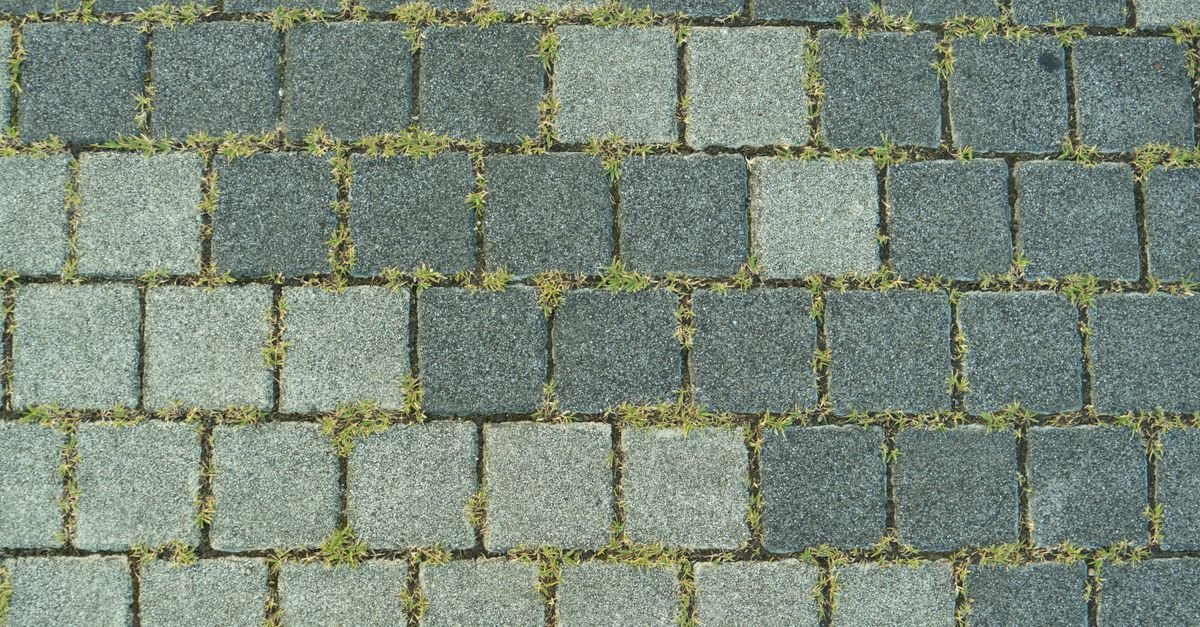
Under the pavers is compacted crushed aggregate with a thin bedding course over it: dark, dense and low in organic matter. Almost nothing germinates there, which is the entire point of building it that way. The growing medium sits above it, and we put it there ourselves without noticing.
CMHA describes the process without mentioning a weed at all: “Sand in joints will likely stabilize over time without additional treatment as a result of silts or other fines working their way into spaces between the sand particles.” Those fines are the problem — wind-blown dust, pollen, the crumbs a leaf leaves when it finally gives up, clippings thrown by the mower. Over three or four seasons the top half-inch of a joint stops being washed silica and becomes a narrow strip of real topsoil.
The strongest evidence is the pattern, and you already have it: weeds come back in the same lines. Not scattered the way they would be if they were finding voids in the base, but in specific joints — the shaded side, the low edge where water sits, the line along the wall where clippings collect. That is a map of where silt accumulates, which is what it should be if the root zone is the joint.
Push a flat screwdriver into a weedy joint and look at the blade. Clean, pale, angular grit means the joint is still doing its job and the weed is a seedling in the top few millimetres. Dark crumbly material that smells like a flower border means you are not looking at jointing sand any more. You are looking at soil in a slot.
One honest exception: the edges. A patio whose edge restraint has broken can genuinely be invaded from the side, because couch and Bermuda grass travel laterally on rhizomes and will run several feet under an edge course. If your weeds are all one grass and all within a foot of one edge, sand will not fix that. The edge restraint will.
Killing a Weed and Removing a Weed Are Different Jobs
Three domestic treatments dominate the advice here, and they do genuinely different things. What they share matters more: not one of them addresses the joint.
Boiling water is the underrated one. A full kettle emptied into a joint denatures the proteins in whatever it touches, immediately, with no residue and nothing to keep children and dogs off afterwards. The limit is thermal rather than chemical: sand and stone are a heat sink, so water entering at 212°F is well below that two or three inches down. It kills seedlings and shallow annuals reliably, and a mature dandelion taproot treats it as weather. On polymeric joints use it sparingly — there is no version of repeatedly boiling a cured binder that improves the binder.
Contact herbicides — household vinegar, or a horticultural acetic acid product — are where the answer has to be blunt. The National Pesticide Information Center at Oregon State puts it in two short sentences: “Acetic acid is a non-selective contact herbicide. It must touch the foliage of the plant in order to work,” and “It does not damage tissue it does not touch. It does not travel throughout the plant” (NPIC, Can I use vinegar to control weeds?).
That is the whole story of why the weeds are back in three weeks. The foliage browns within hours, which reads as success, and the root below the joint surface has received nothing. Annuals with one or two leaves die properly; perennials resprout from a root that was never treated. Meanwhile the acid runs into the joint, where it softens polymeric binder. Our guide to patio cleaning solutions covers which chemical families belong on which paving.
Mechanical removal — hand pulling, a hooked crack weeder, a joint knife — is the only method that reliably takes the root with the plant, and the only one whose side effect is printed on the packaging. A joint knife removes joint material; that is the job it is sold to do. So removal and re-sanding are one operation with a drying period in the middle, not two tasks for different weekends.
| Treatment | What it reaches | The joint afterwards | Typical return |
| Boiling water | Foliage and the top inch of root | Unchanged; sand stays put | 3–8 weeks on perennials |
| Vinegar / acetic acid | Only foliage it physically wets | Unchanged, but acid-loaded | 2–4 weeks on perennials |
| Hand pulling | The full root, if the soil is damp | Sand comes out with the root ball | Only once silt refills it |
| Joint knife | Root plus the growing medium | Emptied on purpose, to a known depth | Depends what goes back |
| Pressure washer | The plant, not perennial root crowns | Emptied by accident, depth unknown | 4–8 weeks, often worse |
Every answer in that last column depends on the joint, and only two rows do anything to it — one on purpose, one by accident.
Removing Weeds From Pavers Ends With a Bag of Sand
Here is the one strong opinion on this page. If you are not prepared to re-sand, do not wash. A patio that is ninety percent clean with full joints will have fewer weeds next June than one that is spotless with empty ones, and that gap is the difference between having a seed bed and not having one. The machine does not solve this. The broom at the end does.
The order matters more than any individual step:
1. Kill or pull first, three to seven days ahead. A browned-off weed leaves a joint with far less sand attached than a living one with a turgid root ball.
2. Clear the joints on purpose. A joint knife to the depth you intend to refill gives a known starting point; a pressure washer gives an unknown one.
3. Wash the faces if you want them clean, understanding that this step is cosmetic and costs sand.
4. Let it dry — a full dry day minimum, longer in shade or humidity.
5. Refill every joint, not only the ones that had weeds. The empty ones are where the weeds go next.
Plain kiln-dried jointing sand is loose angular grains: refills with a broom in twenty minutes, costs very little, and will silt up and grow something again within two or three seasons. That is not failure — it is a material that expects topping up, and it suits narrow joints, tumbled pavers and anyone who realistically sweeps a few times a year.
Polymeric sand binds into a single mass, and that mass is the actual weed control: no loose grains for a root to work between. CMHA is careful about how far to push the claim, and the wording is worth copying — joint and stabilisation materials “reduce the potential for weeds and insects in the joints.” Reduce. Seeds still land on a polymeric joint, and if leaf litter builds on top, something will root in that instead. Polymeric sand does not stop weeds; it removes the rooting medium, which is a different and better claim.
Polymeric Sand Half Done Is Worse Than Not Done
Plain sand fails gracefully. It washes out gradually, you sweep more in, nothing is destroyed. Polymeric sand fails into a solid you have to remove before the joint can be fixed — and its failure modes are published by the people who make it.
Too shallow. Black Diamond Coatings, which manufactures it, asks for “the joint depth to be at least 1 inch” (Black Diamond Coatings, The 6 Biggest Mistakes When Using Polymeric Sand). Poured over old sand at half that, it cures into a thin rigid lid on a loose bed, and lids crack. You now have a shaded, moisture-retaining fissure with a hard roof over it — a better germination site than the open joint you started with, and you cannot brush fresh sand in because the crust is in the way.
Under-watered. The same manufacturer is specific: “Under-watering causes the polymeric sand to simply form a ‘crust’ on the top… Eventually, the crust will break away, eroding the joint.” This is how most first attempts go wrong: a light misting looks like plenty, the surface sets, and it appears to have worked. It has set about a quarter inch of it.
Over-watered. The opposite error has its own mechanism: “Over-watering can lead to the polymers separating from the sand during activation… reducing your bonding strength.” Hose it as though you were rinsing a driveway and the binder floats out, leaving the sand loose and a haze on the paver faces as a souvenir.
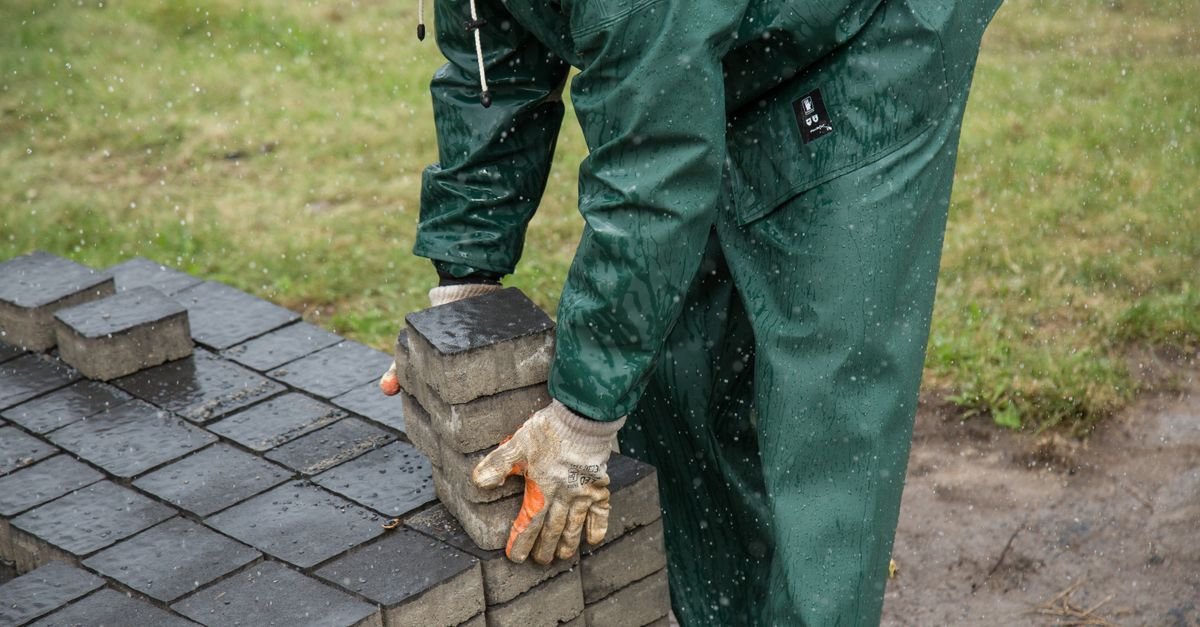
All three failures share one condition: the patio has to be dry going in and dry coming out. The photograph above shows paving being laid in exactly the weather you must not do this in.
So the rule of thumb. If you cannot clear the joints to a full inch, or cannot see two dry days on the forecast, use plain sand this year and put polymeric on the list. Plain sand done well beats polymeric done badly, and only one of the two has to be chiselled out afterwards.
FAQ
Does pressure washing kill weeds between pavers?
No, it removes them, which is not the same thing. The visible plant goes and the root crowns of established perennials often stay, so it regrows from the same point. The wash also strips joint sand, leaving an emptied joint that collects silt and germinates new seed. It is a removal method with a planting side effect.
Why do weeds keep coming back in the same joints?
Because the growing medium is in those joints and nowhere else. Silt, pollen, leaf crumbs and clippings accumulate fastest in shaded joints, low ones where water sits, and those under planting. That organic material is the soil the weeds are rooted in, so the pattern repeats until you replace the joint contents rather than the plants.
Will vinegar kill weeds between pavers?
It burns off the top growth and leaves the root. NPIC states that acetic acid “must touch the foliage of the plant in order to work” and “does not travel throughout the plant,” which is why perennials resprout within a few weeks. It also runs into the joint, where acid softens polymeric binder. Useful on seedlings, misleading on anything older.
Does polymeric sand stop weeds completely?
No, and the manufacturers do not claim it. CMHA says stabilisation materials “reduce the potential for weeds and insects in the joints.” A cured joint gives a root nothing loose to grow into, which is the real effect, but seeds still land on top and will root in any silt or leaf litter allowed to build up there.
Can I use bleach to kill weeds in paver joints?
Sodium hypochlorite scorches foliage, but it is a poor herbicide and a strong contaminant for a joint. It does not travel to the root, it loads the joint with sodium and chloride next to any steel edge restraint, and the runoff kills border planting. Keep it for algae on the paver faces.
Do weeds grow up from under pavers?
Rarely through the middle of a properly built patio, because the compacted base and bedding course are hostile places to germinate. The edges are different: broken or missing edge restraint lets creeping grasses run in laterally on rhizomes, sometimes several feet. If all your weeds are one grass and within a foot of one edge, look at the restraint.
Fill the Joint and the Weeding Stops Being Annual
Pressure washing a weedy patio removes this year’s weeds and builds next year’s nursery, because the joint sand it strips out was the only thing preventing germination. Joint sand is not tidying up. It is the weed control.
So work in the order the joint dictates. Kill or pull the plants and give them a few days to die back. Clear the joints deliberately, to the depth you intend to refill. Wash the faces if you want, knowing that step is cosmetic. Then let it dry and put sand back — plain if the joints are narrow, polymeric if you can clear a full inch and get two dry days, and never polymeric halfway.
Nothing here counts as finished until sand is back in the joints. A cleared joint is an open seed bed, and a patio washed in May with its joints left empty ends up in worse shape by August than one nobody touched. Plain sand if the joints are narrow, polymeric only if you can clear a full inch and get two dry days behind it — and plain sand this year beats polymeric done halfway.