Last Updated on September 26, 2026 by Umar Farooq
Solar panel cleaning is a garden hose, deionised water and a soft brush on a pole — and a pressure washer is the one tool on your property that can cost you the coating, the laminate and the warranty in a single afternoon.
I went looking for a module manufacturer that would give me permission. Not a blog, not a cleaning company with a van — the cleaning document that ships with the product. One maker publishes a maximum pressure that sits below the floor of the entire pressure washer category. Another names pressure washers directly and puts the consequence in the same sentence.
So this page is mostly a refusal, then the method the people who make the panels actually endorse, then the awkward question almost nobody writing about this will touch: whether your panels needed cleaning at all.
A Panel Is a Laminate, and the Edge Seal Is the Whole Argument
A module looks like a sheet of glass in a metal frame, which is exactly why people reach for a pressure washer. It is not.
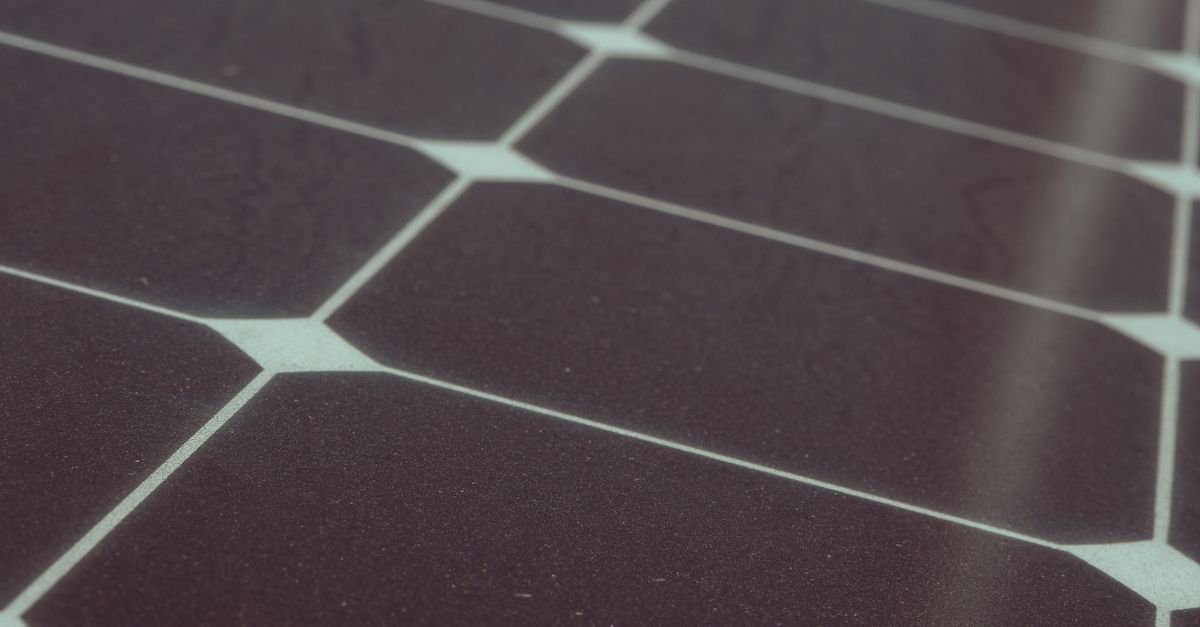
Tempered low-iron glass with a coating on the outer face, a layer of polymer encapsulant, the silicon cells with their printed silver fingers and soldered copper ribbons, more encapsulant, a polymer backsheet. Laminated under heat and vacuum, then clamped into an aluminium frame with a bead of sealant round the perimeter.
Everything electrical is inside the plastic, and its whole defence against water is that perimeter bead plus the fact that rain arrives downward at walking pace. The edge seal is a strip of sealant doing the job of a roof. It is excellent at rain and has no opinion whatsoever about 2,400 PSI, in the way that a letterbox has no opinion about a hosepipe.
REC Group spells out what happens when you ask it for one. High-pressure hoses, their guide says, “may exert pressure in excess of the certified load and cause impact damage, damage to the frame bonding, the laminate or cells and force water between the glass and frame” (REC Group, Quick Guide to Cleaning). First Solar says it as a flat instruction: “Do not spray pressurized water directly at sealed interfaces of module (junction box, edge seal, connectors)” (First Solar, FS-Series PV Module Cleaning Guidelines, PD-5-804).
Water inside a laminate hydrolyses the encapsulant, which loses its grip on the glass and clouds — that is delamination, and a cell that has lost optical contact with its glass has lost output permanently. It also corrodes the solder joints and copper ribbon, raising resistance until an interconnect opens. Neither shows up on the day. They show up as a string producing slightly less than its neighbours two summers later, and nothing in your monitoring app will draw the line back to the Saturday. Everyone who tells you they pressure washed their array and it was fine is measuring over the wrong number of years.
35 Bar Is the Most Generous Figure Anyone Publishes
Roof coverings are usually the frustrating case, because asphalt shingle makers publish no pressure number at all. Panels are the opposite, and that is rare enough to be worth appreciating. There is a figure in writing: “Water pressure must not exceed 35 bar (500 psi) at the nozzle.”
Two caveats before anyone treats that as a licence. First Solar makes thin-film modules that almost all live in utility plants cleaned by trained crews, and the same guideline says to clean “only when in open circuit and when modules are locked out from the load” — not something you can do to a domestic array from the garden. It is also one manufacturer, not a standard. What it is good for is calibration.
| Where the water comes from | Pressure at the tip | Against the 500 PSI ceiling |
| Garden hose, open end | 40–70 PSI | Comfortably inside |
| Hand pump sprayer | Under 60 PSI | Comfortably inside |
| 12-volt soft wash pump | 60–100 PSI | Comfortably inside |
| First Solar’s published maximum | 500 PSI | The ceiling itself |
| Entry-level electric pressure washer | 1,300–2,000 PSI | Three to four times over |
| Homeowner gas machine | 2,800–4,000 PSI | Six to eight times over |
The most generous figure any module maker publishes sits below the floor of every pressure washer sold, and the gap is not close enough to negotiate with. Nor is it a setting you have failed to find — a positive-displacement pump makes a fixed flow and the nozzle orifice sets the pressure, so easing the trigger, throttling the engine and winding the unloader down all leave you nowhere near 500 PSI. The black soap tip drops pressure into the hundreds, not to garden-hose level; our breakdown of low pressure roof cleaning covers how far that gets you and how to measure it.
Every tool that can meet the number, though, is one you already own or can buy for the price of lunch. That is a cheerful ending to a section that opened badly.
“Will Invalidate the Warranty” Is Not My Phrasing
I expected hedging. Manufacturers usually write exclusions in the passive voice and bury them on page nine. REC put theirs in a box with a bold rule through the middle:
“The use of pressure or steam cleaners and high pressure hoses, knives, blades and metallic sponges is not permitted on REC panels and will invalidate the warranty.”
Pressure cleaners sit in the same list as knives and blades. That tells you how the people who laminated the thing rank the risk.
First Solar’s version is quieter and broader: “First Solar does not provide Warranty on modules that are deemed damaged by the cleaning methods used.” No list, no threshold, no PSI to argue about — whoever chose the method carries it.
A domestic array usually carries twenty to twenty-five years of performance warranty, which makes it the most valuable piece of paper attached to the outside of your house. The exclusion does not work by somebody watching you. It works in year seven, when a module underperforms, the claim is inspected, and the inspector finds delamination at the frame edge and corrosion on an interconnect ribbon — the exact fingerprints of water forced past an edge seal. You will be the one explaining.
Two manufacturers are still only two manufacturers. Find the cleaning section in the installation manual for your own modules; the model number is on a label on the back. If yours says something different, believe yours.
The Anti-Reflective Layer Does Not Grow Back
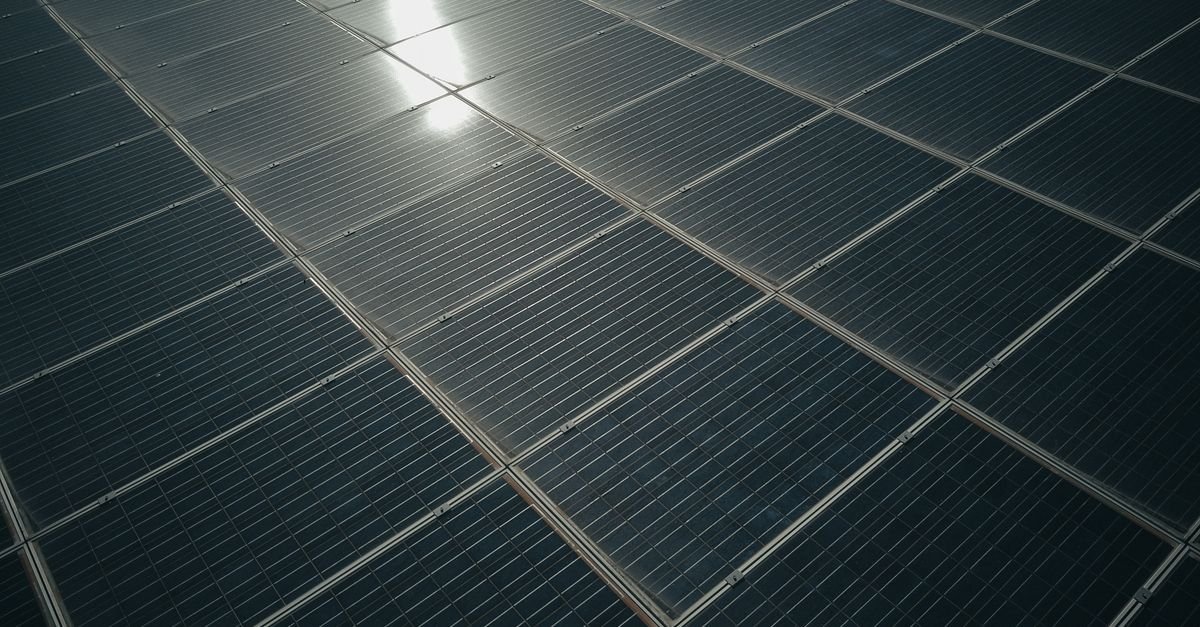
The outer face of the glass carries an anti-reflective coating — a thin porous silica layer, a fraction of a micrometre thick, applied and fired on at the factory. It cuts the reflection off the air-to-glass boundary and is worth a couple of per cent of your annual generation for nothing, forever, provided nobody scrubs it off.
It is thinner than the dirt you are trying to remove, and two things take it off.
Abrasion — not the brush, the grit under the brush. This is why every guide in this subject puts the rinse before the scrub with no flexibility. REC’s wording on drying is the clearest statement of it: “pay attention that any leftover grains of dirt or sand do not scratch the surface of the panel.” A soft brush with a grain of quartz caught in it has become a lapping tool, and it is running across a coating measured in hundreds of nanometres.
Chemistry — First Solar names names. Do not use solutions containing “hydrochloric acid, D-Limonene, ammonia, or sodium hydroxide”, and keep any detergent between pH 6.5 and 8.5. REC manages it in four words: “Acid or Alkali detergent must not be used.” None of that list is obscure: sodium hydroxide is the alkali in a great many degreasers, hydrochloric acid is the working ingredient in masonry cleaner and several descalers, and D-Limonene is the citrus solvent in the products sold as the gentle option — it smells like oranges and is still a solvent.
There is a specific trap here for anyone who has cleaned glass on this house before. The acid that gets hard water stains off of windows is precisely what First Solar prohibits on a module, because a window is glass all the way down and a panel is glass with something applied to it. Same-looking surface, opposite advice.
Which is why deionised water is not fussiness. Hard water dries into an opaque mineral film you then cannot dissolve off, because the acid would take the coating with it. First Solar’s fix is mechanical: hardness under 75 mg/L is fine, and between 75 and 180 mg/L “the water must be squeegeed off to prevent scale buildup.” Deionised water carries no minerals, so it dries leaving nothing, which is the entire reason the professional pole systems run it.
Your Body Weight Exceeds What the Glass Is Rated to Carry
This site has a settled position on roofs and it applies here, but the panel-specific version is sharper and has a design figure behind it.
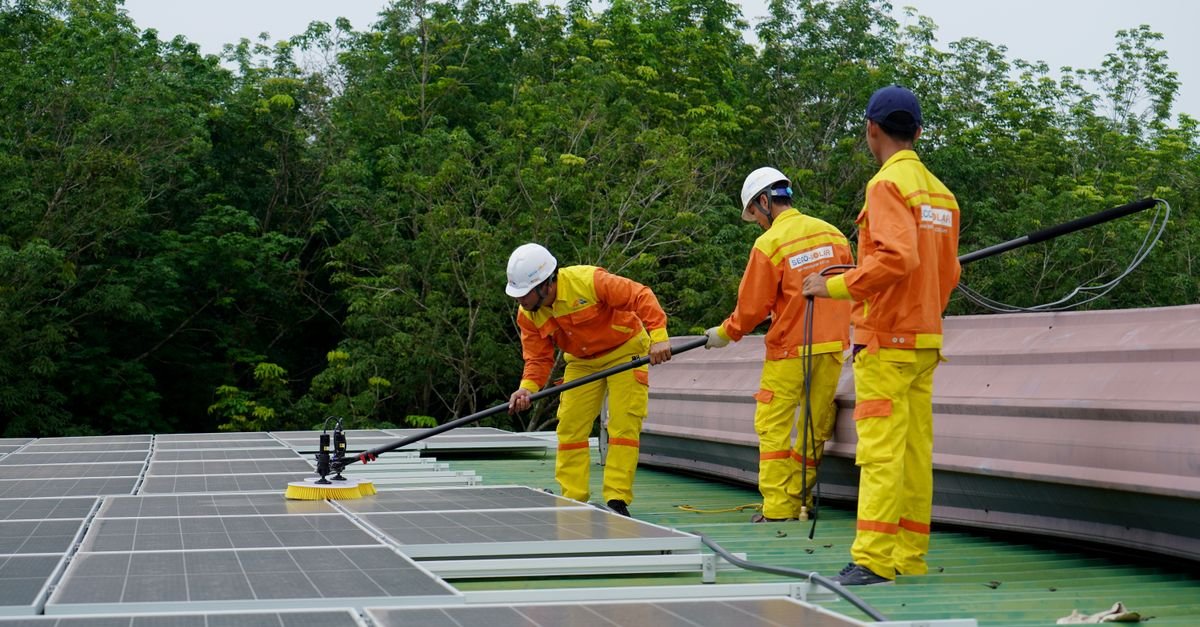
A module is certified for load spread across its whole surface — snow, wind, the uniform stuff. REC: “The panel is designed to carry the certified load across its whole surface area. Standing on the panels applies force through a much reduced surface area, which can far exceed the certified design load.” Then the rule: never “stand on, walk on, lean on or apply pressure to the panels as this can cause both visible and non-visible damage.”
Read “non-visible damage” twice. A microcrack in a silicon cell does not look like anything. It raises resistance locally, runs hotter than the cells around it, and becomes a measurable loss and a hot spot over years. The array looks untouched and is worth less.
Then the electrical side, which has no equivalent anywhere else on the outside of a house. An array is live in daylight and there is no switch on the panel. First Solar does not soften it: “The voltage and current present in an array during daylight hours are sufficient to cause a lethal electrical shock.” A string in series sits at several hundred volts DC, and DC is the unpleasant kind — the current never crosses zero, so an arc that starts has nothing to interrupt it. Add that “cracked or broken modules represent a shock hazard due to leakage currents, and the risk of shock is increased when modules are wet”, and inspecting before you wet anything stops looking like paperwork. Hence the timing in both guides: clean “from dusk to dawn when production is not affected and risk of electrical shock hazard is minimized.”
And the footing. Wet glass on a pitch is the slickest surface your house owns, it stands proud of the covering on clamps, and it is neither a walkway nor an anchor point. Our guide to DIY roof cleaning works through access properly. If you cannot wet and rinse the array from the ground or a ladder at the eave, this is not your job.
What a Year of Dust Actually Costs You in Kilowatt-Hours
Here is the opinion, and it will irritate anyone selling panel cleaning as an annual subscription: on a domestic roof in a climate that rains most weeks, a yearly clean does not recover its own cost. Nobody says so because the honest numbers come attached to conditions that get quietly dropped.
The figures that circulate come from desert research, and the best of it is a twelve-month study across the Atacama in Chile.
| Site | Annual rainfall | Self-cleaning events in 12 months | Annual energy loss to soiling |
| Arica | 0.6 mm | 3 | 39% |
| Iquique | 0.1 mm | 3 | 18% |
| Calama | 3.6 mm | 5 | 3% |
| Copiapó | 13.9 mm | 10 | 1% |
| La Serena | 74.9 mm | 15 | 3% |
| Santiago | 330.1 mm | 23 | 7% |
That 39% is real, and it was measured at a site that received six-tenths of a millimetre of rain in a year (Cordero et al., *Scientific Reports*, 2018). Copiapó, on 13.9 mm and ten self-cleaning events, lost 1%. If ten rain events a year gets a panel to 1%, a roof rained on most weeks is not in the 39% business and never was. Santiago is the wettest site at 330 mm — still drier than a great many places this page will be read — and its 7% has urban air pollution doing part of the work rather than dust.
The authors say the quiet part themselves. For the lower-soiling sites, “the measured annual energy losses (3% or less) may make the need of cleaning the PV modules more than twice a year unlikely (or economically inconvenient).” That is soiling researchers, standing in a desert, concluding that twice a year is already probably not worth the money at 3%.
So do the sum in your own currency rather than in percentages. Open your monitoring app, take last year’s generation in kilowatt-hours, take one per cent of it, multiply by your unit rate. That is the honest upper bound on what an annual clean buys back on a pitched roof in a rainy climate, and next to most quotes it loses by a wide margin.
No monitoring? Fix that before you touch the glass. It is the only diagnostic on your house that tells you whether a job is worth doing before you do it, and soiling has a signature — a slow decline that partially recovers after heavy rain, where shading and a failing module do not recover at all. REC design for this, noting their panels “are manufactured so that normal and regular levels of rainfall will clean them naturally if installed at a sufficient angle.”
Solar Panel Cleaning the Manufacturers Actually Endorse
Everything above is the argument. This is the job, assembled from the two published guides rather than from anybody’s opinion.
Inspect before you wet anything. From the ground, binoculars if the array is high. Cracked glass, a discoloured or scorched-looking cell, a chewed cable, a clamp that has moved — any of those and the next call is your installer, not the tap.
Go out early. REC warns that “applying cool, cold or lukewarm water to hot panels can cause components (e.g., glass) to shrink rapidly, potentially causing cracks and breakages”, and says to clean “before reaching working temperature i.e., early morning”. First Solar gives the tolerance as a number — stay within 20°C of the module’s surface temperature. Not two o’clock in July.
Use the softest water you can get. Deionised first choice; REC says so outright. Rainwater from a butt is a fair second. Soft tap water is fine, and hard tap water commits you to squeegeeing the array dry before it dries itself.
Rinse with a garden hose at mains pressure and let it run. REC: “A standard flexible garden hose with domestic water pressure may be used to apply as much water to the panel or array as necessary, allowing the water to run down the entire surface.” Start at the top and let gravity carry the grit off before anything touches the glass.
Only then, a soft brush on a pole. Non-abrasive, and — the instruction people skip because it sounds like a technicality — non-conductive. First Solar specifies “a non-conductive nylon or similar material brush” and requires agitating tools be built from non-conductive materials “to minimize risk of electric shock”. That specification is not protecting the glass.
Detergent: preferably none. REC allows a mild biodegradable washing-up liquid provided “the panel must be immediately rinsed with plenty of water”, and isopropyl alcohol under 20% for stubborn marks. First Solar allows a mild, non-caustic detergent inside pH 6.5–8.5. Nothing on either list is something you would reach for on a driveway.
Leave the back alone. First Solar: “Do not brush or clean backside of module to avoid accidental stress to lead wires or junction box.” If moss appears underneath, REC’s view is that it “is not generally a cause for concern”.
Do not leave your kit lying on a live panel. A cell shaded while the cells in series with it are in full sun gets driven into reverse bias and heats. First Solar treats “resting or adhering slender objects (tools, brooms, clothing, wires, tape) on sunny side of operating modules” as prohibited high-risk shading, and states that “module shading may result in warranty coverage being voided.” A squeegee left across a working module is a fault condition with a warranty note attached, which is the first time I have had to describe putting a tool down as a mistake.
Dry naturally, or squeegee downward. Air drying is preferred. On hard water the squeegee is compulsory.
Bird Droppings, Lichen and a Flat Array That Never Sheds
None of this is “never clean your panels”. There are five situations where it is genuinely worth doing, and only one of them is dust.
Bird droppings. Always, promptly, and the one case where the cost is wildly out of proportion to the area. A dropping is opaque and does not rinse off, and a fully blocked cell with illuminated neighbours becomes a resistor the whole string is pushing current through — so the bypass diode protecting that substring takes a third of the panel offline to save it. Two square inches of soiling, a third of a module, and a hot spot while it sits there.
Lichen creeping up from the bottom frame. Lichen is attached rather than deposited, so rinsing does nothing, and it establishes along the bottom edge because that is where water stands. It shades the lowest cell row, which is the worst row to shade for the same series-circuit reason. Clear it by hand while it is still a fringe.
A flat or near-flat array. Both guides tie natural cleaning to installation angle, and below roughly ten to fifteen degrees a panel stops shedding. Water sheets, slows, stops, and evaporates where it stopped, leaving the dirt in a band along the bottom. A shallow array on a garage roof genuinely needs periodic cleaning in a way that a 35-degree pitch does not. If you have both on one house, clean one and not the other.
Agricultural, quarry or unsealed-track dust. A combine working the next field, a sawmill, a gravel drive, a building site for a summer. These are real soiling regimes and the conditions under which the desert research starts to mean something. Watch the generation curve rather than the calendar.
A heavy pollen week. Pollen forms a film that light rain smears rather than removes, which is the failure mode that catches people — it rained, so surely it is clean, and instead it has been evenly distributed.
And the one nobody mentions, which is the honest reason to clean a pitched array every few years: the frame lip holds a few millimetres of water along the bottom edge of every module, which dries in place and leaves whatever it was carrying. That grey band thickens over years and shades the bottom of the lowest cells. It is not dust, rain will not shift it, and a soft brush with plenty of water will.
FAQ
Can you pressure wash solar panels?
No. REC Group’s cleaning guide states that pressure and steam cleaners and high-pressure hoses are “not permitted on REC panels and will invalidate the warranty”, and the most permissive figure published by any module maker I could find is 500 PSI at the nozzle — below the floor of every pressure washer sold. The mechanism is water forced past the perimeter edge seal into the laminate, causing delamination and corrosion over months rather than visible damage on the day.
How often should solar panels be cleaned?
On a pitched roof with regular rainfall, often not at all. Check your generation data rather than the calendar. Peer-reviewed measurements found 1% annual loss at a site receiving fourteen millimetres of rain a year, and the authors concluded that cleaning more than twice a year was probably not economic even at 3%. Clean when something specific is on the glass.
Does rain clean solar panels?
On a sufficiently steep array, largely yes — that is what manufacturers design for and what the soiling data shows. Rain fails on three things: anything attached rather than deposited, anything opaque and localised like a dropping, and the standing water at the bottom frame lip. It also fails on a flat array, because water stops before it reaches the edge.
What water should I use to clean solar panels?
Deionised is first choice and REC names it as such. Rainwater is a good second. Soft tap water under 75 mg/L total hardness is acceptable; harder than that and the mineral film it dries into becomes its own shading problem, which you cannot then attack with acid because the acid would take the anti-reflective coating with it.
Does cleaning solar panels void the warranty?
The method can. REC names pressure cleaners, steam cleaners, high-pressure hoses, knives, blades and metallic sponges as invalidating the warranty. First Solar states that it “does not provide Warranty on modules that are deemed damaged by the cleaning methods used”, and separately warns that shading a live module with your tools may void coverage.
Can I stand on solar panels?
No. A module is certified for load spread across its whole surface, and a boot concentrates that load through a few square inches. REC’s guidance is not to stand, walk, lean on or apply pressure to a panel at all, because it causes “both visible and non-visible damage” — and the non-visible sort is a microcrack that costs output for the rest of the panel’s life without ever looking like anything.
Is it worth paying someone to clean solar panels?
Do the sum first. Take last year’s generation in kilowatt-hours, take one per cent, multiply by your unit rate, and compare it to the quote. On a rainy-climate pitched roof the quote usually wins by a lot. It becomes worth paying for when the array is two storeys up, flat, genuinely fouled, or when the alternative is you on the slope with a wet panel underfoot.
Let the Weather Do It, and Read Your Own Warranty
If you take one thing from this page, make it the arithmetic rather than the outrage. An array on a decent pitch, in a climate with rain in it, is mostly self-cleaning, and the honest value of an annual clean is a number you can work out in ninety seconds from your own monitoring data. Most of the time it is smaller than the invoice, and the correct action is to do nothing and enjoy it.
When something genuinely needs to come off, go out early, use the softest water you can get, rinse before you touch the glass, and work with a soft brush on a long pole from somewhere you are not going to fall from. That is the whole method, and it is the method because the panel is a laminate with a seal round the edge and a coating on the front — both of which your machine can reach, and neither of which the factory can put back.
The pressure washer stays in the garage for this one. Not because I am being careful on your behalf, but because REC wrote “will invalidate the warranty” in bold and I am simply the person who went and read it.