Last Updated on September 26, 2026 by Umar Farooq
Cleaning pool deck surfaces is the only flatwork job on your property where the cleaner has to be safe for two things at once — the deck under the brush, and the twenty thousand gallons of water three feet away that is going to end up drinking it.
Every other slab you own drains somewhere you will never think about again. A pool surround drains into a container you have spent all summer balancing, testing and topping up, and it drains there whether that was your plan or not. The deck does not have a drain. It has a swimming pool.
That one fact rules out a surprising share of the shed, and it is why driveway technique transplanted onto a pool surround tends to produce a clean deck and a cloudy pool on the same afternoon. This article is about the surround as a surface and as a routine: what each material will tolerate, which residues are actually on it, and how to get them off without handing the water a problem. If what you are chasing is specifically the green staining on the coping and tile band, swimming pool algae stain removal owns that job and goes deeper on it than I will here.
Your Cleaner Becomes Pool Chemistry Whether You Meant It To or Not
Start here, because it decides what you are allowed to buy. Overspray drifts, runoff finds the low point, and a wet deck sheds toward the coping because that is the direction most surrounds are graded — so assume a fraction of everything you apply arrives in the water. Then ask what that fraction does when it gets there.
| What you put on the deck | What it does in the pool |
| Dish soap, degreaser, any surfactant | Foams. Not for an hour — for days, because there is nothing in a pool designed to remove it |
| A detergent built on phosphates (TSP and its relatives) | Adds algae nutrient to water you sanitise specifically to stop algae |
| Muriatic or dry acid run off the tile band | Drops pH locally and fast; a small volume of concentrate moves a large volume of water |
| Sodium hypochlorite, dilute | The least troublesome arrival, because it is the sanitiser — the dead organic load it carries is the real cost |
| Sodium percarbonate, oxygen-type cleaners | Arrives as carbonate and pushes total alkalinity up |
| Citrus or solvent degreasers | Floats as a film on the surface and gets skimmed rather than filtered |
The phosphate row is the one worth stopping on, because almost nobody joins these two dots. Phosphorus is what limits how much algae a body of water can grow, and the EPA states the consequence plainly: “Too much phosphorus can stimulate excess growth of algae, which leads to low dissolved oxygen levels, potential for harmful algal toxins, blockage of sunlight” (US EPA, Indicators: Phosphorus). Trisodium phosphate is a genuinely good alkaline builder on a greasy slab, which is why it shows up in so many hard-surface recipes — the full account of what it does and does not shift is in cleaning concrete with TSP. It is also, chemically, fertiliser. Scrub a pool surround with it and you are dosing the water with the one nutrient your algaecide budget exists to deny it.
So here is the single strong opinion in this article, and it is less about gentleness than it sounds: on a pool deck the correct default product is warm water, a phosphate-free soap and a stiff nylon brush, not because the deck is delicate but because it is the only option on the list you do not have to keep out of the pool. Everything stronger is a thing you now have to manage in two places. Reach for it when the soap has actually failed, which is later than most weekends assume.
Six Pool Deck Surfaces, Six Different Ceilings
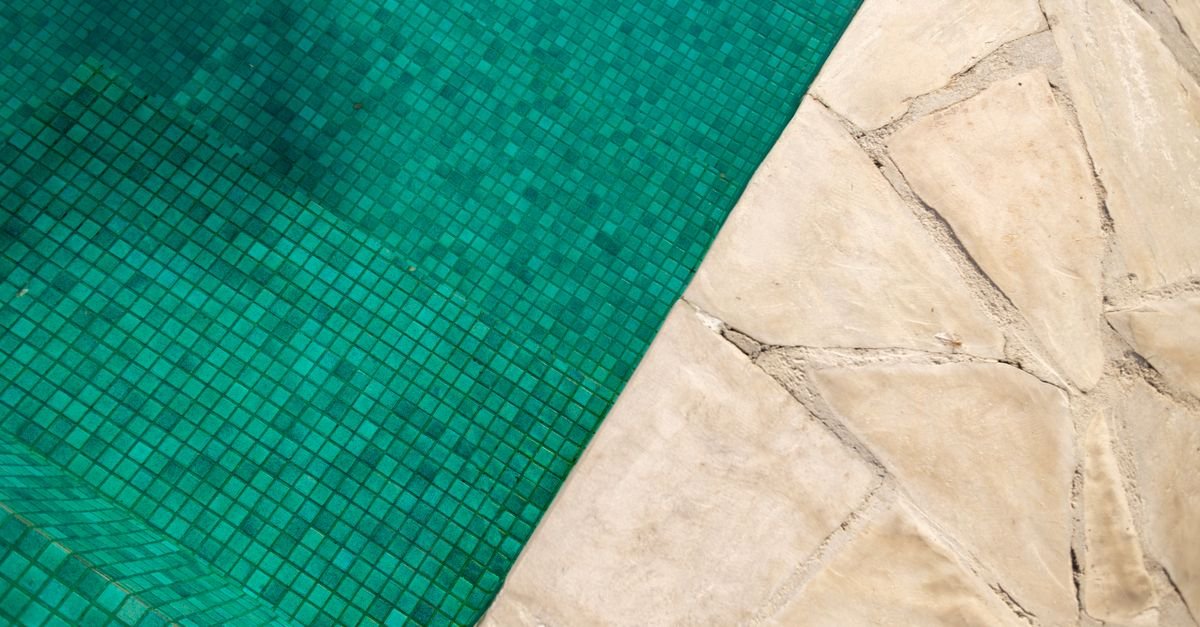
The surround is where builders put the most varied set of materials on the property, usually chosen for how they feel underfoot at 35 degrees rather than for how they wash. Work out which one you have before you pick a pressure.
| Surface | Sensible working pressure | What fails first |
| Broom-finished concrete | 1,500–2,000 PSI, 25° fan or a surface cleaner | The broom peaks flatten before the slab shows any damage |
| Stamped or integrally coloured concrete | 1,200–1,500 PSI, 25°–40° | Pigment and release colour live in a thin top layer; hypochlorite fades them too |
| Cool-deck acrylic texture overlay | Garden hose and a brush — see the next section | The coating itself, and it does not come back |
| Concrete or clay pavers | 1,200–1,500 PSI, 25°–40° | Joint sand, which a narrow tip excavates in about two seconds |
| Travertine, limestone, marble coping and paving | Under 1,200 PSI, 40°, or brush it | The stone’s tooth, and any acid at all dissolves the stone outright |
| Composite or PVC decking | Manufacturer-specific | The board’s surface film — Trex publishes 3,100 PSI with a fan tip no closer than 8 inches for current boards and none at all for early generations |
Two things that table is doing. First, every figure in it sits below the 2,500–3,000 PSI that general concrete flatwork guidance carries, and that is deliberate — a driveway is bare structural concrete, while a pool surround is usually a finish laid on top of concrete for comfort and colour. You are almost never cleaning the slab. You are cleaning something thinner sitting on the slab.
Second, if you cannot identify the surface, the deck will tell you. Tap it: an overlay sounds hollower than poured concrete. Look at an edge or a step nose for a colour line where a coating stops. Find an off-camera corner behind a lounger and test there, wet, for a full minute before you commit to the visible ninety per cent.
Cool-Deck Coatings Have a Care Sheet, and It Rules Out the Wand
This is the section that pays for the article, because the coating in question is extremely common on American pool decks and almost nothing written about pool cleaning mentions it.
A cool deck is a sprayed cementitious-acrylic texture applied over the slab, knocked down to a mottled finish, and coloured. The point of it is thermal: a pale, textured, air-filled surface is bearable on bare feet when plain grey concrete is not. Kool Deck is the best-known name and Mortex Industries makes it — so I went looking for what the manufacturer actually publishes, having found that everybody else was guessing.
Mortex’s care sheet mentions a pressure washer exactly once, and puts two conditions on it. The routine method is not a machine at all: “Surfaces should be cleaned by using strong soap and water and a nylon bristle broom to scrub the surface and then rinsed clean with a garden hose.” Pressure appears only under the heading *Mineral Deposits — Experienced Contractors Only*, where the instruction is that “use of a surface cleaner attachment on a 3000psi or greater pressure washer is recommended for lighter accumulations” (Mortex, Care and Cleaning Instructions for Kool Deck and Solement).
Read that carefully, because it is more interesting than a blanket ban. The maker does not forbid pressure. It forbids the wand. The permitted tool is a surface cleaner, which is a housing holding two nozzles at a fixed height on a spinning bar — the reason that matters is covered properly in pressure wash surface cleaner, but the short version is that a surface cleaner cannot be held two inches from the coating by an enthusiastic human, and a wand can. The variable Mortex is removing is you.
Three more things from the same sheet are worth having:
- Acid is an owner prohibition, not a caution. “The deck owner should not attempt Muriatic acid washes.” Acid baths are described as neither necessary nor recommended for general maintenance.
- A salt chlorinator shortens your interval. “If you have a salt water chlorinator, it is essential that you rinse and clean your deck frequently.” Salt splash dries to a deposit that plain rinsing removes and a month of neglect turns into the grey mineral build-up in the paragraph above.
- A new overlay has a four-week exclusion zone. Curing takes 28 days: no contact for 48 hours, no light use for a week, walking from two weeks, and no patio furniture or hard-soled shoes for the full four.
The failure mode nobody mentions is the edge. Where the coating has chipped at a step nose or cracked over a control joint, a jet aimed across it gets underneath, and an overlay that has lost its bond to the slab lifts in sheets rather than in the spot you were pointing at. Seal the chips when they appear. That is the whole maintenance programme for a cool deck, and it costs a tube of patch.
Sunscreen and Body Oil Are a Grease Job in Disguise
Here is the residue people work hardest on and identify least often. A pool surround accumulates a lipid film — sunscreen emollients, body oil, hair product, the mineral oil in tanning lotion — deposited by wet feet, dripped off towels and transferred by anyone who lies down.
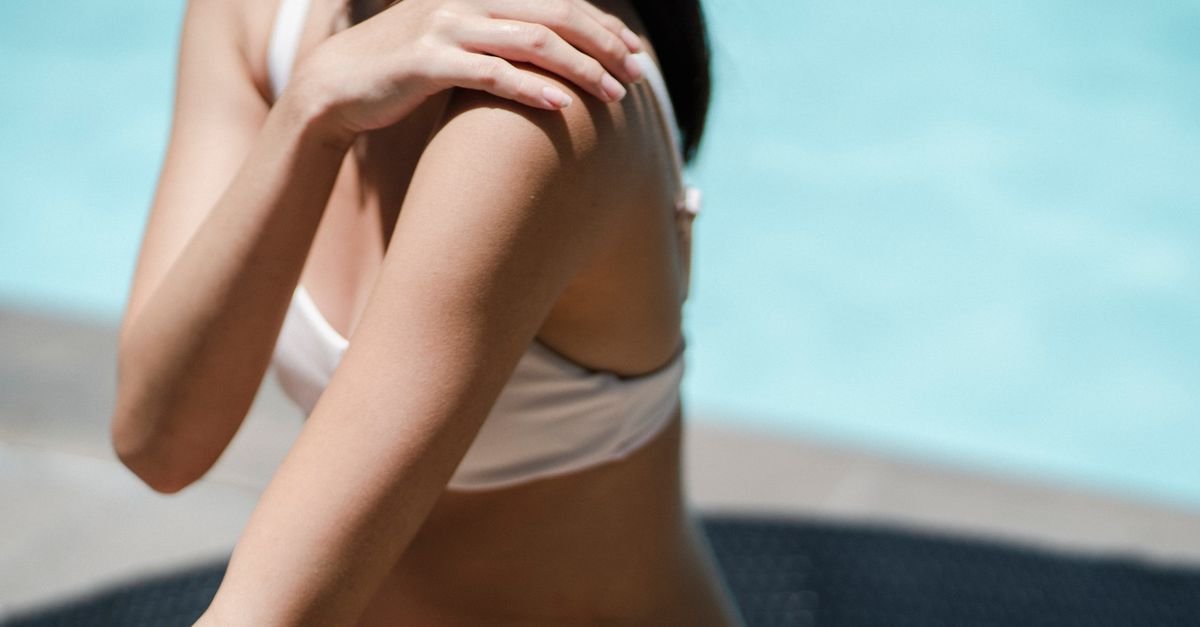
It has three tells, and once you know them you will not misdiagnose it again. It is invisible when the deck is dry and obvious when the deck is wet, because oil repels water and the film beads while the surround around it darkens evenly. It is shaped like human behaviour rather than like weather — a rectangle under each lounger, a band across the top two steps, a patch at the ladder. And it picks up dust, so what you finally notice is grey, not greasy.
Which is why so many people fail at it. They see grey, assume mildew or algae, and reach for hypochlorite. Bleach is an oxidiser: it destroys the coloured organic bonds in a living film, which is exactly right for green. It has no surfactant action whatsoever, so on a lipid layer it lands, sits on top of something that will not wet, and rinses off having accomplished nothing except convincing you the stain is permanent.
Grease needs emulsifying, and the manufacturer of the most common pool deck coating names the remedy without hedging: “Build-ups of oil type stains such as suntan lotion, body oils, etc. can be easily cleaned with this procedure” — the procedure being strong soap, water and a nylon scrub brush. Warm water helps more than pressure does, because a film that is soft shifts and a film that is cool does not. SPF 50 is formulated to survive swimming, sweating and a beach towel; your deck was not a consideration in the brief.
There is a reason to catch it on the deck rather than let it walk into the water, too. Organic UV filters are now tracked as pool pollutants in their own right — one review of octocrylene notes it “has been found in various environments, not least those of swimming pools, where it is evidently released by consumers, to the point that it is now considered an emerging micropollutant,” and that chlorination generates a list of degradation byproducts from it (Molecules, 2022, PMC9415856). The sunscreen on your deck is going to meet your chlorine somewhere. A bucket of soapy water is a cheaper place for that meeting than the pool.
Cleaning Pool Deck Flatwork: The Order That Keeps It Out of the Water
The sequence below is ordered for the water rather than for the deck, which is the part that differs from every other flatwork method on this site.
One — strip the deck and sweep it dry. Loungers, tables, toys, the doormat. Wet leaf litter dragged across a surround has stopped being debris and become a stain, and anything left in place leaves a shadow you will see in October.
Two — cover the pool, or at least the half you are standing over. A solar cover, a tarp, a winter cover, whatever is in the shed. This is the highest-value thirty seconds in the whole job.
Three — soak the borders and planting before anything else gets wet. Wet ground turns most of what lands on it away, and dry ground takes it in. Same trick as on a driveway, more relevant here because pool beds are usually narrow and right against the hard edge.
Four — degrease before you disinfect. Soap, warm water, nylon brush, and work the lounger footprints and the steps first. Doing this in the other order wastes the chlorine on a film it cannot reach.
Five — treat what is left biologically, weakly, and with dwell. Dilute hypochlorite with a little surfactant does the killing on concrete, pavers and clay; go weaker still on calcareous stone, and never let any mix dry on the surface. The staining side of this is the sibling article’s territory rather than mine.
Six — rinse with the fan pointing away from the water, on every strip. People argue about whether to start at the far edge or the coping. The direction of the nozzle matters far more than the order of the strips: whatever you are standing on, the spray travels away from the pool, which means you walk toward the water rather than along it. Lowest pressure that lifts the residue. Distance is your other pressure control and it is free.
Seven — put the machine away and go and test the water. Check pH and free chlorine, run the filter for a full cycle rather than an hour, and skim the surface for film. If the deck was greasy, expect to see something arrive on the water within a day.
That last step is the one people skip, and it is the difference between a deck job and a deck job plus a week of pool correction.
Texture Is a Budget, and Every Pass Spends Some of It
A pool deck is textured on purpose. The broom finish, the knocked-down overlay, the tumbled paver and the honed travertine all exist because people cross them wet, barefoot, and sometimes at a run. That texture is not decorative and it is not renewable.
Several perfectly effective cleaning methods spend it. A rotary or turbo nozzle held in one place polishes the high points off a broom finish. A surface cleaner moved too slowly does the same thing more evenly, which is worse because it looks deliberate. Acid takes the tooth off any calcareous stone, permanently. And a glossy wet-look sealer, chosen because it makes the colour pop in photographs, is the single worst finish decision available on a surface people walk on with wet feet.
So spend less of it:
- Use a wider tip than you think you need and keep the wand moving, always.
- Prefer a fixed-standoff tool over a handheld one on any coated or coloured deck.
- Reach for a deck brush before a narrower nozzle. Agitation is free and it does not remove material.
- If you seal at all, seal matte and penetrating, with a grit additive.
- Test barefoot and wet before you call it finished. If the deck feels faster underfoot than it did last week, you have cleaned it too hard, and the only honest fix is to stop escalating and let it weather.
Dirt washes off. Texture only goes one way.
When to Do It: the Pool’s Week and the Pool’s Year
Timing is a real variable here, not a filler section, because the deck wash adds a load the water then has to process.
Wash the deck at the front of your service cycle, not the back. Do it the day before you would normally shock, brush and backwash anyway, and the correction you were already going to make absorbs the organic load, the surfactant and the dirt. Do it the evening after a full service and you have thrown away the week.
Never on the same surface, on the same day, as anything acidic. If a scale product has been on the tile band, rinse thoroughly and give it a day before anything chlorinated goes near those stones. That applies to sprayers and buckets as well as surfaces.
Let the sun work for you. Hypochlorite degrades in daylight faster than anything else on the shelf, so a mix applied mid-morning and rinsed at midday arrives in the water considerably weaker than one applied at dusk.
As for how often: the surround does not run on a calendar, it runs on how fast it dries. The strip within about four feet of the water never dries properly, and the shaded side dries less than the sunny side, so the two decks either end of the same pool need different intervals. A practical schedule that keeps the annual job small:
- Weekly, in season: hose the wet strip and sweep the rest. Two minutes. This is the entire secret.
- Monthly, in season: soap and brush the lounger footprints and the steps, before the grease accumulates into grey.
- Twice a year: the full wash, at opening and at closing, when the furniture is off the deck anyway.
- With a salt chlorinator: rinse more often than that, on the manufacturer’s own instruction.
- On a new overlay: nothing at all for four weeks.
FAQ
What is the best way to clean a pool deck?
Warm water, a phosphate-free soap and a stiff nylon brush, in that order of importance, with a hose rinse. That is not a compromise recommendation — it is what the maker of the most common pool deck coating publishes as its routine method, and it is the only approach you do not also have to keep out of the pool. Escalate to dilute hypochlorite for biological growth and to a pressure washer for large areas of plain concrete.
Can you pressure wash a pool deck?
On broom-finished concrete or pavers, yes, at 1,200 to 2,000 PSI with a 25 or 40-degree fan, or with a surface cleaner. On a cool-deck acrylic overlay, on stamped or coloured concrete, and on travertine or limestone, a handheld wand is the wrong tool and a surface cleaner or a brush is the right one. Identify the surface first; the ceilings differ by more than a factor of two.
Can you pressure wash a Kool Deck?
Only in one specific way. Mortex, which makes it, gives the routine method as soap, a nylon bristle broom and a garden hose, and permits pressure only as “a surface cleaner attachment on a 3000psi or greater pressure washer,” described as being for mineral deposits and for experienced contractors. It also tells owners not to attempt muriatic acid washes. A handheld wand is not on the list, and a chipped edge is where an overlay starts to lift.
How often should a pool deck be cleaned?
The interval is set by how many hours the surface spends wet, not by a date. Rinse the four-foot wet strip weekly in season, soap the lounger and step areas monthly, and do the full wash twice a year at opening and closing. Heavy tree cover, a shaded aspect or a salt chlorinator all shorten every one of those.
What PSI is safe on a travertine pool deck?
Stay under about 1,200 PSI with a 40-degree tip, and be honest about whether you need the machine at all — travertine is soft, porous and quick to lose its surface tooth. The more important rule on travertine is chemical rather than mechanical: it is calcium carbonate, so any acid dissolves the stone itself, and that includes vinegar and any scale remover intended for the tile band.
Why does my pool deck look clean when it is dry and dirty when it is wet?
That is a grease film, almost certainly sunscreen and body oil. Oil repels water, so the film beads while the surround around it darkens, which makes it visible only when wet. Bleach will not move it, because bleach has no surfactant action. Soap, warm water and a brush will, and the patches will be shaped like furniture rather than like weather.
Soap, Patience, and a Rinse That Runs the Other Way
Everything difficult about a pool surround comes from one constraint: it is a small, permanently damp patio with a large open container in the middle that you are not allowed to drain into. Work backwards from that and the method writes itself. Identify the finish before you pick a pressure, degrease before you disinfect, keep the fan pointed away from the water, and treat the texture as something you can only spend.
Degrease before you disinfect. Bleach has no surfactant action, and a sunscreen film is the single most common thing people try to bleach off a pool surround. The rest of the order follows from that one: identify the finish before you pick a pressure, soap and a nylon broom on the oily patches, dilute hypochlorite only on what is genuinely growing, and every rinse angled away from the coping. No acid on travertine at any dilution, vinegar included, because the stone and the scale are the same mineral.