Last Updated on September 25, 2026 by Umar Farooq
If your pressure washer won’t run without choke after the engine has properly warmed up, it is running lean — the choke is strangling the air side to make up for fuel that is not arriving, which makes it a symptom you are reading, not a setting you have found.
This is the cleanest diagnostic on the whole machine, and it is worth saying that out loud before anything else. Most faults make you guess. A machine that dies the moment you open the choke has already done the narrowing for you: it has spark, it has compression, and it has fuel somewhere, because it ran. What it does not have is enough fuel arriving at the throttle position you are asking for. Three things cause that, and this article is those three things and nothing else.
When a Pressure Washer Won’t Run Without Choke, It Is Running Lean
The choke plate is a flap that closes across the carburettor’s air intake. Shut it and you restrict the air while the fuel circuits keep drawing at roughly the same rate, so the mixture arriving in the cylinder gets richer. A cold engine needs that, because cold petrol does not vaporise well and cold metal condenses what does. Thirty seconds later the engine is warm and the choke should be fully open.
So a warm engine that still wants choke is telling you something specific: the only way it can reach a mixture it can burn is by throttling the air down to meet the fuel. The fuel side is short. Vanguard’s own service note puts the same reading in a single line — “the engine starts and runs but only on full or half choke: this may indicate restricted fuel flow to the carburetor or it may indicate a partial restriction of a jet or passageway within the carburetor” (Vanguard, rebuilding a small engine carburetor). That is a manufacturer saying, in print, that choke dependence is a diagnosis rather than a quirk.
Two boundaries before we go further. If yours is an electric pressure washer, there is no choke and none of this applies. And if the machine needs choke for the first twenty or thirty seconds on a cold morning and then runs perfectly with it open, nothing is wrong — that is the part the choke was fitted to do.
Everything else on this page assumes the machine is warm, the choke is still doing work, and you would quite like to stop holding it there like a man keeping a door shut with his foot.
Separating the Three Causes Without Removing a Single Part
Before you undo anything, get the engine warm, connect the water, and pay attention to *when* it needs the choke. The throttle position and the history are what split the three causes apart, and both are free.
| What you observe | What it points at |
| Needs choke at idle and low throttle, runs cleanly at full throttle with the choke open | The low-speed (pilot) circuit — varnish |
| Needs the same choke at every throttle position, warm or cold | Unmetered air getting in after the carburettor |
| Ran fine for five or ten minutes, then wanted progressively more choke | Supply upstream — vent, tap, filter or line |
| Machine sat a season with fuel in it and has been like this since | Varnish, first suspect, no argument |
| Started right after somebody had the carburettor off | Air leak — a gasket, a spacer or two mounting nuts |
| Got worse the moment the tank was filled to the brim | The cap vent, and it is a ten-second test |
The single most useful sentence here: the throttle position at which the engine needs choke tells you which fuel circuit is short. A carburettor has separate passages for idle and for full throttle, and varnish closes the small one long before the big one. An air leak does not care about throttle position at all — it is a hole, and a hole behaves the same way all day.
If the pattern is ambiguous, work the list below in order anyway. It is ordered by how often each one turns out to be the answer, not by how satisfying it is to fix.
Varnish Shuts the Smallest Passage First
This is the common one, and it is not close. The low-speed circuit — the pilot jet and the tiny transfer ports just behind the throttle plate — contains the smallest holes on the machine. They are drillings you have to hold against a window to see through.
Petrol left standing evaporates unevenly, and what stays behind is an amber lacquer that coats everything it touched. Deposit a film of it two thousandths of an inch thick and the main jet barely notices. The same film closes a pilot jet most of the way, because area goes with the square of the diameter — take two thousandths off the walls of a hole that was only a few thousandths across and you have taken most of what it had. That is why a single storage season can produce an engine that starts beautifully on choke and dies the instant you open it.
The tell is the throttle test in the table above: choke needed at idle, not needed at full throttle. That is a machine whose main circuit is fine and whose idle circuit is closed. Confirm it by dropping the carburettor bowl and looking into it. An amber film across the base is a positive result, and the whole check takes five minutes.
What happens next is not this article’s job. The strip, the soak, the four places a carburettor blocks and the rule about never putting anything metal through a jet are all in pressure washer carburetor cleaning, which owns that afternoon properly. One thing worth carrying over from it: if the throttle shaft rocks sideways in its bore, you have cause one and cause two in the same part, and cleaning will not fix the second half.
Where Is the Unmetered Air Getting In?
A carburettor does not measure fuel. It measures *air*, and meters fuel against it. Every drop it delivers is proportioned to the airflow passing through its own throat. So any air that enters the engine downstream of that throat was never counted against any fuel at all, and the mixture leans out by exactly that much, with no warning and nothing to see.
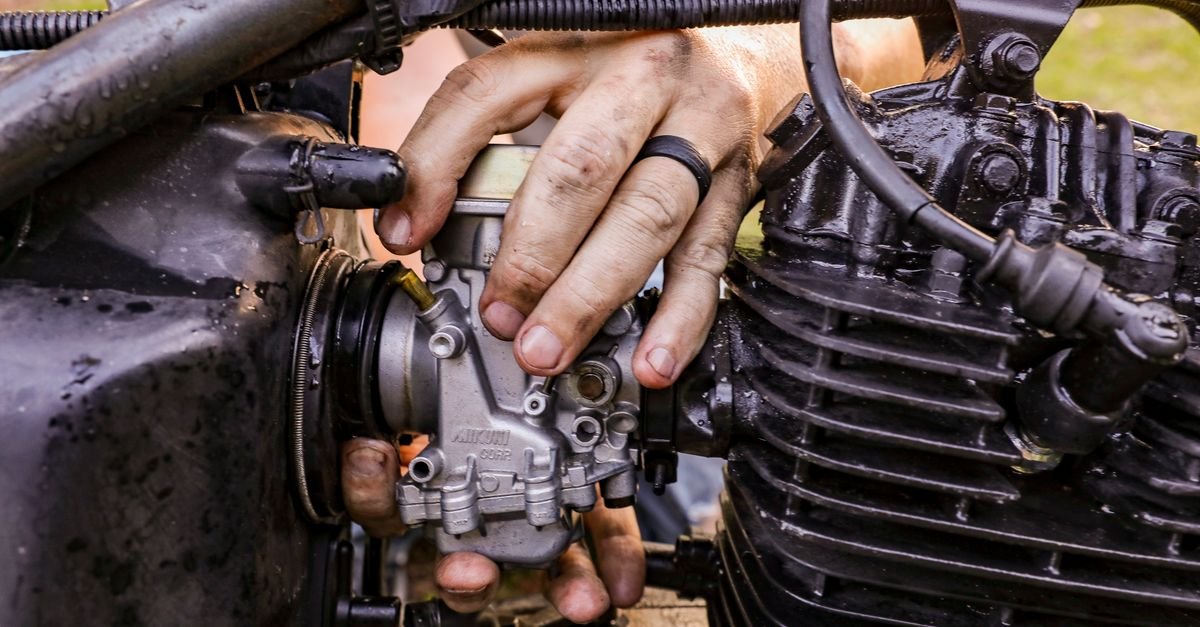
Toro’s own engine service manual lists “Air Intake System Leaks” as a named cause under *Hard Starting / Poor Running*, sitting in the same list as fuel contamination and carburettor debris (Toro LC1P65FC engine service manual). It is not an exotic diagnosis. It is on the short list, and on a machine that vibrates for a living it deserves to be.
Four routes, in the order they actually happen:
1. The two carburettor mounting nuts. A pressure washer shakes for an hour at a time with the pump hammering away underneath it. Fasteners back off. Check them cold, with a spanner, before anything else.
2. The gasket and the insulating spacer. The spacer is the phenolic or plastic block between carburettor and head, and its job is keeping engine heat out of the fuel. It is also the part most often refitted the wrong way round, or left in the bottom of the tray, after a carburettor clean.
3. The crankcase breather hose. It feeds crankcase vapour back into the intake. Perished, split or off its barb, it is an open pipe into the air stream.
4. The throttle shaft bore, worn oval, which is the one cleaning cannot touch.
Here is the part that catches people, and it is worth its own sentence: if the leak started right after a carburettor job, the nuts are the first suspect and over-tightening is as likely as under-tightening. These are M6 fasteners. Toro’s table puts the accessory nuts on this class of engine at 6 to 7.5 ft-lbs — a firm wrist, not a heave. Pull an aluminium carburettor flange down onto a gasket at car-engine torque and you bow the flange, which converts a temporary leak into a permanent one you will then fail to find twice.
An air leak also has one behavioural signature the other two causes lack: it often gets *worse* as the machine warms, because alloy grows, a gasket that has taken a set does not, and the gap opens. If the choke requirement increases over the first ten minutes and never settles, look here rather than at the jets.
Catch the Fuel in a Jar Before You Blame the Carburettor
The third cause is the one people skip, because the carburettor is the interesting part and a fuel tap is not. But a carburettor cannot meter fuel it is not being handed, and there is a published way to check that takes about two minutes.
Tecumseh’s service manual spells the procedure out: check the fuel cap vent is open, then “with a proper draining receptacle, remove the fuel line clamp on the carburetor fuel inlet and pull the fuel line off the fitting to examine the fuel flow and fuel condition,” because “improper fuel flow indicates the fuel, fuel line, filter or tank require cleaning or replacement” (Tecumseh four-cycle L-head engines service manual). Engine cold, outdoors, away from anything hot, into a container you are happy to have petrol in — a glass jar is ideal because you can also see what comes out.
You are looking for two things.
Flow. Open the tap and you want a continuous stream that keeps going, not a strong start that tails into a dribble. If you want a number rather than an impression, your own manual gives you one for free: divide the tank capacity by the published run time. A machine that holds a gallon and runs for an hour is consuming somewhere around an ounce a minute, and a healthy gravity feed will beat that by a margin so wide there is nothing to measure. A supply that struggles to fill a jam jar in thirty seconds is a supply that cannot keep a bowl full under load.
Condition. Water sits as separate beads at the bottom. Rust, grit or a brown tint means the tank and the inline filter both need attention, not just one of them.
Then work back up the line: the fuel tap turned fully open rather than left at the first position that produced a trickle, the inline filter held up to the light, the line itself checked for a kink where it crosses the frame or a soft collapsed section at a clamp, and the cap vent. Tecumseh’s shortcut on the last one is to loosen the cap and retry — a blocked vent lets the tank pull a vacuum against itself, and the machine will starve slowly with fuel visible eight inches above the carburettor. That one takes ten seconds, so do it first even though it is fourth on the list.
Fixed Emission Jets Mean There Is No Screw to Turn
Somewhere in every forum thread on this symptom, somebody suggests winding the mixture screw out a quarter turn. On most machines sold in the last fifteen years, that advice has nothing to grip.
Tecumseh’s manual states it in capitals, which is not a thing service manuals do lightly: “EMISSION GRADE CARBURETORS HAVE FIXED IDLE AND MAIN JETS. THE ABSENCE OF THE ADJUSTING SCREW INDICATES A FIXED JET OR RESTRICTOR AND NO ADJUSTMENT IS NECESSARY.” It goes further on one design, noting that what looks like an adjustable screw is a restrictor and “is not adjustable and must remain tight for proper operation.”
Two consequences, and both matter more than they sound.
The first is that the screw you are being told to turn either does not exist on your machine, exists behind a factory limiter cap that allows a fraction of a turn, or is a fixed restrictor that somebody is about to unscrew and lose. The second is the important one: a fixed-jet carburettor gives you no way to compensate for a restriction. You cannot trim around a blocked pilot jet or an air leak. The jet is calibrated, the calibration assumes everything upstream and downstream is sealed and clear, and when it is not, the only available repair is to make it so.
Which is, conveniently, the entire point of this article. There is no setting to find. There is a passage to clear, a gasket to seal or a supply to restore.
Half Choke Is a Loan, and the Interest Is Heat
Here is the opinion, and it is the one a rental counter would be reluctant to print: finishing the job on half choke is the most expensive way to clean a driveway. Not because the machine will explode — it will not — but because you are paying for the repair twice and taking delivery of it later.
The mechanism is that a choke plate is a *fixed* restriction and the fault it is covering is not. A blocked pilot jet starves the engine at low throttle and barely affects it at full. An air leak admits roughly the same volume of air whatever the throttle is doing, so it leans the mixture most when total airflow is lowest. Set the choke where the engine idles sweetly and you are running rich at part throttle and still lean at full load — which is precisely when the engine is making the most heat and has the least margin to shed it, because it is air-cooled and there is no coolant to hide behind. Tecumseh files carburettor adjustment under OVERHEATS in its engine-operation table, alongside low oil and blocked cooling fins, which tells you how the people who built these engines rank it.
The rich half of that deal is not free either. Unburnt petrol washes the oil film off the bore and lands on the plug, and a plug that has been kept wet does not recover on its own. If you have already run several tanks this way, pull the plug and read it before you replace it — the six deposit patterns and what each one means are in the guide to the pressure washer spark plug, and the reading is worth more than the part.
And underneath both halves, the actual fault carries on getting worse. Varnish does not stabilise. A gasket that has started leaking does not reseat. A vent blocked with detergent overspray does not clear itself.
One honest gap, because the internet will happily fill it for you: I went looking for a published figure on how many hours of choke-dependent running it takes to do measurable damage to a small engine, and I could not find one. Manufacturers say do not do it. Nobody publishes a clock. So I am not going to give you a number I cannot stand behind — the mechanism is the argument, and the mechanism is enough.
FAQ
Why does my pressure washer only run with the choke on?
Because the mixture is lean and the choke is the only air restriction available to correct it. Vanguard’s service guidance names the two causes directly: restricted fuel flow to the carburettor, or a partial restriction of a jet or passageway inside it. Add unmetered air leaking in after the carburettor and you have all three.
Is it OK to run a pressure washer on half choke?
To finish a job that is nearly done, yes. As a way of living with the machine, no. Half choke is a fixed restriction covering a variable shortfall, so you end up rich at part throttle and still lean under load, and the fault underneath keeps progressing while you do it. It also fouls the spark plug, which adds a second symptom on top of the first.
Why does my pressure washer die when I open the choke?
Because opening the choke restores full airflow and the fuel side cannot match it. The most common single reason is varnish in the low-speed circuit after the machine has stood with fuel in it. Check whether it will hold full throttle with the choke open — if it will, the idle circuit is your answer and the main circuit is fine.
Can a dirty air filter make a pressure washer need the choke?
No, and this is worth knowing because the filter gets blamed constantly. A blocked filter restricts air, which makes the mixture richer — the same direction the choke pushes it. An engine demanding choke wants less air, so a dirty filter would be helping, not hurting. Rich faults announce themselves with black smoke and a sooty plug instead.
Will fresh fuel fix a pressure washer that needs the choke?
Sometimes, and it is always worth doing first because it costs almost nothing and rules out a variable. But fresh petrol does not dissolve varnish that has already set in a jet. If draining and refilling does not change the behaviour within a couple of minutes of running, the deposits are still there and the bowl needs to come off.
How do I tell the difference between a blocked jet and an air leak?
Use the throttle. A blocked low-speed circuit needs choke at idle and low throttle and releases it at full throttle. An air leak needs roughly the same choke everywhere, and frequently gets worse as the engine warms and the alloy expands away from a hardened gasket. History helps too: a leak very often starts immediately after somebody had the carburettor off.
Does a pressure washer need the choke when the engine is warm?
It should not. Choke exists for a cold start, and on most machines it should be fully open within about thirty seconds. If it is still needed after ten minutes of work, treat that as a fault report rather than a normal operating position — the engine has just told you which side of the mixture it is short of.
My machine needs choke and also runs unevenly the second I pull the trigger. Same fault?
Not necessarily. Choke dependence is a mixture fault; a clean, steady drop in speed the moment the trigger opens is usually a load fault instead, and the two have different fixes. If the engine also cuts out entirely a few seconds after firing, the fuller fault tree for that is in pressure washer starts then dies.
Fix the Fuel Side, Then Leave the Choke Alone
Three causes, one symptom, and a free way to tell them apart. Choke needed at idle and released at full throttle is varnish in the smallest passage on the machine. Choke needed at every throttle position, worse as it warms, is air getting in past a gasket or two loose nuts. Choke needed progressively after ten good minutes is a supply that cannot keep up — a vent, a tap, a filter or a kinked line — and a jar under the carburettor inlet settles that in two minutes.
What none of them are is an adjustment. The jets on a modern machine are fixed by design, so there is no screw to trim and no mixture to dial in. There is only a passage to clear, a joint to seal, or a fuel path to reopen.
And when it does run properly with the choke wide open, spend the two minutes that stop it coming back: stabilise the fuel or run the tank dry, then shut the tap. The choke was never the fix. It was the engine being unusually clear about what it needed, which is more than most machines manage.