Last Updated on September 25, 2026 by Umar Farooq
The piece of roof cleaning equipment that decides whether the job happens is the ladder, not the pump. Everything that sprays is cheap, well documented and easy to choose. Everything that gets you and the spray within range of the shingles is expensive, dull, and the actual constraint.
That is not how the category is sold. Search the term and you get skids, twin-pump systems and proportioner valves, priced from a hundred dollars to five figures, none of which mention that the roof is thirty feet away and at an angle. So let us do this in the order the job does it: what the kit is for, what each tier genuinely reaches, and the point at which the sensible purchase stops being a purchase.
Two Shopping Lists, and Most People Buy the Wrong One First
There are two separate lists here and they get printed as one, which is where the money goes wrong.
| Delivery list | Access list |
| Something to hold mixed solution | A ladder long enough, with the right duty rating |
| Something to push it up a hose | A standoff arm so the ladder does not sit on the gutter |
| Something to aim it — gun, wand or pole | Levellers, if the ground is not flat |
| Hose, strainer, measuring jug | An anchor point, if you are going onto the slope |
| Goggles, gloves, plant sheeting | A harness and a line, attached to that anchor |
| A garden hose for the rinse | Or: a hired lift or tower, and none of the above |
The delivery list is the one with spec sheets, so it is the one people research. Flow rates, orifice sizes, seal materials, battery amp-hours — all knowable, comparable and mildly enjoyable to shop for. The access list is a ladder and some webbing. It has no interesting numbers on the box.
Here is the position, and it is the only strong claim on this page: a complete 12-volt soft wash kit capable of treating a two-storey roof costs less than the access equipment that would let you do the same job by climbing, and the access equipment is the half you cannot improvise around. You can clean a roof with a five-gallon sprayer that costs less than dinner. You cannot clean a roof with a ladder that is two rungs short. One of those failures makes the day longer. The other ends it.
So read the two lists in the opposite order to the one the internet gives you. Work out what reach you have. Then buy the delivery gear that matches it.
Tier One: A Pump Sprayer, a Hose and a One-Storey Ceiling
The entry tier is a two- to five-gallon hand pump sprayer for the solution and a garden hose for the rinse. That is the whole machine. The plunger is the motor.

It is not a compromise. A hand sprayer runs under 60 PSI and a municipal garden hose sits around 40 to 70 PSI, and both of those are already inside the band a roof wants. Nothing in this tier is capable of damaging a shingle, which is a property worth more than it sounds.
What limits it is not pressure and it is not chemistry. It is two things:
- Reach. A sprayer throws a few feet past wherever you are standing. Your roof is therefore the sum of the ladder positions you can safely set, times whatever a wand adds at each one. That is a number you can measure this afternoon.
- Evenness. Five gallons treats a surprisingly small area. Refilling mid-slope leaves the top third drying while you mix, and a roof applied in two batches at two slightly different strengths keeps the seam for years.
Three things belong in the bucket alongside it and routinely do not. A measuring jug, so the dilution is a measurement rather than a pour — getting a ratio right by eye out of a jug is a skill people badly overestimate, and our guide to roof cleaning chemicals has the numbers on that. Sealed goggles rather than safety glasses, because a sprayer held above head height drips, and safety glasses are open at the sides. And a sprayer whose seals survive hypochlorite; the cheap ones use Buna-N, which softens and weeps inside a season.
Tier one honestly covers a single-storey house with a shallow pitch and a roof you can wet from the eaves. That is a lot of houses. It is not a lot of two-storey houses.
Tier Two: The 12-Volt Kit That Works From the Ground
The step up is a 12-volt diaphragm pump, a tank of pre-mixed solution, a hose reel and a dedicated gun. Sixty to 100 PSI, several gallons a minute, running off a leisure battery. This is what almost every professional soft wash rig is underneath the branding.
What it buys is not strength. It is a steady application rate held across an entire roof by one person standing on the drive, so the whole surface wets at the same time and dries at the same time. That is the difference between a clean roof and a roof with bands on it.
The specs worth arguing about live in two places. Our guide to the 12v soft wash pump covers flow, duty cycle, seal materials and battery draw, and the soft wash spray gun piece covers orifice sizing, stream coherence and why reach comes from volume rather than pressure. I am not going to restate either here. The assembly point is the one neither can make alone: the pump, the gun and the hose have to be specified against the same flow figure, or the weakest of the three sets your reach. A generous pump behind a restrictive gun is a restrictive gun.
And a warning the kit’s own marketing will not give you. A 12-volt system does not delete the ladder. It deletes most of the ladder work — the solution and the rinse — and leaves the rest: debris clearing, the gutter flush afterwards, and the far slope that no amount of throw reaches from the only side of the house you can stand on. Budget for a ladder anyway.
Tier Three: What a Professional Rig Buys That a Homeowner Cannot
A contractor’s rig is a skid: a gas engine, a 100 to 300 gallon tank, one or two pumps, a few hundred feet of hose on a reel, and a proportioner that mixes at the gun instead of in the tank.
| Tier one | Tier two | Tier three | |
| Pressure at the tip | Under 60 PSI | 60–100 PSI | 60–150 PSI |
| Solution on board | 2–5 gallons | 30–100 gallons | 100–300 gallons |
| Refills per roof | Several | One or none | None |
| Realistic reach | Where you stand, plus a few feet | Most of a two-storey roof from the ground | The same, without stopping |
| Suits | Single storey, shallow pitch | Committed homeowner, two storeys | A crew doing three roofs before lunch |
Read the reach row carefully, because it is the row people expect to differ and it does not. Tier three does not spray higher than tier two in any way that matters on a house. What it buys is uninterrupted run time and a mixing ratio held constant for eight hours, which is a business requirement rather than a cleaning one.
There is also a fact about the tank that the brochures keep in the footnotes. Water weighs about 8.3 pounds a gallon, so a 200-gallon tank full of solution is roughly 1,670 pounds before you add the tank, the pump, the engine and the hose. That is not a piece of equipment. That is a trailer, a tow rating and a difficult conversation with your driveway.
The Ladder Is the Roof Cleaning Equipment That Decides Everything
Now the half nobody photographs. The ladder is the boring purchase, which is exactly why it is the one people economise on and then stand on.
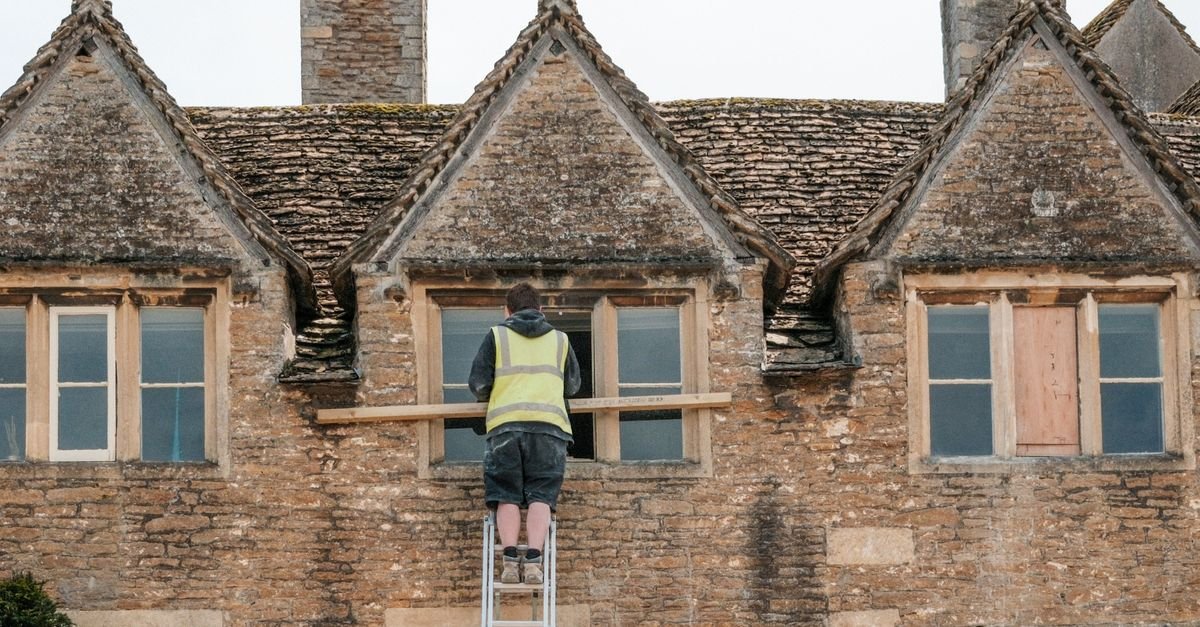
Two numbers set it up, and they are published rather than folklore. The federal construction rule for portable ladders requires that a non-self-supporting ladder be used at an angle where “the horizontal distance from the top support to the foot of the ladder is approximately one-quarter of the working length”, and that where a ladder gives access to an upper landing, “the ladder side rails shall extend at least 3 feet (.9 m) above the upper landing surface” (29 CFR 1926.1053). The homeowner translation:
1. One foot out for every four feet up. A ladder touching a twenty-foot eave stands its feet five feet from the wall. So before you buy the ladder, check that five feet of level, firm ground actually exists at that spot. Flower bed, slope, drain cover, bark chippings — any of those and the ladder is the wrong tool regardless of its length.
2. Three feet of ladder above the gutter line, so there is something to hold while you transfer your weight. This is why a “just long enough” ladder is short by three feet, and why a standoff arm earns its money: it holds the stiles off a plastic gutter that was never designed to take a point load, and it gives you the rail height at the same time.
3. The duty rating covers you plus everything you are holding. A full five-gallon jug is about forty-two pounds. It counts.
Then the rule that every roof cleaning video on the internet breaks inside thirty seconds. The same regulation says a worker “shall not carry any object or load that could cause the employee to lose balance and fall” while climbing. A wand attached to a charged hose is exactly that object — it tugs, it snags, and it takes one hand permanently out of service. If your plan requires you to climb holding equipment, the plan is wrong, and the fix is either a rope to haul kit up separately or a delivery tier with enough throw that you never climb at all.
Add ladder levellers if the ground slopes, which at the gable end of most houses it does. They are the cheapest item on the access list and they prevent the one failure nobody sees coming: a ladder that walks sideways the moment your weight shifts.
Anchor First, Harness Second, and Guess Which One Gets Skipped
If any part of the job puts you on the slope, you are into fall protection, and fall protection is a system of four things: an anchor, a connector, a harness and a line. People buy the harness. The harness is the only one of the four that is comfortable to try on in a shop.
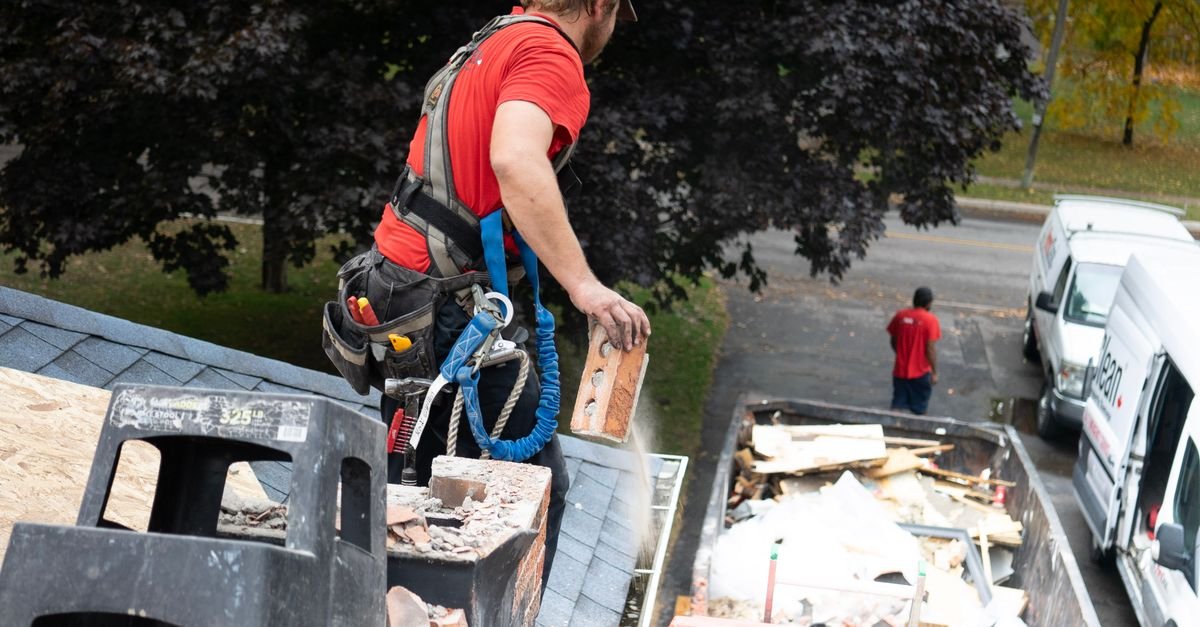
The number that settles the argument is the anchor spec. Anchorages for personal fall arrest must be “capable of supporting at least 5,000 pounds (22.2 kN) per employee attached” (29 CFR 1926.502). Two and a half tons. Whatever you were about to tie to — a ridge vent, a plumbing stack, a chimney whose mortar you have never inspected, the tow hitch of a car parked on the other side of the house — is not a 5,000 pound anchor and was never tested as one. A real roof anchor is a bracket lagged through the sheathing into rafters, which means fixing something permanent to the roof before you are allowed to clean it.
There is a second number almost nobody quotes, and on a domestic house it matters more. The same regulation limits free fall to six feet, allows a deceleration distance of up to 3.5 feet, and caps arresting force at 1,800 pounds with a body harness. Add six feet of fall, 3.5 feet of deceleration, the height of the person below the attachment point and a little harness stretch, and you need something past fifteen feet of clear space below the anchor. A single-storey eave is around ten feet up. Fall arrest needs room underneath it to work, and a bungalow does not have that room — you would reach the lawn before the system finished doing its job.
Which points at the answer the trade uses and homeowners never hear. On a low roof the correct system is restraint, not arrest: a line short enough that you physically cannot reach the edge. It is less equipment, not more, and it fails in the only direction worth failing in. Our piece on DIY roof cleaning works through the conditions that take going up off the table entirely, and most of them come back to this.
Rent the Reach: What a Towable Lift Costs for a Day
The choice always gets framed as ladder or contractor, and there is a middle that gets skipped because nobody prices it. So I went and priced it.
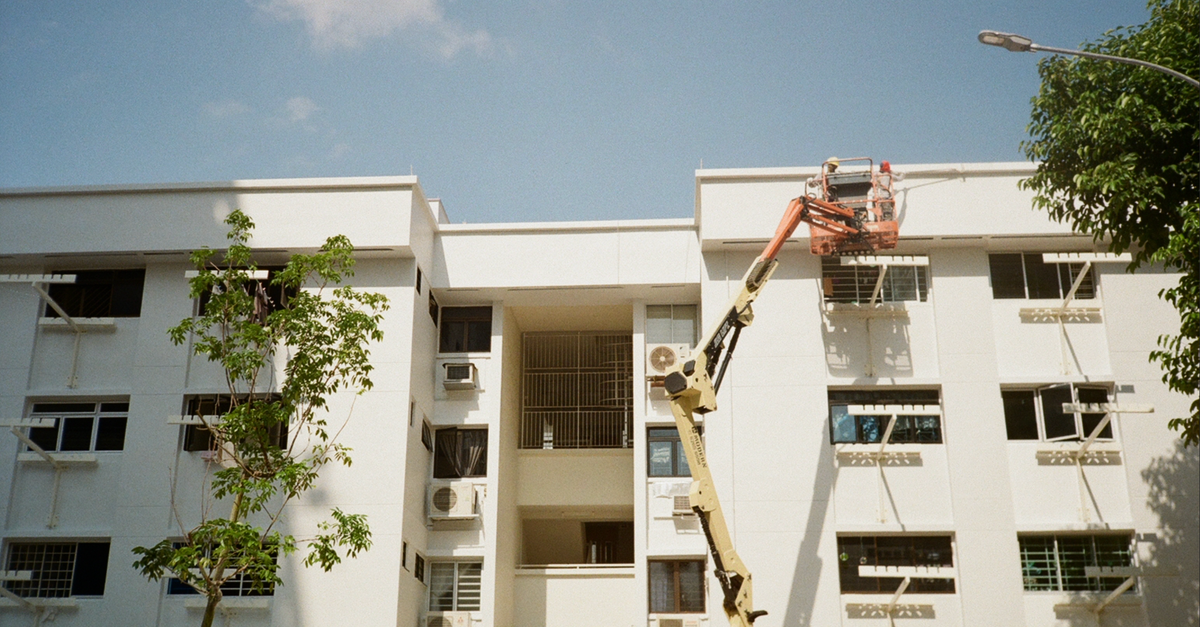
A rental marketplace publishing figures drawn from 2,992 actual boom lift quotes across the US and Canada puts the national daily average at $580 a day — but that average is dragged upward by hundred-foot machines. The line that matters for a house is the towable boom lift in the 30 to 55 foot range: $150 to $350 a day, or $400 to $900 for the week (DOZR boom lift rental pricing, March 2026). Small electric scissor lifts run cheaper still, from around $100 a day, but a scissor lift goes straight up and nowhere sideways, and it wants a hard flat surface underneath it. Beside a pitched roof, on a lawn, that vocabulary is too small.
Now set it against the honest comparison. For one roof, once, a contractor usually wins: you are paying $150 to $350 plus a delivery charge plus your Saturday, against a quote that already includes the Saturday. Renting reach starts winning when the lift does more than one job — roof, gutters, fascia boards, the upstairs windows, the soffit vent you have been meaning to look at since spring. That is the weekend where the arithmetic flips.
Four things to check before booking, because they are the four that cancel bookings: whether the yard delivers or expects you to tow it, and whether your vehicle is rated to; whether a gate and a route exist wide enough to get it into the garden; whether the ground will carry it after rain; and what familiarisation or training the yard requires before handing over the keys. A scaffold tower is the other version of the same idea — hired by the week, no fall-arrest arithmetic, completely stable — with the trade-off that it covers one elevation at a time and you will spend part of the job moving it.
Four Things Sold for Roofs That Belong on a Driveway
Search this category and four items will be recommended to you that should not go near a shingle. Each one is genuinely useful somewhere else on the property, which is what makes the pitch convincing.
1. The telescoping pressure washer extension wand. It solves reach by putting the tip eighteen feet away from you — still at whatever pressure the machine is producing, now on the end of a pole you cannot aim precisely, held overhead. It is a soffit and driveway-edge tool.
2. The rotary “roof wand” with a turbo nozzle in it. It is the turbo nozzle with a longer handle and a better name. A rotating 0-degree jet still lands as a 0-degree jet; the rotation spreads the coverage, not the impact.
3. A surface cleaner. It needs around 3 GPM and a flat, load-bearing surface to seal against. A roof is neither, and the disc was designed to be walked over concrete, not dragged across granules.
4. A stiff brush or broom. Worth naming because it is what people reach for when the chemistry appears not to have worked. The roofing manufacturers’ own guidance rules out brushes and brooms in the same breath as power washers, for the same reason: the granule layer is bonded to the asphalt beneath it, and anything that scrubs takes some of it away. The method that replaces all four is chemistry, dwell time and patience.
If your existing pressure washer is the only pump you own, it can still act as a delivery pump through a downstream injector with the black soap nozzle fitted. But the soap nozzle then stays on for the entire job and the rinse comes off the garden hose. The classic way to ruin a correctly treated roof is to swap to a green tip at the last step to “just rinse it”.
FAQ
What equipment do professional roof cleaners use?
A skid-mounted soft wash system: a tank of 100 to 300 gallons, one or two pumps running at roughly 60 to 150 PSI, a few hundred feet of hose on a reel, a long-bore gun, and usually a proportioner that mixes solution at the gun. Plus the access side — ladders, standoffs, roof anchors and, on taller properties, a hired lift. The pressure figures are deliberately low; the volume figures are what make it a commercial tool.
Can I clean a roof with just a pump sprayer and a garden hose?
On a single-storey house with a shallow pitch, yes, and the result is the same as a professional’s because the chemistry is identical. The limits are how much roof you can reach from your ladder positions and whether five gallons covers a slope before the first part dries. Mix everything in one container before you start.
Do I need a pressure washer to clean a roof?
No, and on asphalt shingles you specifically should not use one as a pressure washer. If you already own one it can serve as a delivery pump with a downstream injector and the soap nozzle fitted, which drops the pressure far enough to apply solution safely. It must not be used for the rinse.
What size ladder do I need for roof cleaning?
Long enough that three feet of ladder stands above the gutter line when the feet are set one foot out for every four feet of height. For a twenty-foot eave that means roughly twenty-three feet of working length with the feet five feet from the wall, on ground that is level and firm for that whole distance. If the ground at that spot is a flower bed or a slope, ladder length is not your problem.
Is it cheaper to rent a lift than to hire a roof cleaner?
For one roof, usually not — a towable boom lift runs $150 to $350 a day before delivery, and you still supply the labour. It gets cheaper when the same lift also does the gutters, fascia, upstairs windows and every other high-level job inside the hire period. Price the whole weekend, not the roof.
Do I need a safety harness to clean my roof?
Only if you are going onto the slope, and a harness on its own is not the answer. It needs an anchor rated to 5,000 pounds, which almost no house has fitted, and on a single-storey roof there is not enough height below that anchor for fall arrest to stop you before the ground does. A short restraint line that stops you reaching the edge is the better system at domestic heights.
What is the difference between a soft wash system and a pressure washer?
A pressure washer makes high pressure and low volume, and its job is to break a bond mechanically. A soft wash system makes low pressure and high volume, and its job is to carry a chemical onto a surface and leave it there. They are different machines aimed at different problems, and a roof only has the second kind of problem.
Can I use a 12-volt soft wash pump for anything else?
Yes, which changes the purchase considerably. The same pump and gun handle siding, fences, soffits, render and anything else where chemistry does the work and pressure would cause damage. If the only job in the calculation is one roof every four years, it is a lot of kit. Across the whole exterior of a house, it is the tool that gets used most.
Spend the Money on Getting Up There, Not on the Spray
Choose the access first and let it pick the delivery gear. Measure how much roof you can genuinely wet from the ladder positions your ground will actually support. If that is all of it, a five-gallon sprayer and a hose finishes the job and the sprayer is the entire outlay. If it is most of it, a 12-volt kit closes the gap from the driveway and will go on to clean everything else on the outside of the house. If it is half of it, no amount of delivery equipment fixes that, and the honest options are a hired lift, a scaffold tower, or somebody else’s crew.
The one purchase I would argue against in every case is more pressure. Every roof cleaning equipment failure I have read about runs in the same direction — somebody reaching for force because the reach was short. Shingles cannot tell the difference between impatience and a plan. They only record the result, in granules, in the gutter, for the next twenty years.