Last Updated on September 25, 2026 by Umar Farooq
How to remove mildew from outdoor pillows, honestly: the cover is a thirty-minute job, the core is a three-day one, and if you only do the thirty minutes the speckles come back before the cushion has finished drying.
That is the entire article in two clauses, and it is why patio cushions have a reputation for being unsalvageable. They are not. They are just two separate objects sewn into one shape, and almost every cleaning guide treats them as one.
A general clean of a whole patio set is a different job, covered in how to remove mildew from furniture — frames, weave, slings and all. This page is only about the soft parts: seat pads, scatter cushions, sun-lounger pads, and the covers that come off them. They are the hardest thing on the patio to get right, and the only thing out there with a sponge inside it.
Your Cushion Is Two Objects and You Only Cleaned One
Pick up a mildewed seat pad and you are holding two materials with completely opposite relationships to water. The cover is a tight woven fabric with a water-repellent finish that sheds most of what lands on it and dries in an hour of sun. The core is an open-cell block engineered to be mostly air, which is another way of saying it is engineered to be mostly space for water.
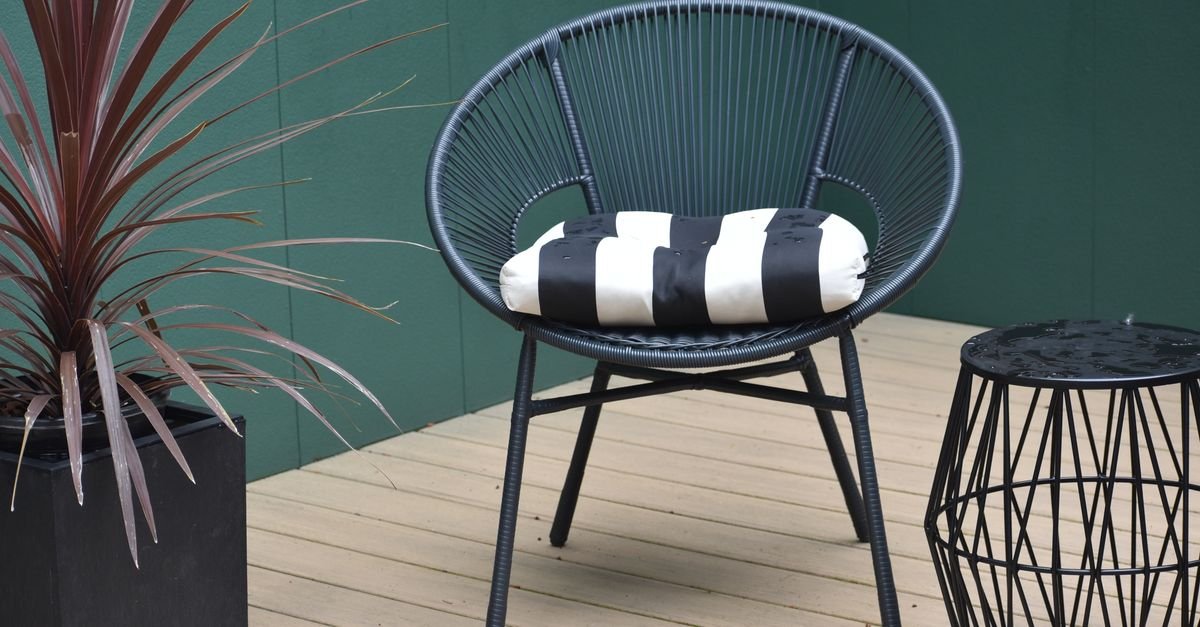
The grey-black speckling you can see is on the cover. The colony that puts it back is in the core. Mildew wants moisture, shade and something organic to eat, and the outside of a cushion only reliably offers it the third one — pollen, sunscreen, spilled drink, the film of tree debris that settles on everything left out for a season. The inside of the cushion offers all three at once, permanently, for months.
So here is the failure mode that sends people back to the internet a fortnight later. You unzip the cover, wash it properly, dry it in the sun, and slide it back over a block that is still holding water from the rain three weeks ago. You have now wrapped a wet organic sponge in a fresh airtight-ish envelope and put it back in the shade. The cover looks excellent. It will look excellent for about eleven days.
Which is the opinion I will defend for the rest of this: on a standard foam cushion, drying beats cleaning, and it is not close. A clean cover on a wet core fails every time. A grubby cover on a genuinely dry core mostly does not, because nothing is growing.
What the Zip Is Actually Telling You
Before you pull anything, look at the zip properly, because outdoor cushions have three different ones and only one of them is an invitation.
A zip running around three sides is a removal zip. It exists so the casing can come off and go back on. Use it.
A short zip along one edge only, often tucked under the welt cord and sometimes with the pull tucked in and taped, is usually a manufacturing zip. It was there so someone could get the foam in at the factory. It will open, but the opening is smaller than the block and you are going to fight it in both directions. Doable, not designed for it.
No zip at all means the casing was sewn or welded shut, and that is common on cheap scatter cushions and on almost anything with a printed polyester face. You are not separating those two objects without a seam ripper.
Sunbrella — who weave a very large share of the outdoor fabric in North America — put the caution plainly in their own cleaning instructions: consult the furniture manufacturer before removing the casing, “as cushion construction varies,” and close all zippers before washing (Sunbrella, how to clean Sunbrella upholstery). Closing the zip is not fussiness. An open slider in a drum is a small metal tool being thrown at your fabric for forty minutes.
Two more things the zip is quietly telling you, which nobody prints on the label.
Outdoor casings are cut tight, on purpose, so the cushion looks filled rather than baggy. That means the reinstallation is the hard step, not the wash. Put the cover back on while it is still very slightly damp — damp fabric is more compliant and slides over foam instead of gripping it. Wait until it is bone dry and stiff and you will spend twenty minutes wrestling a seat pad on your kitchen floor while it makes a noise like a balloon.
And if there is no zip, stop trying to clean the inside. A sewn-shut cushion is one object, permanently, and everything below in the drying section applies to the whole assembly with roughly an extra day added.
Solution-Dyed or Printed? Only One Survives Bleach
This is the fork that decides whether your cushion survives the treatment, and it takes about fifteen seconds to resolve.
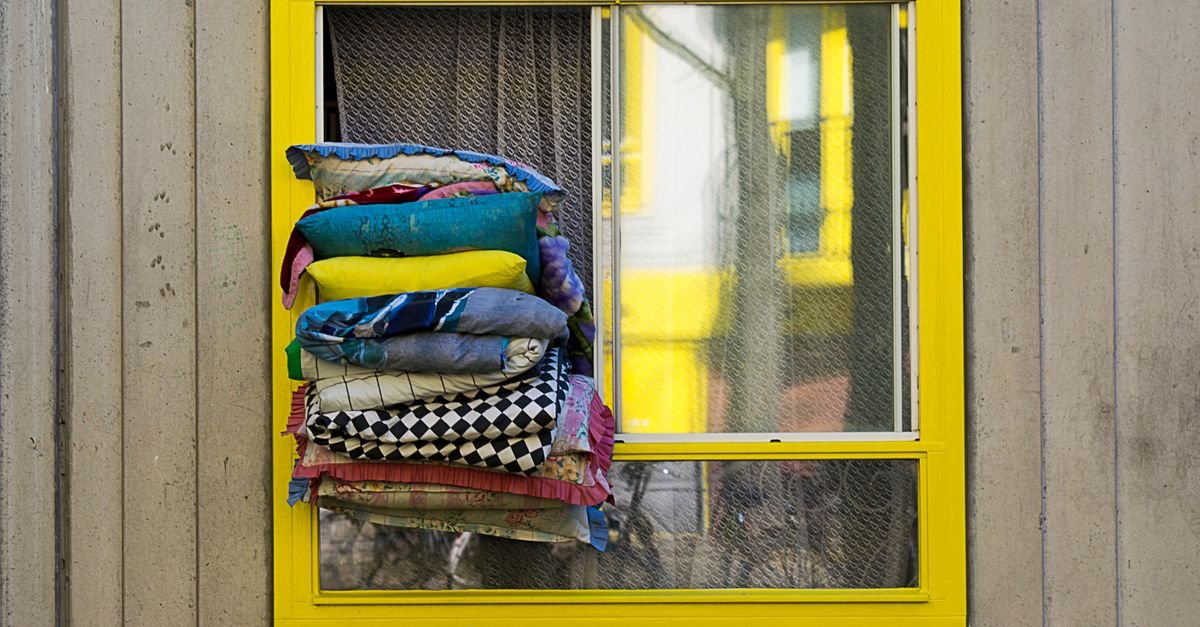
Solution-dyed acrylic has its pigment mixed into the liquid polymer before the fibre is ever extruded. The colour is not on the yarn, it is the yarn, all the way through, like a stick of seaside rock. Printed polyester has its pattern applied to one face of a finished white cloth. Both look fine on the shelf. They behave like entirely different materials the moment chlorine arrives.
The test: turn the fabric over and look at the reverse, or open a seam allowance. If the back carries the same colours as the front, you have solution-dyed. If the back is white or pale grey with the pattern faintly ghosting through, it is printed. A cut edge tells you the same thing — coloured through, or white core with a skin of colour.
Why it matters: Sunbrella publishes a bleach mix for its own fabric, which is an unusual thing for a textile maker to do. Their mould and mildew solution is 1 cup of bleach and 1/4 cup mild soap per gallon of water, sprayed on, left 15 minutes, then cleaned off and rinsed, and they add that “for severe mold/mildew growth, bleach quantities may be increased.” They can say that because there is no surface dye for the chlorine to strip. Apply the same mix to printed polyester and it works exactly as designed: it destroys coloured organic compounds. It cannot tell the difference between the mildew and your pattern.
| What you have | Back of the fabric | Chlorine bleach | Use instead |
| Solution-dyed acrylic | Same colours as the front | Yes, at the published mix | — |
| Solution-dyed olefin | Same colours as the front | Usually yes — test a hidden corner | Oxygen bleach if unsure |
| Printed polyester | White or pale grey | No | Oxygen bleach, longer dwell |
| Printed acrylic | White or pale grey | No | Oxygen bleach, longer dwell |
| Unlabelled, no visible reverse | Unknown | Not until you have tested | Oxygen bleach |
A note on the alternative, because the internet is very confident about it and the research is not. Oxygen bleach — sodium percarbonate — is the gentler option and is what I would reach for on anything printed. But the USDA Forest Products Laboratory, reviewing oxygen against chlorine cleaners, says flatly that it is “difficult to compare the advantages and disadvantages of the two types of cleaner” because active-ingredient concentrations, additives and substrates vary so widely between products. It is gentler on colour. Whether it is as effective on the organism is genuinely not settled, so give it the longer dwell and expect to repeat it.
Whatever you mix, test it on the underside of the cushion — the face that sits against the chair — and let the test patch dry fully before you commit. Wet fabric lies about its colour.
How to Remove Mildew From Outdoor Pillows Without Wrecking the Print
Five steps. The order is doing as much work as the products are.
1. Go dry first, and go outside. Brush the cushion down with a dry stiff-ish brush, working the seams, the welt cord and the piping, where the growth always starts because that is where debris collects. Do this well away from the back door, and not on a windy day directly upwind of yourself. Adding water to a layer of dry pollen and dead colony turns it into a grey paste that bonds into the weave, and then you are cleaning two things.
2. Separate the two objects. Cover off the core if the zip permits. This is the step everyone skips and it is the one that makes the difference, because from here on the cover and the core get completely different treatment. If it will not separate, carry on, and add a day to step 5.
3. Kill it, with contact time, at the strength your fabric can take. Solution-dyed: the published bleach mix above, kept visibly wet for the full fifteen minutes by re-misting. Printed: an oxygen bleach solution at label strength, twenty to thirty minutes, in shade rather than hot sun. The dwell is the active ingredient here. A biocide that has dried has stopped working and started staining, and a cushion sprayed and immediately rinsed has been rinsed, not treated.
4. Wash, then rinse past the point you think is enough. Removable casings can generally go in the machine: Sunbrella’s instruction is cold water, delicate cycle, normal amounts of mild laundry detergent, zips closed. Hand washing in a bath works just as well and is kinder to a cover with a fitted shape. Then rinse until the water runs off clear. Leftover detergent is a surfactant film that holds dirt, and dirt is what the next colony is coming for.
5. Air dry only, and never tumble. Sunbrella’s own wording is “allow fabric to air dry,” and they also say do not use a steamer or an iron on a steam setting. Heat is what shrinks an outdoor cover past the point where it goes back over its foam, and that failure is not recoverable — you cannot un-shrink acrylic. Line it, peg it by a seam, leave it. Then reinstall while very slightly damp.
One thing that is not on the list, on a site about pressure washers: do not point the machine at a cushion. Not on the white tip, not from six feet, not “just to rinse it.” A pressure washer drives water into open-cell foam faster than any rainstorm ever will, which is the precise condition you are trying to reverse. The wand has a job on the frame the cushion sits on and no job at all on the cushion. Where it genuinely helps on a patio set — slings, mesh, resin weave — is set out with the pressure limits in the furniture article.
Foam, Fibre Fill or Reticulated: Which Core Do You Own?
Now the half of the cushion nobody photographs. There are three things that might be in there, and they fail in three different ways.
Reticulated foam, sold as dry-fast or quick-dry, has had its cell walls removed, leaving a skeleton of struts. The upholstery trade describes it exactly: it has “large, open pores that promote airflow and excellent water drainage abilities,” and “water passes right through the foam without being absorbed” (Sailrite, outdoor foam buying guide). Hose it, stand it up, and it is done in an afternoon.
There is a cost, and it is the part the marketing leaves out. The same supplier classes dry-fast as an “occasional use” foam with a 1-3 year lifespan, and does not recommend it for everyday seating, because the structure that lets water through is the structure that stops it supporting weight for long. Standard outdoor polyurethane at 1.8 PCF runs 3-5 years — and “will soak up water like a sponge and is not naturally water-draining.” You are choosing between a core that drains and a core that lasts. Nobody sells it as a choice, but that is what it is.
Polyester fibre fill is what is inside most outdoor scatter pillows. It can be washed and it does dry, but wet fibre fill mats into dense clumps that dry from the outside in, so a pillow can feel light and fluffy on the surface with a cold damp lump in the middle. Break the clumps apart with your hands while it dries, or you are drying a shell around a problem.
Polyester batting — the soft white wrap between the foam and the cover on better cushions, sometimes called Dacron — deserves its own warning. It is there for shape, it is the most absorbent layer in the whole cushion, and most people do not know it exists until they unzip a cover and find a soaking wet blanket wrapped round a nearly dry foam block. Peel it off and dry it separately.
| Core | How it handles water | Service life | Realistic verdict when mildewed |
| Reticulated (dry-fast) | Drains straight through | 1-3 years | Rinse, stand on edge, dry same day |
| Outdoor polyurethane 1.8 PCF | Absorbs, holds it | 3-5 years | Surface-treat and dry hard, or replace |
| Indoor HR foam 2.3, used outside | Absorbs badly | 12-20 indoors | Wrong material outdoors, replace |
| Polyester fibre fill | Mats and holds in clumps | Varies | Washable, needs breaking up by hand |
| Polyester batting wrap | Most absorbent layer present | Varies | Remove and dry separately |
And the limit worth being honest about: you cannot clean the middle of a foam block. The EPA’s guidance on porous materials is blunt — mould “can grow on or fill in the empty spaces and crevices of porous materials, so the mold may be difficult or impossible to remove completely” (US EPA, mold cleanup in your home). A six-inch cushion is nothing but empty spaces and crevices. If the growth is in the centre of the block rather than on its faces, the core is finished, and a replacement insert is a far smaller purchase than a cushion set. The thing to buy next time is the foam type, not the pattern.
Getting a Foam Core Dry Is the Entire Job
Evaporation from a foam block is not limited by how warm you make it. It is limited by how fast water vapour can get out of the middle and how fast moving air can carry it off the surface. That single sentence explains why a cushion left in a hot, still garage is still damp on Thursday and one left on a breezy north-facing bench is not.
So do the physics in the right order.
Squeeze the bulk water out first. Evaporation is a slow way to remove liquid that could simply be pushed out. Stand the core on edge and press it hard against a wall, or lay it on a dry towel, fold the towel over and kneel on it along the full length. Repeat with a dry towel until the towel comes up merely damp. Five minutes of this removes more water than a full day of sunshine. Press, do not wring — twisting a foam block tears cell walls and the damage is permanent.
Then stand it on edge with air on both faces. Two battens, a slatted bench, an airer, the rungs of a ladder. Flat on the patio means one whole face is sealed against a wet surface, and that face is where it will still be damp on day three.
A fan beats warmth. Moving air strips the saturated boundary layer off the surface so the next lot of vapour has somewhere to go. Still warm air saturates and then just sits there being warm.
Weigh it. This is the diagnostic almost nobody uses and it is the only one that gives you a number. Put the core on kitchen scales when it is genuinely dry, write the weight on the underside of the cover in marker, and next time you can check it in ten seconds instead of guessing. If you have a matched pair and one weighs noticeably more than the other, that one is still wet — no interpretation required. A seat pad can carry a surprising amount of water without feeling wet to a hand, because your hand only ever meets the outside.
If it is dry and still smells, that is a different mechanism with its own chemistry — the odour is a gas the organism produced, not the stain it left, and it outlasts both. That is covered properly in how to remove mildew odour, along with the sniff test that tells you which object on the patio is actually responsible.
Winter Is Where Next Year’s Mildew Is Decided
Cushions go away in October and come back out in April. Whatever moisture they are holding on the day the lid shuts, they have six months alone in the dark to do something with it. Nothing you do in spring matters as much as what you do in that one afternoon.
The deck box is the usual culprit, and the mechanism is worth knowing because it explains a very specific symptom. A sealed plastic box outdoors heats in the day and cools at night, so moisture evaporating out of the contents condenses on the coldest surface available, which is the underside of the lid. It then drips back down. That is why the top cushion in the stack is reliably the worst one, and why people conclude the lid leaks when the lid is fine.
Four things fix it, and none of them costs anything.
Put them away dry, not dry enough. Give them an extra day you were not planning to give them. Six months of storage punishes optimism.
Get the box off the slab and let it breathe. Two battens underneath, drainage holes clear, and if it has vents do not block them with the last cushion. A box that can exchange a little air does not build a condensation cycle.
Store them on edge, not stacked flat. Stacked cushions hold a film of moisture between every pair of touching faces, in full shade, until spring. Standing them on edge with gaps breaks every one of those contacts.
Use breathable covers, never a plastic sack. A sealed bag around a cushion is a small greenhouse with an organic floor. A fabric storage bag, or nothing at all in a dry shed, beats it comfortably.
In season, the highest-return habit is the dullest one: bring them in, or stand them on edge under cover when rain is coming, and hose them off once a month during pollen season. You are removing the food before it becomes a meal. It takes two minutes and it is the difference between doing this article once and doing it annually.
FAQ
Can you put outdoor cushion covers in the washing machine?
Removable casings usually can. Sunbrella’s published instruction is cold water, delicate cycle, mild laundry detergent, all zips closed, then air dry. The two hard rules are no heat and no tumble dryer — heat shrinks the casing and a shrunk outdoor cover will not go back over its foam. Never put a foam core in a machine.
Does vinegar remove mildew from outdoor pillows?
It helps, and it is the right choice when you do not trust the fabric’s colourfastness, because a weak acid is far less likely to lighten a print than chlorine is. It is slower and weaker than bleach on the organism, so give it a longer dwell and expect to repeat it. On solution-dyed acrylic there is no reason to use it — that fabric is designed to take the stronger mix.
What kills mildew on outdoor cushion fabric?
A biocide held in contact with the growth long enough to reach it. On solution-dyed fabric that is the manufacturer’s own mix of one cup of bleach and a quarter cup of mild soap per gallon of water, left wet for fifteen minutes. On printed fabric it is oxygen bleach at label strength with a longer dwell. On any fabric it is not pressure, and it is not a quick spray and rinse.
Can you pressure wash outdoor cushions?
No. A pressure washer forces water deep into open-cell foam in seconds, which is the exact condition mildew needs and the exact condition you are trying to undo. Use the machine on the frame the cushions sit on, at low pressure with the white 40-degree tip, and clean the cushions by hand.
How do I get mildew out of a cushion with no zip?
Treat it as a single object. Brush it dry, apply the right solution for the fabric, keep the dwell, rinse it through with a hose rather than soaking it in a bath, then squeeze as much water out as you physically can between towels and dry it on edge with a fan for three days rather than two. If the smell persists after that, the growth is inside the core and you are choosing between a replacement insert and a new cushion.
Are mildewed outdoor cushions worth saving?
If the speckling is on the cover and the core is dry, yes, comfortably. If the core is a standard polyurethane block that has been soaked repeatedly and smells from the middle, no — nothing you can apply reaches the centre of a foam block, and you will be washing a cover every six weeks to manage a problem you cannot get at. Replace the insert and keep the covers.
Why do my cushions still smell after I washed the covers?
Because the smell was never in the cover. Mildew odour is a gas produced by the organism and it sorbs into porous material and releases slowly, so it outlasts both the visible growth and a very thorough wash. The mechanism and the fix are in how to remove mildew odour.
How long should outdoor cushions take to dry?
Reticulated dry-fast foam drains in minutes and is usable the same afternoon. Standard polyurethane that has been soaked through is a two to three day job on edge with air moving, and longer in humid weather or full shade. If you want to stop guessing, weigh the core when it is properly dry and write the number down.
Will bleach ruin my outdoor cushions?
It depends entirely on how the colour got into the fabric. Solution-dyed acrylic has pigment through the whole fibre and the manufacturer publishes a bleach ratio for it. Printed polyester has colour on one face only, and chlorine removes coloured organic compounds without checking which ones you wanted. Look at the back of the fabric before you mix anything.
Should I clean the cushions or the furniture first?
Frames first, cushions second. Washing a frame afterwards drips dirty run-off onto cushions you have just dried, and on a mixed patio set the frame is usually the part that wants the most water. The order and the material-by-material limits are in how to clean plastic patio furniture.
A Dry Core Beats a Clean Cover Every Time
If you take one thing from this: the cushion has an inside, and the inside is where the argument is being won or lost. Everything visible — the speckling, the grey seams, the stain you have been looking at since June — is a symptom of a block of foam that has not had a properly dry week since spring.
So separate the two objects, treat the cover according to how its colour got there, squeeze the core, stand it on edge, and give it a day longer than feels reasonable. Write the dry weight on it while you are at it, because next October you will not remember.
And if you are standing over a cushion right now trying to decide whether it is worth the effort — press your thumb hard into the middle of it. If something cold comes back at you, you have your answer, and it is not a cleaning product.